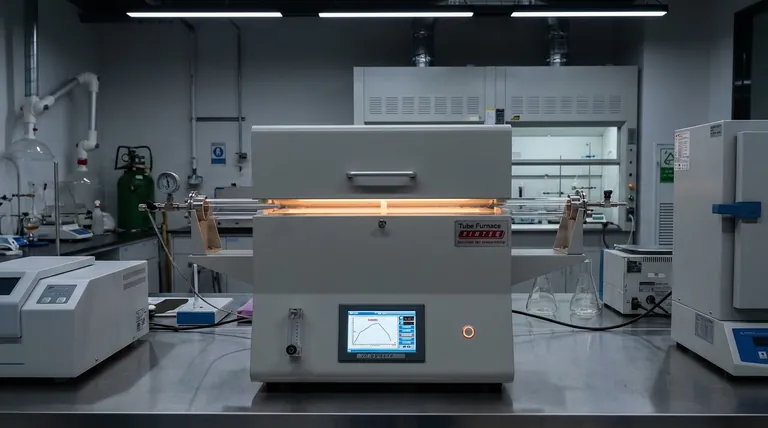
The Hidden Variable in Every Experiment
There's a quiet anxiety familiar to every materials scientist. It's the feeling after weeks of preparation when a crucial sample—a single crystal, a thin film, a synthesized powder—emerges from the heat-treatment process flawed.
The formula was correct. The precursors were pure. Yet, the result is unusable.
More often than not, the culprit isn't a failure of chemistry, but a failure of physics. The invisible enemy is non-uniformity: microscopic temperature gradients that introduce stress, create defects, and silently sabotage the experiment.
Controlling for this variable is everything. It’s where the elegant engineering of a laboratory tube furnace transforms a simple heating process into an act of precision.
Engineering a Zone of Thermal Stillness
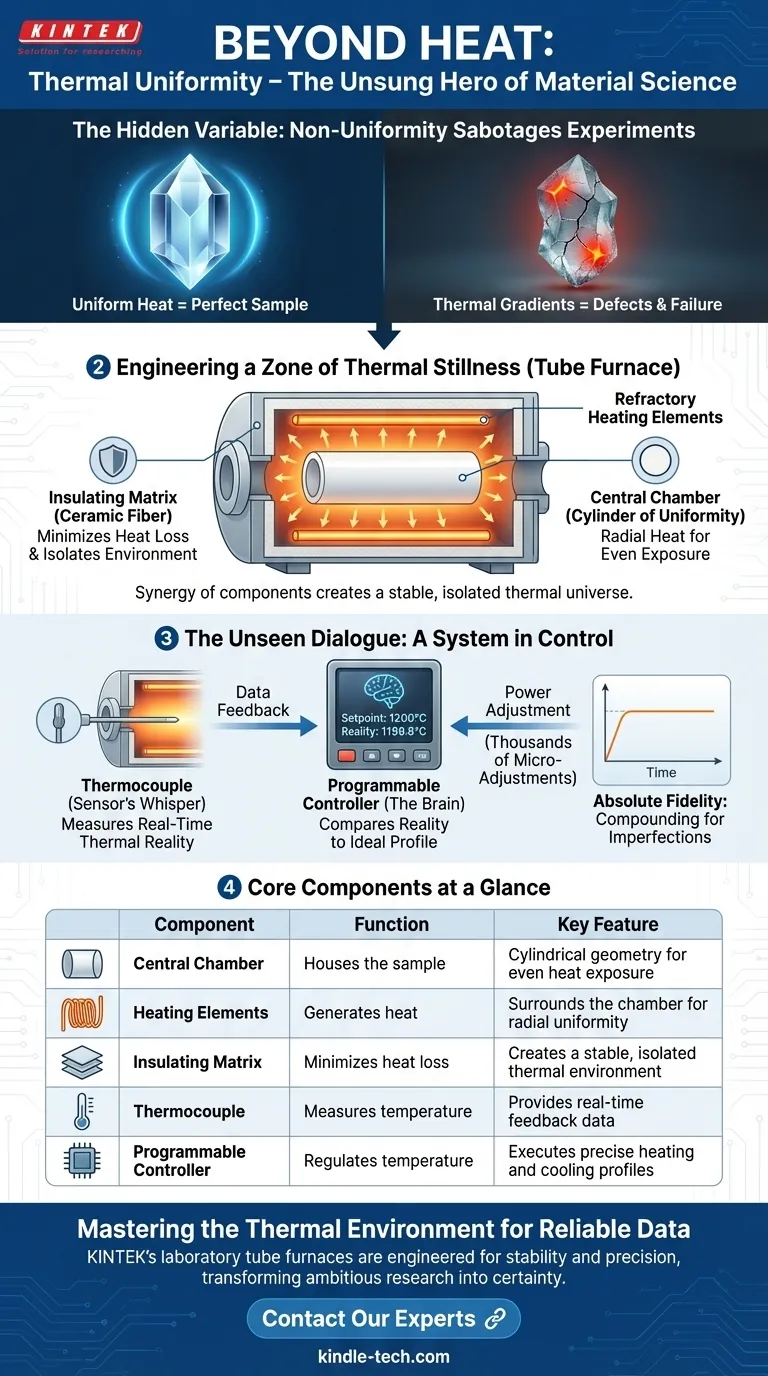
At its heart, a tube furnace is designed to defeat thermal gradients. Its entire construction is a systematic approach to creating a perfectly stable and uniform environment. This is achieved through the synergy of three core components.
The Heart: A Cylinder of Uniformity
The process begins in the central chamber, a cylindrical tube typically made of high-temperature ceramics. The choice of a cylinder isn't arbitrary; it's geometric elegance.
Surrounding this chamber are refractory heating elements. By encircling the sample, they apply heat radially, from all directions at once. This design minimizes the hot and cold spots that plague simpler furnace designs, creating an exceptionally uniform thermal zone along the length of the sample.
The Shield: Insulating the Environment
The entire heating assembly is then encased in a thick matrix of thermal insulation, like ceramic fiber. This serves a dual purpose.
First, it dramatically improves energy efficiency by preventing heat from escaping. Second, and more importantly, it isolates the internal chamber from the ambient fluctuations of the laboratory. It creates a small, controlled universe where the only thermal variable is the one you dictate.
The Unseen Dialogue: A System in Control
Achieving a uniform temperature is one challenge. Holding it there with unwavering precision is another. This doesn't happen passively. It's the result of a constant, high-speed conversation between a sensor and a controller.
The Sensor's Whisper: The Thermocouple
A thermocouple acts as the furnace's nerve ending, placed inside the chamber to get a true reading of the internal temperature. It constantly measures the thermal reality of the environment and sends this data, like a whisper, back to the furnace’s brain.
The Controller's Command: The Setpoint vs. Reality
The programmable temperature controller is the brain. It holds the ideal temperature profile in its memory—the "setpoint." It continuously compares this ideal to the reality reported by the thermocouple.
If the temperature drops by a fraction of a degree, the controller sends more power to the heating elements. If it overshoots, it throttles the power back. This feedback loop is relentless, making thousands of micro-adjustments to ensure the temperature profile is executed with absolute fidelity. For extreme environments where a thermocouple might fail, advanced systems can even switch to a pyrometer, extending this precision into ultra-high temperature ranges.
The Physics of Imperfection and Precision
No system is perfect, but a well-engineered one accounts for its limitations.
The heating elements themselves can experience "thermal drift" over long periods—a subtle change in their electrical resistance. A simpler system would let this drift ruin an experiment. But in a tube furnace, the feedback loop from the thermocouple makes this irrelevant. It compensates in real-time, correcting for the hardware's imperfections to deliver a perfect result.
This level of control comes at a cost. The sophisticated controllers, specialized materials, and precise construction make these instruments a significant investment. But you aren't just buying a heater. You are buying certainty. You are eliminating a critical variable that stands between a hypothesis and a discovery.
Core Components at a Glance
| Component | Function | Key Feature |
|---|---|---|
| Central Chamber | Houses the sample | Cylindrical geometry for even heat exposure |
| Heating Elements | Generates heat | Surrounds the chamber for radial uniformity |
| Insulating Matrix | Minimizes heat loss | Creates a stable, isolated thermal environment |
| Thermocouple | Measures temperature | Provides real-time feedback data |
| Programmable Controller | Regulates temperature | Executes precise heating and cooling profiles |
For researchers whose work depends on process repeatability and absolute sample uniformity, mastering the thermal environment is non-negotiable. Instruments like KINTEK's laboratory tube furnaces are engineered specifically to solve this fundamental challenge, providing the stability and precision required to turn ambitious research into reliable data.
To ensure your process achieves the highest degree of thermal control and repeatability, Contact Our Experts.
Visual Guide
Related Products
- Rotary Tube Furnace Split Multi Heating Zone Rotating Tube Furnace
- Laboratory Vacuum Tilt Rotary Tube Furnace Rotating Tube Furnace
- 1200℃ Split Tube Furnace with Quartz Tube Laboratory Tubular Furnace
- 1400℃ Laboratory High Temperature Tube Furnace with Alumina Tube
- 1700℃ Laboratory High Temperature Tube Furnace with Alumina Tube
Related Articles
- The Geometry of Heat: Why Motion Matters in Material Synthesis
- Exploring Rotary Tube Furnaces: A Comprehensive Guide
- Exploring the Functions and Advantages of Rotary Tube Furnaces
- Exploring the Benefits and Applications of Rotary Furnaces: A Comprehensive Guide
- The Physics of Perfection: How Rotary Furnaces Eliminate Randomness in Material Processing



















