The Tyranny of the Static Batch
Imagine a materials scientist who has just synthesized a breakthrough battery cathode powder. In a small crucible, its performance is revolutionary. But when the process is scaled up in a standard box furnace for pilot production, the results become erratic. One batch is perfect; the next is a failure.
This isn't a failure of chemistry. It's a failure of physics.
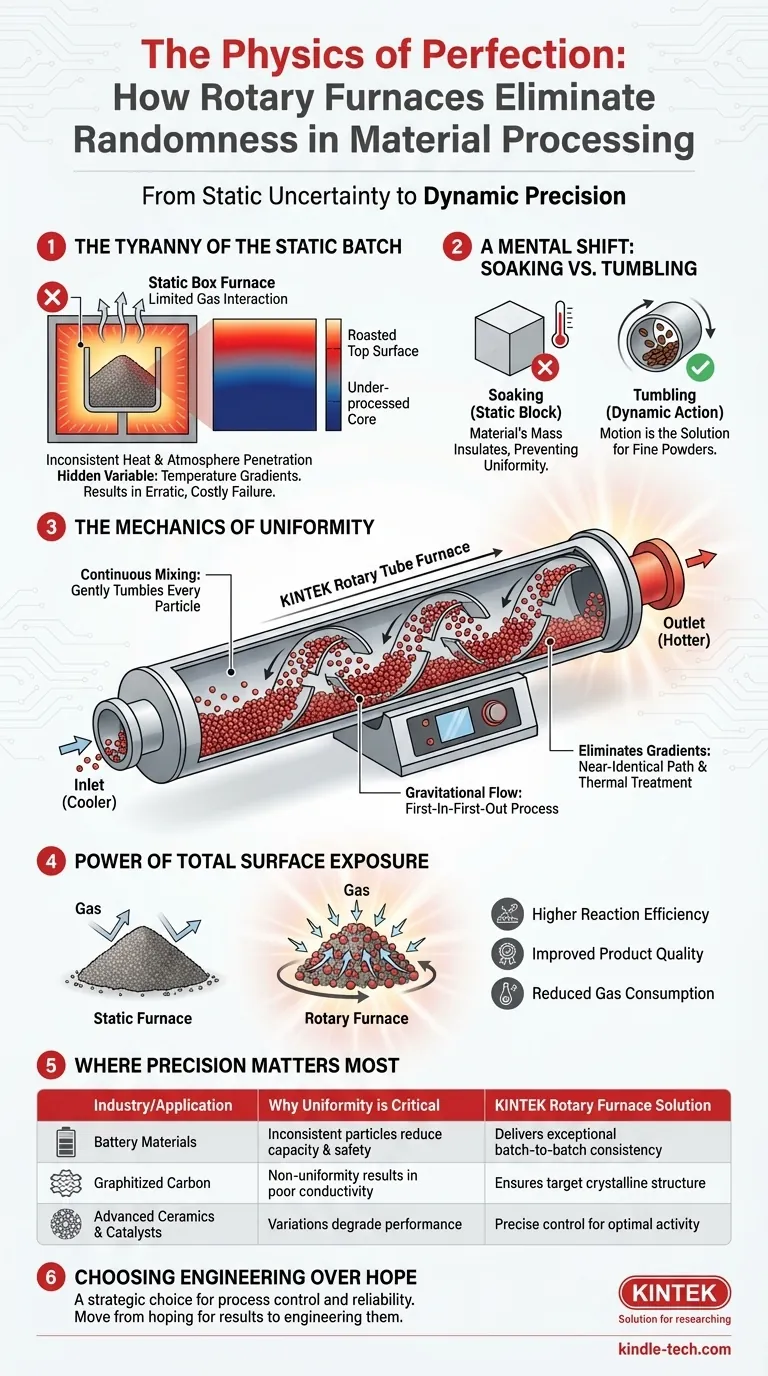
The scientist is battling a hidden variable: the temperature gradient. In a static pile of powder, the particles on top get roasted while those at the core remain under-processed. The process gas only interacts with the exposed surface. The result is inconsistency, a frustrating and costly form of randomness baked into the system.
This is the tyranny of the static batch. We treat the furnace like a simple oven, but for fine powders and granules, it's a deeply flawed tool.
A Mental Shift: From Soaking to Tumbling
Our intuition about heating is based on solid, single objects. We place a part in a furnace and let it "soak" at temperature.
This mental model breaks down for powders. The material's own mass becomes an insulator, preventing uniform heat and atmosphere penetration.
The solution is not more power or more time. The solution is motion.
Consider roasting coffee beans or nuts. No one would just heat them in a static pan and expect an even result. We intuitively know they must be tumbled, stirred, or agitated. This simple, dynamic action is the key. A rotary tube furnace applies this fundamental principle to high-technology materials with engineering precision.
The Mechanics of Uniformity
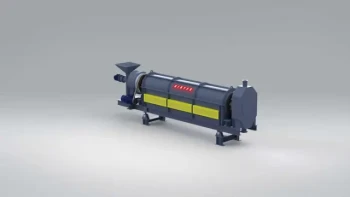
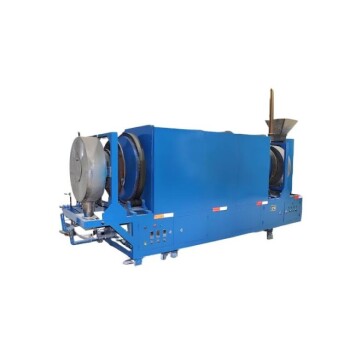
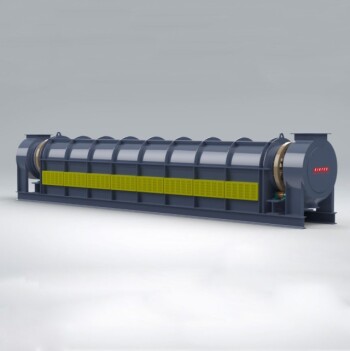
At its core, a rotary tube furnace is an elegantly simple system designed to solve a complex thermodynamic problem. It consists of a cylindrical tube, mounted at a slight angle, that rotates slowly.
- Continuous Mixing: As the tube rotates, the material inside gently tumbles. Every particle is continuously folded back into the batch, moving from the cooler core to the hotter exterior.
- Gravitational Flow: The slight incline ensures the material travels from the inlet to the outlet, enabling a continuous, first-in-first-out process flow.
This constant, gentle agitation systematically destroys the temperature gradients that plague static furnaces. It ensures every single particle follows a near-identical path and receives the same thermal treatment.
The Power of Total Surface Exposure
The benefits of dynamic heating extend beyond temperature. In processes requiring a controlled atmosphere—such as calcination, reduction, or graphitization—success depends on efficient gas-solid interaction.
In a static furnace, the process gas can only react with the top layer of the powder.
In a rotary furnace, the tumbling action exposes the entire surface area of every particle to the atmosphere. This leads to:
- Higher Reaction Efficiency: Processes complete faster and more thoroughly.
- Improved Product Quality: The final material has more consistent and predictable properties.
- Reduced Gas Consumption: No gas is wasted trying to penetrate a dense, static bed of material.
Where Precision Motion Matters Most
The demand for absolute uniformity is most critical in the manufacturing of advanced materials, where microscopic consistency translates directly into macroscopic performance. This is why rotary tube furnaces have become indispensable in specific fields.
| Industry/Application | Why Uniformity is Critical | KINTEK Rotary Furnace Solution |
|---|---|---|
| Battery Materials | Inconsistent cathode/anode particles lead to reduced capacity, shorter cycle life, and safety risks. | Delivers exceptional batch-to-batch consistency for reliable, high-performance battery components. |
| Graphitized Carbon | Non-uniform graphitization results in poor electrical conductivity and structural integrity. | Ensures every particle achieves the target crystalline structure for superior material properties. |
| Advanced Ceramics & Catalysts | Variations in particle porosity and surface area degrade performance. | Provides precise control over the thermal process to produce catalysts with optimal activity and selectivity. |
These are not niche problems. They are the central manufacturing challenges for the technologies defining our future, from electric vehicles to next-generation electronics.
Choosing the Right System, Not Just a Furnace
A rotary tube furnace is a specialized instrument. It is not a universal replacement for all heating applications. Its mechanical drive system is more complex than a simple box furnace, and it's designed specifically for free-flowing powders and granules—not large, singular parts.
The decision to use one is a strategic choice to prioritize process control over simplicity. It's an acknowledgment that for high-value materials, eliminating randomness is the primary goal. Achieving this requires a system engineered for precision, control, and reliability.
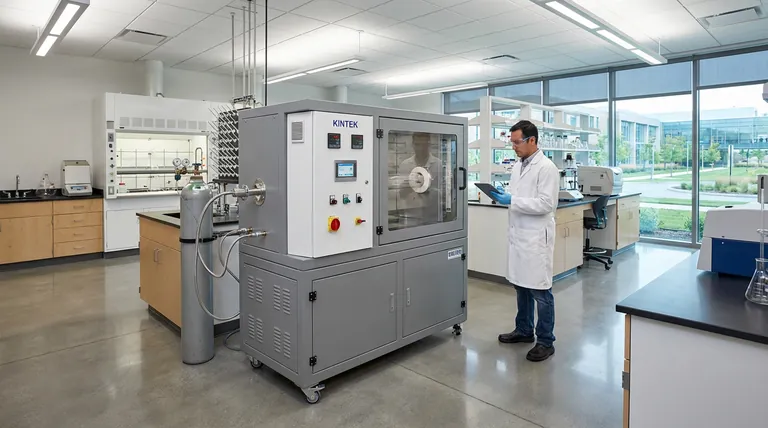
By replacing the uncertainty of static heating with the predictable physics of dynamic processing, you move from hoping for good results to engineering them. With a high-quality system like the KINTEK rotary tube furnace, you gain precise control over rotation speed, temperature profile, and atmosphere, ensuring your process is not just repeatable, but perfectable.
If your work demands the highest possible material consistency, it's time to move beyond the limitations of the static batch. Contact Our Experts
Visual Guide
Related Products
- Rotary Tube Furnace Split Multi Heating Zone Rotating Tube Furnace
- Vacuum Sealed Continuous Working Rotary Tube Furnace Rotating Tube Furnace
- Laboratory Vacuum Tilt Rotary Tube Furnace Rotating Tube Furnace
- Inclined Rotary Plasma Enhanced Chemical Vapor Deposition PECVD Equipment Tube Furnace Machine
- Electric Rotary Kiln Small Rotary Furnace for Activated Carbon Regeneration
Related Articles
- The Geometry of Heat: Why Motion Matters in Material Synthesis
- The Geometry of Heat: Engineering the Perfect Thermal Environment
- Exploring the Functions and Advantages of Rotary Tube Furnaces
- Exploring Rotary Tube Furnaces: A Comprehensive Guide
- Exploring the Advantages of Rotary Tube Furnaces in Industrial and Laboratory Applications