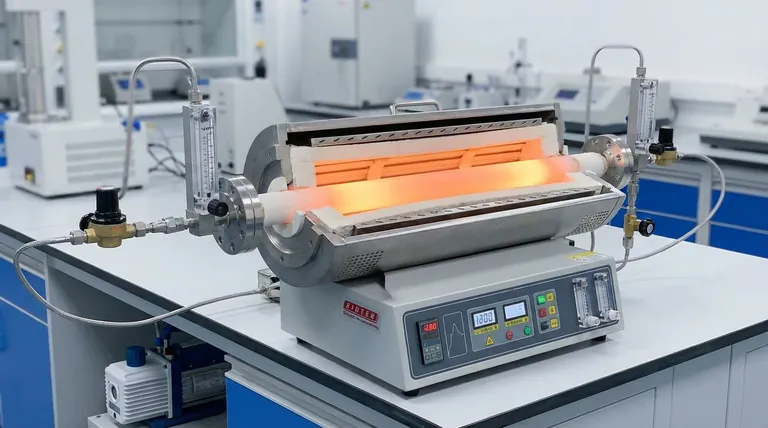
The Hidden Variable in High-Temperature Work
Imagine a materials scientist spending months developing a novel semiconductor. The calculations are perfect, the precursor materials are pure. The final step is a high-temperature annealing process.
The sample goes into a standard furnace, the temperature ramps up, holds, and cools down exactly as programmed. But the result is a failure. The material’s properties are wrong. Microscopic analysis reveals oxidation and impurities that have ruined the delicate crystal lattice.
The thermometer was not the problem. The problem was the air.
This scenario highlights a fundamental truth in thermal processing: for advanced materials, controlling the invisible atmosphere is often more critical than controlling the temperature itself.
The Psychology of Absolute Control
At a glance, a furnace is a simple box that gets hot. But the desire for a tube furnace stems from a deeper need—the need to eliminate uncertainty.
It’s an acknowledgment that at 1200°C, even trace amounts of oxygen or moisture are no longer passive bystanders. They become aggressive chemical agents. A tube furnace is an engineer’s solution to this anxiety. It’s a tool designed not just to apply heat, but to create a hermetically sealed, perfectly managed universe for a sample.
This obsession with control is what separates routine heating from precision material synthesis.
Engineering an Isolated Universe
The value of a tube furnace is delivered through elegant design principles that address the twin challenges of thermal uniformity and atmospheric integrity.
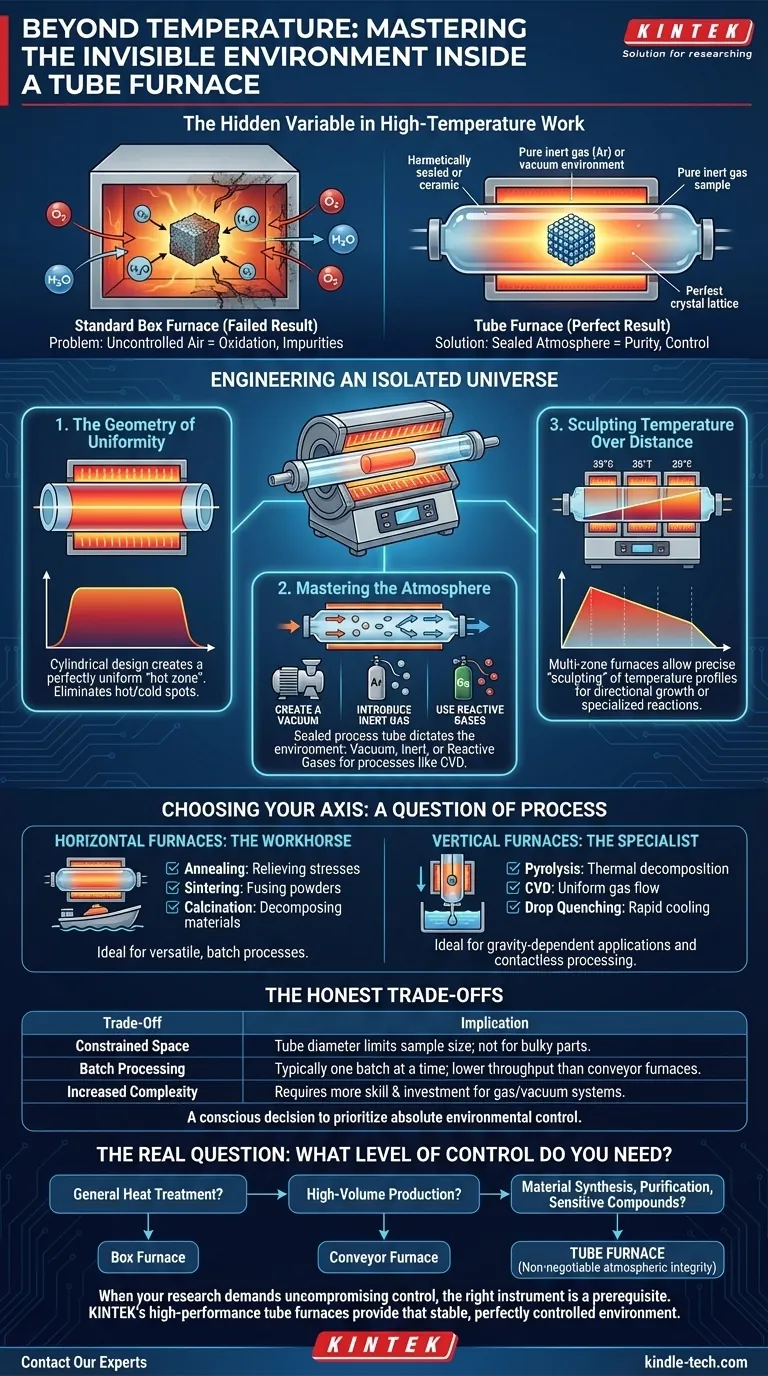
The Geometry of Uniformity
Heat in a simple box furnace can be chaotic, creating hot and cold spots. A tube furnace solves this with geometry.
Its cylindrical heating chamber, surrounded by elements, radiates energy inward from all directions. This creates an exceptionally uniform "hot zone" along the tube's central axis. It’s a simple, powerful concept ensuring that every part of your sample experiences the exact same thermal journey.
Mastering the Atmosphere
This is the defining feature. The sealed process tube allows you to completely dictate the environment. You can:
- Create a Vacuum: Evacuate the air to remove reactive gases like oxygen, preventing oxidation and purifying materials.
- Introduce Inert Gas: Flow argon or nitrogen through the tube to create a stable, non-reactive blanket around the sample.
- Use Reactive Gases: Deliberately introduce specific gases for processes like chemical vapor deposition (CVD), where the gas itself is part of the reaction that builds a new material.
The sealed tube transforms the furnace from a simple oven into a sophisticated chemical reactor.
Sculpting Temperature Over Distance
Advanced processes often require not just a uniform temperature, but a precise gradient. Multi-zone tube furnaces achieve this by dividing the heating elements into separately controlled sections.
This allows a user to "sculpt" the temperature profile along the tube's length, creating a gradual ramp or specific thermal landscape. This is indispensable for sophisticated applications like directional crystal growth or specialized chemical transport reactions.
Choosing Your Axis: A Question of Process
The furnace's orientation—horizontal or vertical—isn't an arbitrary choice. It's dictated by the physics of the process itself.
The Workhorse: Horizontal Furnaces
Horizontal furnaces are the versatile standard. Their ease of loading and unloading makes them ideal for a wide range of batch processes:
- Annealing: Relieving internal stresses in metals.
- Sintering: Fusing powders into a solid mass.
- Calcination: Decomposing materials through heating.
They are the pragmatic choice for general-purpose, high-uniformity heat treatment.
The Specialist: Vertical Furnaces
Vertical furnaces are employed when gravity is a useful tool or when contact with the tube walls must be avoided. They excel in applications like:
- Pyrolysis: Thermal decomposition in an inert atmosphere.
- CVD: Ensuring uniform gas flow around a suspended substrate.
- Drop Quenching: Rapidly cooling a sample by dropping it from the hot zone into a liquid bath below.
The Honest Trade-Offs
The precision of a tube furnace comes with inherent limitations. Acknowledging them is key to making an informed decision.
| Trade-Off | Implication |
|---|---|
| Constrained Space | The tube diameter limits sample size. These are not for large, bulky parts. |
| Batch Processing | Most are designed for one batch at a time, unlike high-throughput conveyor furnaces. |
| Increased Complexity | Gas and vacuum systems require more operator skill and investment than a simple box furnace. |
Choosing a tube furnace is a conscious decision to prioritize absolute environmental control over sample volume or throughput.
The Real Question: What Level of Control Do You Need?
The right thermal processing tool is the one that meets the specific demands of your work.
- If your goal is general heat treatment of robust parts, a box furnace may suffice.
- If your goal is high-volume production, a conveyor furnace is the logical choice.
- But if your work involves material synthesis, purification, or processing sensitive compounds, where atmospheric integrity is non-negotiable, a tube furnace is the only correct tool for the job.
When your research or production demands this level of uncompromising control, the right instrument is not a luxury; it's a prerequisite. KINTEK's range of high-performance tube furnaces is engineered to provide that stable, predictable, and perfectly controlled environment for your most critical processes.
If your work requires mastery over both temperature and atmosphere, Contact Our Experts.
Visual Guide
Related Products
- Rotary Tube Furnace Split Multi Heating Zone Rotating Tube Furnace
- High Temperature Alumina (Al2O3) Furnace Tube for Engineering Advanced Fine Ceramics
- Laboratory Vacuum Tilt Rotary Tube Furnace Rotating Tube Furnace
- 1200℃ Split Tube Furnace with Quartz Tube Laboratory Tubular Furnace
- 1400℃ Laboratory High Temperature Tube Furnace with Alumina Tube
Related Articles
- The Geometry of Heat: Why Motion Matters in Material Synthesis
- Exploring the Functions and Advantages of Rotary Tube Furnaces
- The Geometry of Heat: Engineering the Perfect Thermal Environment
- Exploring the Advantages of Rotary Tube Furnaces in Industrial and Laboratory Applications
- The Physics of Perfection: How Rotary Furnaces Eliminate Randomness in Material Processing



















