A materials science student spends weeks trying to synthesize a novel perovskite film. The precursor chemistry is perfect, the protocol is followed meticulously, but the results are a frustrating mess. One sample shows promise, the next is inert, and the third is a crystalline disaster.
The student blames the reagents, the substrate, even their own technique.
But the real culprit is invisible. It’s the trace amount of oxygen in their conventional box furnace, an uninvited guest that poisons the reaction. The problem wasn't a lack of heat; it was a lack of control.
This scenario isn't an exception; it's a common story in labs worldwide. It highlights a fundamental psychological trap: we think of temperature as the primary variable, but in advanced material processing, the environment is the experiment.
The Illusion of "Just Heat"
We tend to see temperature as a single number on a display. 800°C. 1100°C. Simple.
But inside a heating chamber, temperature is a complex landscape of gradients and fluctuations. More importantly, the gas surrounding the sample—often just ambient air—is an active chemical agent. For processes that are sensitive to oxidation or hydration, an open-air furnace is like trying to perform surgery in a sandstorm.
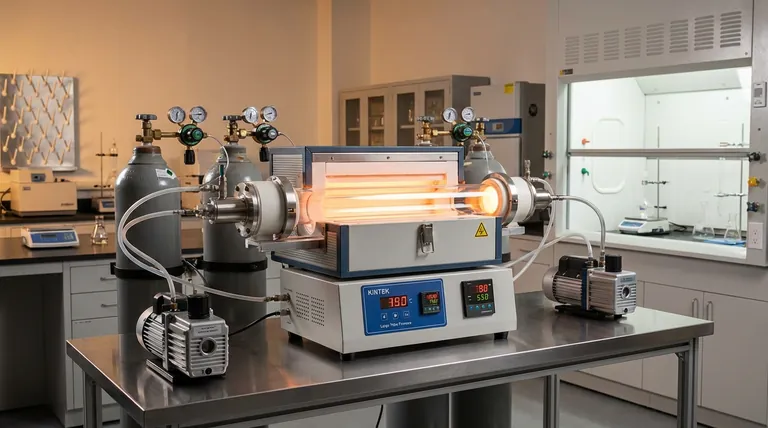
A tube furnace is designed around a single, powerful idea: to move from heating a sample to controlling its entire state of being. It's a shift from brute force to finessed manipulation.
The Two Pillars of Absolute Control
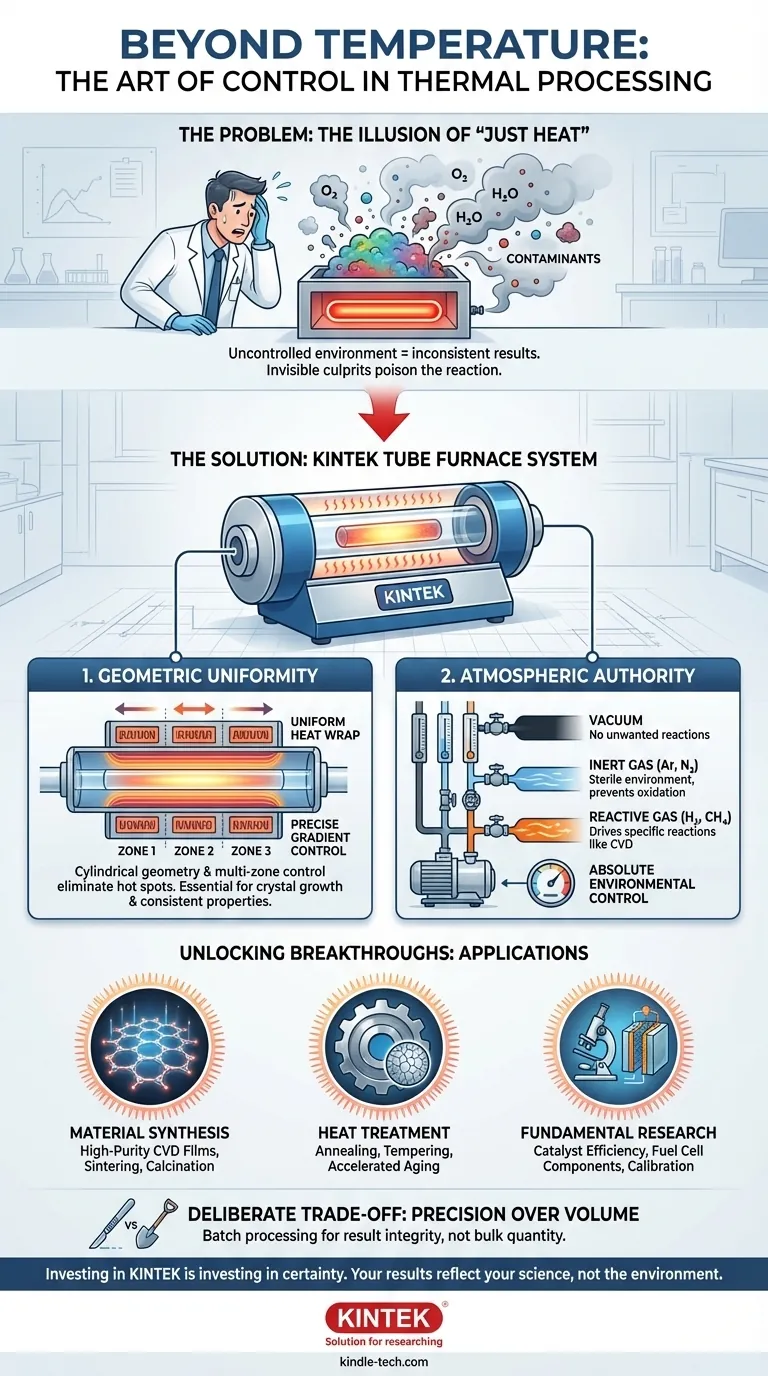
This control is not a single feature but a system built on two core principles: geometric uniformity and atmospheric authority.
1. The Geometry of Uniformity
A conventional box furnace heats a chamber, but a tube furnace heats a sample within a tube. This cylindrical geometry is inherently superior for distributing heat evenly. It wraps the thermal energy around the sample, minimizing the hot and cold spots that plague rectangular chambers.
For work that demands near-perfect thermal consistency, this can be taken a step further.
- Single-Zone Furnaces: Provide a stable, uniform hot zone, ideal for processes like annealing or tempering where the entire sample must experience the exact same thermal journey.
- Multi-Zone Furnaces: Employ several independent heating coils along the tube. This allows an operator to either create a perfectly flat temperature profile over a longer length or establish a precise, stable temperature gradient—essential for processes like crystal growth or chemical vapor transport.
2. The Atmosphere as an Active Ingredient
This is where the tube furnace truly separates itself. Its sealed process tube transforms the atmosphere from an uncontrolled variable into a deliberate parameter.
By connecting the tube to gas handling and vacuum systems, a researcher gains complete command.
- Vacuum: You can remove the atmosphere entirely, preventing any unwanted gas-phase reactions.
- Inert Atmosphere: You can flood the chamber with gases like Argon or Nitrogen to create a sterile environment, protecting the sample from oxidation even at extreme temperatures.
- Reactive Atmosphere: You can introduce specific gases to drive a chemical reaction, such as in Chemical Vapor Deposition (CVD) , where gases react to form a solid, ultra-pure film on a substrate.
The furnace is no longer just a hot box; it is a self-contained, programmable micro-environment.
From Control to Breakthrough: What This Unlocks
When you master the environment, you unlock new possibilities. The applications of a tube furnace are not just about what you can heat, but what you can create and discover.
For Material Synthesis & Purification
Here, the goal is to build something new or purify something existing. The controlled atmosphere is a core part of the recipe.
- Chemical Vapor Deposition (CVD): Growing high-purity films like graphene or silicon nitride.
- Sintering: Fusing ceramic or metallic powders into a solid mass without melting them, often in an inert atmosphere.
- Calcination: Decomposing materials or removing volatile fractions in a controlled gas flow.
For Heat Treatment & Material Testing
This is about precisely modifying the properties of an existing material. Repeatability is paramount.
- Annealing: Softening metals to improve ductility, requiring slow, uniform cooling.
- Hardening & Tempering: Tailoring the strength and toughness of steels with precise thermal cycles.
- Accelerated Aging: Testing how materials withstand high temperatures over time in a stable environment.
For Fundamental Research
In a lab, the goal is often to isolate a single variable. The tube furnace provides the stable baseline needed for discovery.
- Catalyst Research: Testing the efficiency of catalysts in specific gas streams without cross-contamination.
- Fuel Cell Components: Simulating the high-temperature, gas-rich environments inside a working fuel cell.
- Thermocouple Calibration: Using the stable, uniform hot zone as a reference standard.
The Deliberate Trade-Off: Precision Over Volume
A tube furnace is not a bulk production tool. Its primary constraint is the diameter of the tube, which limits sample size. It is a batch-processing instrument by nature.
But this isn't a flaw; it's a deliberate engineering trade-off. You choose a tube furnace when the integrity of the result is more important than the quantity of the output. It is a scalpel chosen for its precision, not a shovel for its capacity.
The right tool depends entirely on your objective.
| Primary Goal | Key Challenge | Optimal Solution |
|---|---|---|
| Heat Treatment | Consistent material properties | Single-Zone Tube Furnace |
| Material Synthesis | Preventing contamination, enabling reactions | Tube Furnace with Gas/Vacuum |
| Advanced Research | Eliminating variables, creating gradients | Multi-Zone Tube Furnace |
Ultimately, investing in a tube furnace is an investment in certainty. It's about eliminating the invisible culprits and gaining the confidence that your results reflect your science, not the whims of an uncontrolled environment.
For researchers and engineers dedicated to this level of precision, having the right instrument is non-negotiable. KINTEK specializes in high-performance tube furnaces designed to provide the absolute environmental control required for demanding research and industrial applications. Whether you need reliable annealing or a sophisticated platform for advanced material synthesis, our systems deliver the stability and repeatability your work depends on.
Contact Our Experts to define the ideal thermal processing environment for your next breakthrough.
Visual Guide
Related Products
- Rotary Tube Furnace Split Multi Heating Zone Rotating Tube Furnace
- Laboratory Vacuum Tilt Rotary Tube Furnace Rotating Tube Furnace
- 1200℃ Split Tube Furnace with Quartz Tube Laboratory Tubular Furnace
- 1400℃ Laboratory High Temperature Tube Furnace with Alumina Tube
- 1700℃ Laboratory High Temperature Tube Furnace with Alumina Tube
Related Articles
- The Geometry of Heat: Why Motion Matters in Material Synthesis
- Exploring the Functions and Advantages of Rotary Tube Furnaces
- Exploring the Benefits and Applications of Rotary Furnaces: A Comprehensive Guide
- The Physics of Perfection: How Rotary Furnaces Eliminate Randomness in Material Processing
- The Geometry of Heat: Engineering the Perfect Thermal Environment



















