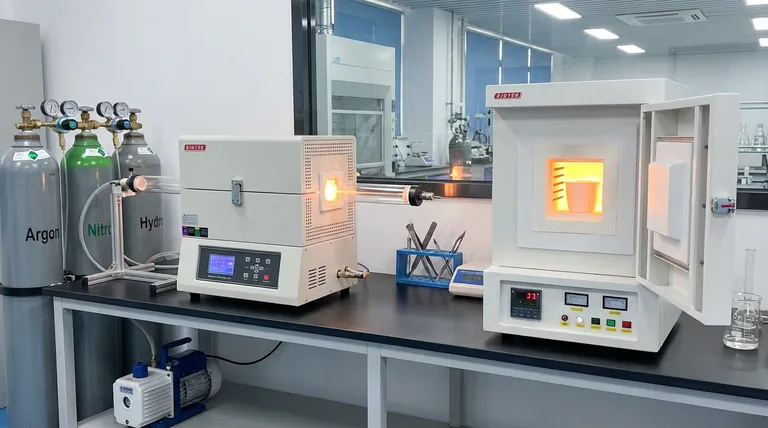
The Unseen Variable in Thermal Processing
Imagine a materials scientist meticulously preparing a sample. The temperature profile is programmed to perfection, the ramp rate is precise, and the dwell time is exact. Yet, the experiment fails. The material, instead of forming the desired crystalline structure, emerges oxidized and useless.
The error wasn't in the heat. It was in the air.
This scenario highlights a fundamental, often overlooked, truth in thermal processing: temperature is only half the story. The other half—the crucial, invisible variable—is the atmosphere surrounding your sample. The decision between the two most common laboratory furnaces, the tube furnace and the muffle furnace, hinges entirely on this single question of atmospheric control.
It's not a choice between a good tool and a better one. It’s a choice between two profoundly different philosophies of heating.
The Fundamental Divide: Control vs. Simplicity
The core difference between these furnaces isn't their heating elements or their insulation; it's how they answer the question: "What should surround the sample?" This dictates their design, their complexity, and their purpose.
The Tube Furnace: A World Under Your Control
A tube furnace is a sealed environment. Its purpose is to isolate a sample from the ambient world, allowing you to create a bespoke atmosphere inside a containment tube (typically quartz or alumina).
Think of it as a cleanroom for your material. It’s the essential tool when the air itself is a contaminant.
- Protective Atmospheres: Prevents oxidation by filling the tube with an inert gas like argon or nitrogen.
- Reactive Atmospheres: Introduces specific gases that are part of the chemical reaction.
- Vacuum Environments: Removes the atmosphere entirely to prevent any gas-phase reactions or contamination.
This level of control is non-negotiable for synthesizing air-sensitive materials, annealing exotic alloys, or performing specific types of chemical vapor deposition (CVD).
The Muffle Furnace: The Power of Open Air
A muffle furnace, by contrast, is a bastion of simplicity. It is an insulated chamber designed to heat samples directly in the air. It asks nothing more of the atmosphere than for it to be present.
It is the workhorse of the lab, ideal for processes where the oxygen in the air is either a necessary reactant or a harmless bystander.
Common applications are straightforward and robust:
- Ashing: Burning off organic material to measure inorganic content, a process that requires oxygen.
- Annealing: Heat-treating standard metals and glass where slight surface oxidation is acceptable or desired.
- Calcination: Decomposing materials through heating, where atmospheric interaction is not a concern.
The muffle furnace embodies an engineering elegance found in doing one thing exceptionally well: providing uniform heat in air.
The Psychology of Choice: Resisting Needless Complexity
There's a natural cognitive bias toward choosing the more complex, feature-rich tool. A tube furnace, with its gas lines, vacuum pumps, and flanges, can feel more "advanced" or "capable." But this complexity is a liability if it's not required.
Each additional component—every seal, valve, and controller—is another potential point of failure. The operational overhead of managing gas flow or pulling a vacuum adds time and introduces variables to your process.
The wiser choice is driven by a disciplined focus on the actual requirements of the experiment. The question isn't "Which furnace can do more?" but "What is the simplest tool that guarantees my desired outcome?" Choosing a muffle furnace for a simple ashing process isn't a compromise; it's a mark of efficiency and process intelligence.
A Practical Framework for Your Decision
To make the right choice, anchor your decision in the non-negotiable demands of your material process.
Key Decision Factors
| Feature | Tube Furnace | Muffle Furnace |
|---|---|---|
| Primary Goal | Process requires a specific gas or vacuum | Simple heating in ambient air is sufficient |
| Sample Volume | Constrained by the inner diameter of the tube | Large, flexible box-shaped chamber |
| Complexity | High (requires vacuum/gas handling systems) | Low (often "plug and play") |
| Cost | Higher initial investment and maintenance | Lower initial investment and maintenance |
| Process Risk | Coking can occur in confined spaces (e.g., cracking) | No risk of process-induced confinement issues |
When You Absolutely Need a Tube Furnace:
- Your material is sensitive to oxygen or moisture.
- Your reaction requires a specific gas (e.g., hydrogen, ammonia) to proceed.
- You are performing a process under vacuum.
When a Muffle Furnace is the Smarter Choice:
- Your goal is ashing, burn-off, or simple heat treatment in air.
- You need to process large samples or a high quantity of smaller samples simultaneously.
- You value operational simplicity, reliability, and cost-effectiveness above all else.
Ultimately, mastering thermal processing is about understanding that the environment is as critical as the energy you apply. Choosing the right furnace is the first and most important step in controlling that environment.
At KINTEK, we understand that the right equipment is the foundation of reproducible results. We specialize in providing high-quality, reliable tube and muffle furnaces designed for the specific demands of your lab work. To ensure you select the most effective and efficient tool for your process, Contact Our Experts.
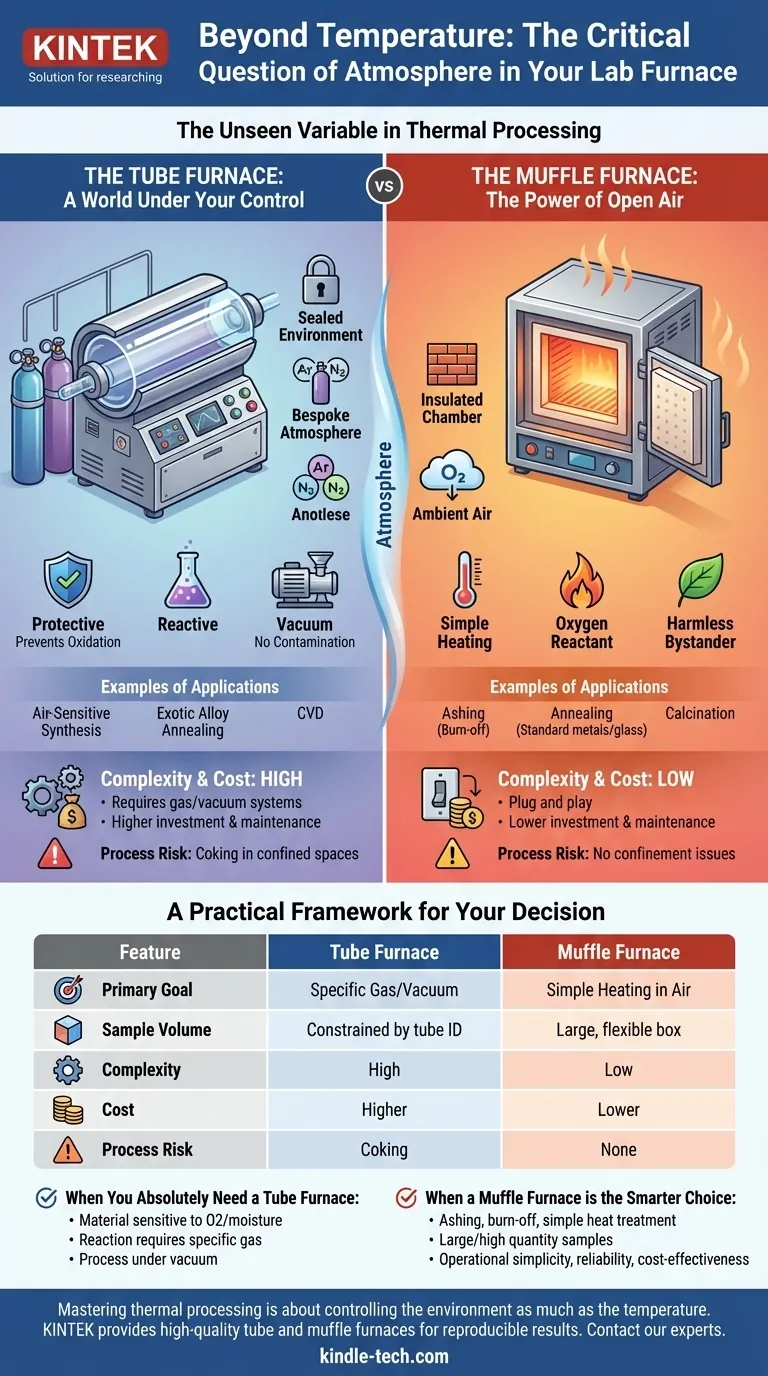
Visual Guide
Related Products
- Lab-Scale Vacuum Induction Melting Furnace
- 1200℃ Muffle Furnace Oven for Laboratory
- High Temperature Muffle Oven Furnace for Laboratory Debinding and Pre Sintering
- 1700℃ Laboratory High Temperature Tube Furnace with Alumina Tube
- 1800℃ Muffle Oven Furnace for Laboratory
Related Articles
- Melting process and maintenance of vacuum induction melting furnace
- How Vacuum Induction Melting Outperforms Traditional Methods in Advanced Alloy Production
- Vacuum Melting Furnace: A Comprehensive Guide to Vacuum Induction Melting
- Vacuum Induction Melting Furnace: Principle, Advantages, and Applications
- Vacuum Induction Melting Furnace vs Arc Melting Furnace: Choosing the Right Equipment for Your Process



















