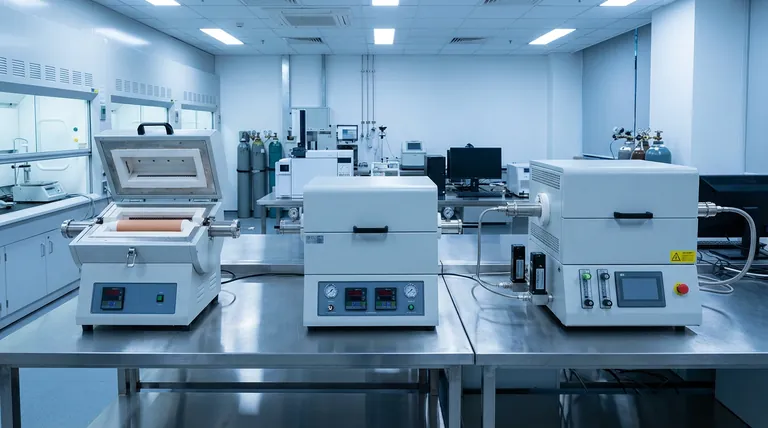
The Furnace is Not Just a Box
A researcher stands before a new material. Their goal is not merely to heat it, but to transform it—to anneal its stresses, to grow a perfect crystal from its vapor, to sinter fine powders into a solid ceramic.
The tool for this transformation is the tube furnace. But to see it as just a hot box is a critical mistake. It is an environment, a miniature reactor where atmosphere, temperature, and even gravity are precisely controlled variables.
Choosing the wrong furnace doesn't just mean inefficient heating. It means compromised data, frustrating setups, and failed experiments. The right choice, however, feels like an extension of your own intent. It requires making three fundamental decisions about the furnace's architecture.
The various "types" of tube furnaces are not mutually exclusive categories. Instead, they are combinations of design features that must be matched to the psychology and physics of your thermal process.
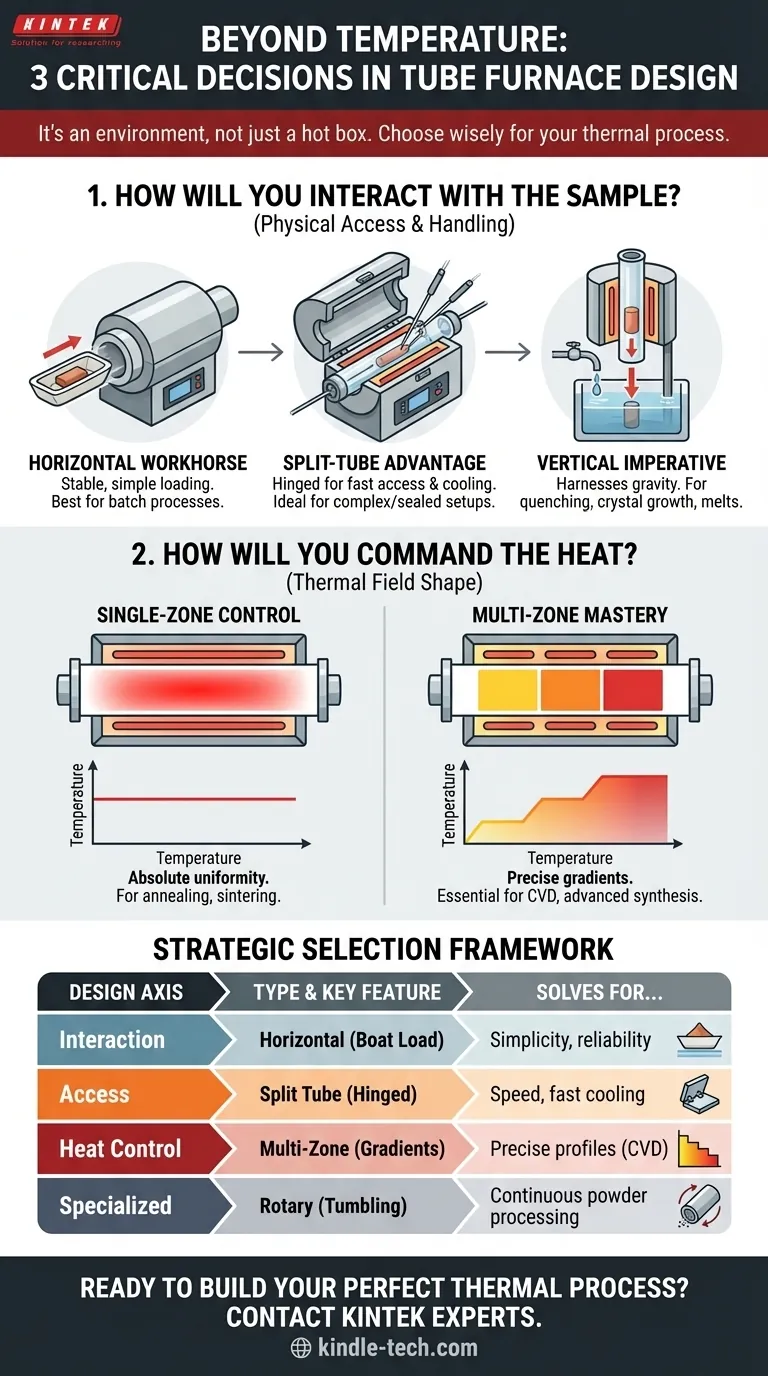
Decision 1: How Will You Interact with the Sample?
This is a question of physical access and handling. It's determined by the furnace's orientation and its mechanical construction.
The Horizontal Workhorse
The default mental image of a furnace is horizontal. A sample, resting in a ceramic "boat," is pushed into the hot zone. It's simple, stable, and incredibly effective for a vast range of batch processes like calcination and purification. Its strength is its straightforwardness.
The Demand for Access: The Split-Tube Advantage
Now, imagine your process tube is sealed, with delicate probes and gas lines attached. You cannot simply slide it in. Or perhaps your process requires rapid cooling, and waiting for a solid block of insulation to cool is not an option.
This is the psychological need that the split tube furnace answers. Hinged along its length, it opens like a clamshell. This grants immediate, complete access to the process tube. It’s a design born from a need for speed and flexibility, allowing you to place complex setups directly into the heat and remove them just as quickly.
The Command of Gravity: The Vertical Imperative
Some processes are more elegant. Consider growing a crystal that cannot touch the tube walls, or instantly quenching a sample from 1000°C into a liquid bath. Here, you need to harness a fundamental force.
A vertical furnace turns gravity into a process tool. It allows for drop-quenching, directional solidification, and processing molten materials that would slump or stick in a horizontal tube. It is the choice when the process itself demands an alignment with physics.
Decision 2: How Will You Command the Heat?
This is about temperature, but not just its peak value. It's about the shape of the thermal field you need to create.
The Pursuit of Uniformity: Single-Zone Control
For most heat treatments—annealing, sintering, aging—the goal is absolute temperature uniformity. You need every part of your sample to experience the exact same conditions.
A single-zone furnace is an instrument of uniformity. It uses one controller and one set of heating elements to create a single, stable, homogenous hot zone. It is the definition of doing one thing and doing it exceptionally well.
The Art of the Gradient: Multi-Zone Mastery
But what if uniformity is the enemy? In processes like Chemical Vapor Deposition (CVD), you need a precise temperature gradient. One zone must be hot enough to vaporize a precursor chemical, while a downstream zone must be at a different, specific temperature for that vapor to decompose and deposit as a thin film.
A multi-zone furnace is a tool for sculpting a thermal landscape. With two, three, or even more independent heating zones, you can create a precise temperature profile along the tube's length. This is not a luxury feature; for advanced materials synthesis, it is a non-negotiable capability.
A Framework for Strategic Selection
Choosing a furnace means navigating the trade-offs between these design principles. The temptation is to over-spec—to get the multi-zone, vertical, split-tube model "just in case." But the most effective tool is the one that cleanly maps to the problem at hand.
| Design Axis | Type | Key Feature | Solves For... |
|---|---|---|---|
| Interaction | Horizontal | Sample loaded on a boat | Simplicity, reliability (e.g., annealing) |
| Vertical | Uses gravity for quenching | Processes with melts, crystal growth | |
| Access | Solid Tube | Continuous insulation body | Maximum uniformity, repeatable processes |
| Split Tube | Hinged for easy access | Speed, fast cooling, complex/sealed tubes | |
| Heat Control | Single-Zone | One uniform hot zone | Uniformity (e.g., sintering, calcination) |
| Multi-Zone | Independent temperature zones | Precise gradients (e.g., CVD) | |
| Specialized | Rotary | Rotates tube for tumbling | Continuous powder processing |
Your process dictates the furnace's form.
- Need simple, repeatable heat treatment? A horizontal, solid, single-zone furnace is your robust and economical choice.
- Need to run fast cycles on sealed reactors? A split-tube design is essential.
- Need to grow advanced crystalline films? A multi-zone furnace is the only tool for the job.
Understanding this framework transforms your selection from a guess into a strategic decision. At KINTEK, we understand that a furnace is the heart of many laboratory processes, and our range of equipment is designed to provide the precise control your work demands. We can help you navigate these decisions to find the perfect architecture for your application.
Ready to build a thermal process that works for you, not against you? Contact Our Experts
Visual Guide
Related Products
- Rotary Tube Furnace Split Multi Heating Zone Rotating Tube Furnace
- Laboratory Vacuum Tilt Rotary Tube Furnace Rotating Tube Furnace
- 1200℃ Split Tube Furnace with Quartz Tube Laboratory Tubular Furnace
- 1400℃ Laboratory High Temperature Tube Furnace with Alumina Tube
- 1700℃ Laboratory High Temperature Tube Furnace with Alumina Tube
Related Articles
- The Geometry of Heat: Why Motion Matters in Material Synthesis
- Exploring Rotary Tube Furnaces: A Comprehensive Guide
- Exploring the Functions and Advantages of Rotary Tube Furnaces
- Exploring the Benefits and Applications of Rotary Furnaces: A Comprehensive Guide
- The Physics of Perfection: How Rotary Furnaces Eliminate Randomness in Material Processing



















