Blog Density Without Destruction: The Quiet Power of Hot Press Sintering
Density Without Destruction: The Quiet Power of Hot Press Sintering

Density Without Destruction: The Quiet Power of Hot Press Sintering

1 week ago

The Engineer's Paradox

In material science, we often face a paradox. To create a component with ultimate strength, we need to eliminate every microscopic void within it, forging loose powder into a solid, unified whole. The most intuitive tool for this is heat.

But heat is a blunt instrument.

While it encourages particles to bond, excessive heat held for too long causes the material's internal crystalline structure—its grains—to grow. Larger grains often lead to brittleness and weakness. It’s like trying to build a strong wall with giant, clumsy boulders instead of fine, interlocking bricks. You gain solidity, but you sacrifice structural integrity.

This is the engineer's dilemma: how do you achieve perfect density without inadvertently destroying the material's refined internal architecture?

A Solution of Synergy, Not Brute Force

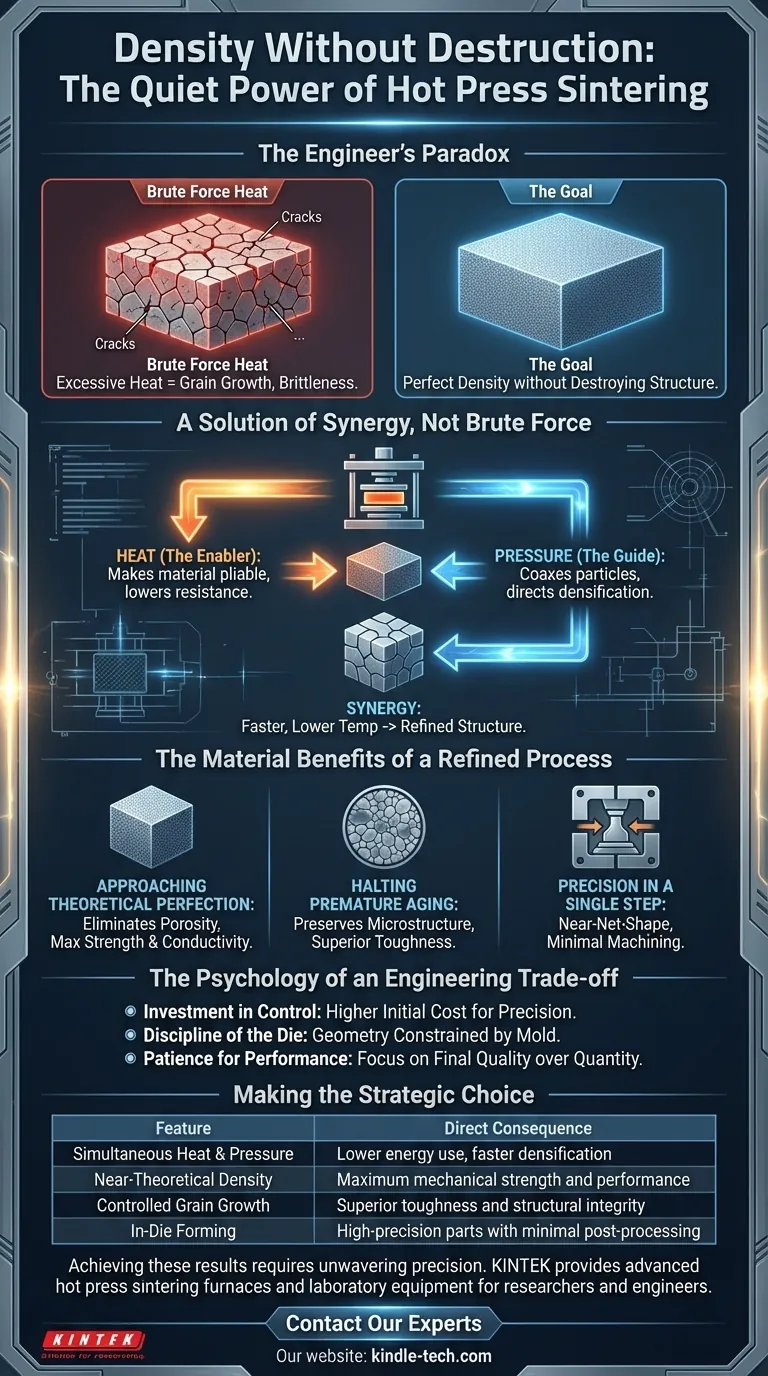
Instead of relying solely on overwhelming heat, hot press sintering employs a more elegant strategy: the simultaneous application of heat and pressure.

This isn't just doing two things at once; it's creating a synergistic effect where the result is far greater than the sum of its parts. Think of it as a negotiation with the material itself.

How Heat and Pressure Collaborate

Heat acts as the great enabler. It raises the material's temperature to a point below its melting point, making it pliable and dramatically lowering its resistance to deformation. The material becomes receptive.

Pressure provides the guidance. Applied concurrently, this mechanical force physically coaxes the softened particles into closing the gaps between them. It directs the densification process with an efficiency that heat alone could never achieve.

This teamwork means you need less of both. The required temperature drops significantly, and the process completes much faster. It's the difference between shouting a command and having a quiet, persuasive conversation.

The Material Benefits of a Refined Process

This nuanced approach directly translates into superior materials with tangible performance advantages.

Approaching Theoretical Perfection

The primary victory of hot pressing is its ability to eliminate porosity. By physically squeezing out the voids, the process can produce components that approach 100% of their theoretical density. This void-free state is directly linked to superior mechanical strength, thermal conductivity, and electrical properties.

Halting Premature Aging

The fight against grain growth is a fight against a form of material entropy. The lower temperatures and shorter cycle times of hot pressing are its greatest weapons. By minimizing the material's time at high temperatures, the process preserves the fine, strong-grained microstructure that is essential for high-performance applications in advanced ceramics and metallurgy.

Precision in a Single Step

Because the component is formed and densified within a die, hot pressing creates near-net-shape parts. This minimizes the need for costly and time-consuming secondary machining, delivering complex and precise components efficiently.

The Psychology of an Engineering Trade-off

No process is a universal solution. Choosing hot pressing is a strategic decision that acknowledges a specific set of priorities. It involves a conscious trade-off, prioritizing ultimate quality over other factors.

The Investment in Control

The equipment required to manage intense heat and pressure simultaneously is inherently complex. This represents a higher initial investment, a clear choice to prioritize the precision and control needed for top-tier results.

The Discipline of the Die

The process is constrained by the geometry of its mold. You cannot create the infinitely complex shapes possible with additive manufacturing. This is the trade-off for achieving unparalleled density and material properties within those defined boundaries.

Patience for Performance

While the sintering phase itself is fast, the full cycle—loading, heating, pressing, and cooling—can be longer than some mass-production techniques. This reflects a deliberate focus on the final quality of a single component rather than the sheer quantity produced.

Making the Strategic Choice

Your manufacturing choice should be a direct reflection of your primary goal.

  • When performance is non-negotiable: For applications demanding maximum density and strength, hot press sintering is a leading candidate.
  • When working with difficult materials: It excels with high-melting-point metals and ceramics where traditional melting is impractical or detrimental.
  • When balancing cost and volume: For mass-produced, less critical parts, other methods might be more economical.

Ultimately, choosing hot pressing is an intentional decision to favor material integrity above all else.

Feature Direct Consequence
Simultaneous Heat & Pressure Lower energy use and faster densification
Near-Theoretical Density Maximum mechanical strength and performance
Controlled Grain Growth Superior toughness and structural integrity
In-Die Forming High-precision parts with minimal post-processing

Achieving these results requires equipment that can exert these forces with unwavering precision. In the lab or on the production line, control is everything. KINTEK provides advanced hot press sintering furnaces and laboratory equipment designed to give researchers and engineers the precise control needed to turn advanced powders into superior components.

If your goal is to push the boundaries of material performance, let's explore the right solution for your application. Contact Our Experts

Visual Guide
Density Without Destruction: The Quiet Power of Hot Press Sintering Visual Guide

Related Products

Related Articles

Related Products

Vacuum Hot Press Furnace Machine Heated Vacuum Press

Vacuum Hot Press Furnace Machine Heated Vacuum Press

Discover the advantages of Vacuum Hot Press Furnace! Manufacture dense refractory metals & compounds, ceramics, and composites under high temp and pressure.

Vacuum Hot Press Furnace Heated Vacuum Press Machine Tube Furnace

Vacuum Hot Press Furnace Heated Vacuum Press Machine Tube Furnace

Reduce forming pressure & shorten sintering time with Vacuum Tube Hot Press Furnace for high-density, fine-grain materials. Ideal for refractory metals.

Vacuum Heat Treat and Sintering Furnace with 9MPa Air Pressure

Vacuum Heat Treat and Sintering Furnace with 9MPa Air Pressure

The air pressure sintering furnace is a high-tech equipment commonly used for the sintering of advanced ceramic materials. It combines vacuum sintering and pressure sintering techniques to achieve high-density and high-strength ceramics.

600T Vacuum Induction Hot Press Furnace for Heat Treat and Sintering

600T Vacuum Induction Hot Press Furnace for Heat Treat and Sintering

Discover the 600T Vacuum Induction Hot Press Furnace, designed for high-temperature sintering experiments in vacuum or protected atmospheres. Its precise temperature and pressure control, adjustable working pressure, and advanced safety features make it ideal for nonmetal materials, carbon composites, ceramics, and metal powders.

Laboratory High Pressure Vacuum Tube Furnace

Laboratory High Pressure Vacuum Tube Furnace

KT-PTF High Pressure Tube Furnace: Compact split tube furnace with strong positive pressure resistance. Working temp up to 1100°C and pressure up to 15Mpa. Also works under controller atmosphere or high vacuum.

Vacuum Hot Press Furnace Machine for Lamination and Heating

Vacuum Hot Press Furnace Machine for Lamination and Heating

Experience clean and precise lamination with Vacuum Lamination Press. Perfect for wafer bonding, thin-film transformations, and LCP lamination. Order now!

Spark Plasma Sintering Furnace SPS Furnace

Spark Plasma Sintering Furnace SPS Furnace

Discover the benefits of Spark Plasma Sintering Furnaces for rapid, low-temperature material preparation. Uniform heating, low cost & eco-friendly.

Vacuum Heat Treat and Molybdenum Wire Sintering Furnace for Vacuum Sintering

Vacuum Heat Treat and Molybdenum Wire Sintering Furnace for Vacuum Sintering

A vacuum molybdenum wire sintering furnace is a vertical or bedroom structure, which is suitable for withdrawal, brazing, sintering and degassing of metal materials under high vacuum and high temperature conditions. It is also suitable for dehydroxylation treatment of quartz materials.

Vacuum Heat Treat Furnace with Ceramic Fiber Liner

Vacuum Heat Treat Furnace with Ceramic Fiber Liner

Vacuum furnace with polycrystalline ceramic fiber insulation liner for excellent heat insulation and uniform temperature field. Choose from 1200℃ or 1700℃ max. working temperature with high vacuum performance and precise temperature control.

Molybdenum Vacuum Heat Treat Furnace

Molybdenum Vacuum Heat Treat Furnace

Discover the benefits of a high-configuration molybdenum vacuum furnace with heat shield insulation. Ideal for high-purity, vacuum environments like sapphire crystal growth and heat treatment.

Vacuum Dental Porcelain Sintering Furnace

Vacuum Dental Porcelain Sintering Furnace

Get precise and reliable results with KinTek's Vacuum Porcelain Furnace. Suitable for all porcelain powders, it features hyperbolic ceramic furnace function, voice prompt, and automatic temperature calibration.

Ultra-High Temperature Graphite Vacuum Graphitization Furnace

Ultra-High Temperature Graphite Vacuum Graphitization Furnace

The ultra-high temperature graphitization furnace utilizes medium frequency induction heating in a vacuum or inert gas environment. The induction coil generates an alternating magnetic field, inducing eddy currents in the graphite crucible, which heats up and radiates heat to the workpiece, bringing it to the desired temperature. This furnace is primarily used for graphitization and sintering of carbon materials, carbon fiber materials, and other composite materials.

Graphite Vacuum Continuous Graphitization Furnace

Graphite Vacuum Continuous Graphitization Furnace

High-temperature graphitization furnace is a professional equipment for graphitization treatment of carbon materials. It is a key equipment for the production of high-quality graphite products. It has high temperature, high efficiency and uniform heating. It is suitable for various high-temperature treatments and graphitization treatments. It is widely used in metallurgy, electronics, aerospace, etc. industry.

Lab-Scale Vacuum Induction Melting Furnace

Lab-Scale Vacuum Induction Melting Furnace

Get precise alloy composition with our Vacuum Induction Melting Furnace. Ideal for aerospace, nuclear energy, and electronic industries. Order now for effective smelting and casting of metals and alloys.

2200 ℃ Graphite Vacuum Heat Treat Furnace

2200 ℃ Graphite Vacuum Heat Treat Furnace

Discover the power of the KT-VG Graphite Vacuum Furnace - with a maximum working temperature of 2200℃, it's perfect for vacuum sintering of various materials. Learn more now.

Vertical High Temperature Graphite Vacuum Graphitization Furnace

Vertical High Temperature Graphite Vacuum Graphitization Furnace

Vertical high temperature graphitization furnace for carbonization and graphitization of carbon materials up to 3100℃.Suitable for shaped graphitization of carbon fiber filaments and other materials sintered in a carbon environment.Applications in metallurgy, electronics, and aerospace for producing high-quality graphite products like electrodes and crucibles.

Graphite Vacuum Furnace High Thermal Conductivity Film Graphitization Furnace

Graphite Vacuum Furnace High Thermal Conductivity Film Graphitization Furnace

The high thermal conductivity film graphitization furnace has uniform temperature, low energy consumption and can operate continuously.

1200℃ Controlled Atmosphere Furnace Nitrogen Inert Atmosphere Furnace

1200℃ Controlled Atmosphere Furnace Nitrogen Inert Atmosphere Furnace

Discover our KT-12A Pro Controlled atmosphere furnace - high precision, heavy duty vacuum chamber, versatile smart touch screen controller, and excellent temperature uniformity up to 1200C. Ideal for both laboratory and industrial application.

Non Consumable Vacuum Arc Induction Melting Furnace

Non Consumable Vacuum Arc Induction Melting Furnace

Explore the benefits of Non-Consumable Vacuum Arc Furnace with high melting point electrodes. Small, easy to operate & eco-friendly. Ideal for laboratory research on refractory metals & carbides.

Chemical Vapor Deposition CVD Equipment System Chamber Slide PECVD Tube Furnace with Liquid Gasifier PECVD Machine

Chemical Vapor Deposition CVD Equipment System Chamber Slide PECVD Tube Furnace with Liquid Gasifier PECVD Machine

KT-PE12 Slide PECVD System: Wide power range, programmable temp control, fast heating/cooling with sliding system, MFC mass flow control & vacuum pump.


Leave Your Message