Blog From Milliseconds to Megawatts: Deconstructing Industrial Combustion with a Drop Tube Furnace
From Milliseconds to Megawatts: Deconstructing Industrial Combustion with a Drop Tube Furnace

From Milliseconds to Megawatts: Deconstructing Industrial Combustion with a Drop Tube Furnace

4 hours ago

The Illusion of the Average

Picture a utility-scale boiler. It's a colossal inferno, consuming tons of pulverized coal or biomass every hour. Inside is a chaotic, turbulent world of fire and pressure.

From the outside, we measure outputs—megawatts, emissions, efficiency. We see the system as a whole and tend to think in averages. The average temperature, the average fuel consumption, the average residence time.

But in complex systems, the average is often a misleading fiction. The real story, the one that governs efficiency and unlocks innovation, is not found in the average. It's found in the journey of a single, individual particle as it tumbles through the fire.

The fundamental engineering challenge is this: How do you isolate and study one particle's experience in a system of millions?

Isolating the Individual: The Engineering of a Drop Tube Furnace

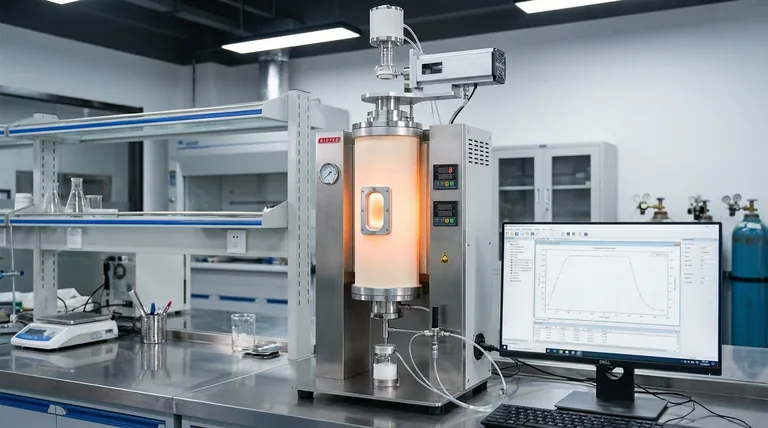
The answer is an elegant piece of laboratory engineering: the Drop Tube Furnace (DTF). It is not a tool for bulk processing; it is a microscope for high-temperature reactions. It strips away the chaos of an industrial reactor to reveal the fundamental physics and chemistry at play.

A Controlled Fall Through Fire

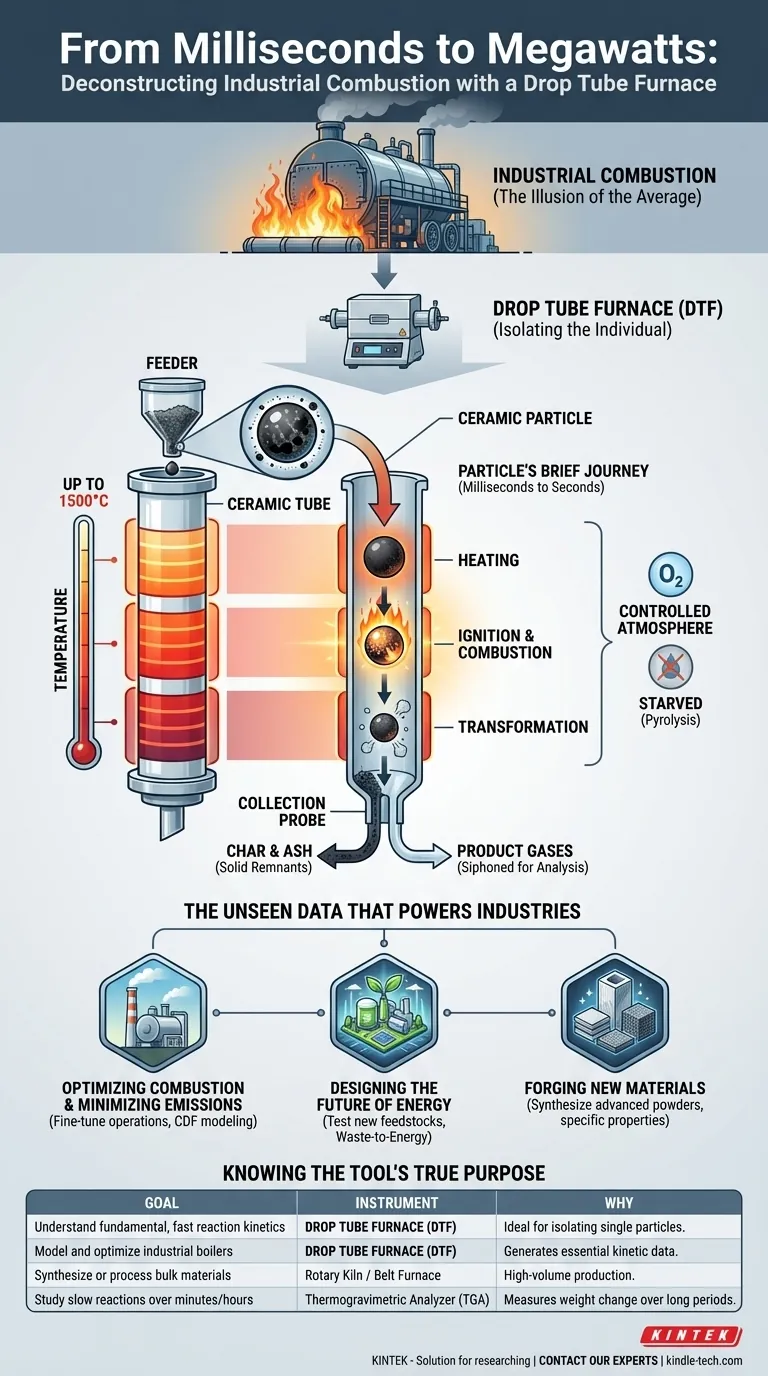
At the heart of the DTF is a vertical ceramic tube, capable of withstanding extreme temperatures, often exceeding 1500°C. This tube is not just a hot pipe; it's a meticulously controlled environment. Multiple, independent heating zones allow researchers to create a precise temperature profile that a particle would experience in a full-scale boiler.

This is the stage where the experiment happens.

The Particle's Brief, Violent Journey

A sophisticated feeder at the top introduces a tiny, metered stream of sample particles. Gravity takes over. For a few brief moments—from milliseconds to a few seconds—the particle is in freefall through the furnace's controlled atmosphere.

This journey mimics the violent life of a fuel particle in an industrial system. In this short residence time, it heats up, ignites, combusts, and transforms. We can precisely control the gas around it, simulating everything from the oxygen-rich environment of a boiler (combustion) to the oxygen-starved conditions of a gasifier (pyrolysis and gasification).

Capturing the Aftermath

At the bottom, a collection probe rapidly quenches the reaction, freezing the particle in time. The solid remnants—char and ash—are collected. The product gases are siphoned off for analysis.

This aftermath is not waste; it is data. It is the complete story of what happened to that single particle during its journey.

The Unseen Data That Powers Industries

This particle-level data is not merely academic. It is the bedrock upon which industrial processes are optimized and new technologies are built.

  • Optimizing Combustion, Minimizing Emissions: By understanding how quickly a specific biomass char burns out or how much NOx is formed from a type of coal, engineers can fine-tune boiler operations for maximum efficiency and minimal pollution. The DTF provides the exact parameters needed for accurate computational fluid dynamics (CFD) modeling.

  • Designing the Future of Energy: When developing waste-to-energy or advanced biofuel technologies, the DTF is indispensable. It allows scientists to test the gasification potential of new feedstocks quickly and affordably, predicting how they will behave before investing millions in a pilot plant.

  • Forging New Materials: The controlled temperature and atmosphere are perfect for synthesizing advanced materials. Processes like calcination or ore roasting can be studied at the micro-level to produce ceramic powders or metals with highly specific properties.

Knowing the Tool's True Purpose

The human mind has a bias to use a familiar tool for every problem. But the power of an instrument like the Drop Tube Furnace lies in knowing exactly what it is for—and what it is not.

A DTF offers an idealized view. It cannot replicate the complex particle-to-particle interactions of a dense fluidized bed. Its gravity-dependent residence time is inherently short, making it unsuitable for reactions that take minutes or hours.

To make an informed choice, you must align the tool with the question you are asking.

Your Primary Goal Recommended Instrument Why
Understand fundamental, fast reaction kinetics at the particle level. Drop Tube Furnace (DTF) Ideal for isolating single particles in a controlled environment.
Model and optimize industrial boilers or gasifiers. Drop Tube Furnace (DTF) Generates the essential kinetic data for accurate simulations.
Synthesize or process bulk materials. Rotary Kiln / Belt Furnace Designed for continuous, high-volume production.
Study slow reactions over minutes or hours. Thermogravimetric Analyzer (TGA) Measures weight change over long periods with high precision.

Understanding this distinction is key. The DTF is a powerful analytical instrument, a window into the fundamental events that, when multiplied by billions, power our world.

This level of granular analysis isn't just academic; it's the foundation of industrial efficiency and innovation. At KINTEK, we provide the precision-engineered drop tube furnaces that bridge the gap between a single particle and a power plant. To generate the critical data needed for your research, you need the right tool. Contact Our Experts

Visual Guide
From Milliseconds to Megawatts: Deconstructing Industrial Combustion with a Drop Tube Furnace Visual Guide

Related Products

Related Articles

Related Products

1700℃ Laboratory High Temperature Tube Furnace with Alumina Tube

1700℃ Laboratory High Temperature Tube Furnace with Alumina Tube

Looking for a high-temperature tube furnace? Check out our 1700℃ Tube Furnace with Alumina Tube. Perfect for research and industrial applications up to 1700C.

1400℃ Laboratory High Temperature Tube Furnace with Alumina Tube

1400℃ Laboratory High Temperature Tube Furnace with Alumina Tube

Looking for a tube furnace for high-temperature applications? Our 1400℃ Tube Furnace with Alumina Tube is perfect for research and industrial use.

Laboratory Rapid Thermal Processing (RTP) Quartz Tube Furnace

Laboratory Rapid Thermal Processing (RTP) Quartz Tube Furnace

Get lightning-fast heating with our RTP Rapid Heating Tube Furnace. Designed for precise, high-speed heating and cooling with convenient sliding rail and TFT touch screen controller. Order now for ideal thermal processing!

Vertical Laboratory Tube Furnace

Vertical Laboratory Tube Furnace

Elevate your experiments with our Vertical Tube Furnace. Versatile design allows for operation under various environments and heat treatment applications. Order now for precise results!

Laboratory Vacuum Tilt Rotary Tube Furnace Rotating Tube Furnace

Laboratory Vacuum Tilt Rotary Tube Furnace Rotating Tube Furnace

Discover the versatility of Laboratory Rotary Furnace: Ideal for calcination, drying, sintering, and high-temperature reactions. Adjustable rotating and tilting functions for optimal heating. Suitable for vacuum and controlled atmosphere environments. Learn more now!

Multi-zone Laboratory Tube Furnace

Multi-zone Laboratory Tube Furnace

Experience precise, efficient thermal testing with our Multi Zone Tube Furnace. Independent heating zones and temperature sensors allow for controlled high-temperature gradient heating fields. Order now for advanced thermal analysis!

1200℃ Split Tube Furnace with Quartz Tube Laboratory Tubular Furnace

1200℃ Split Tube Furnace with Quartz Tube Laboratory Tubular Furnace

KT-TF12 split tube furnace: high-purity insulation, embedded heating wire coils, and max. 1200C. Widely used for new materials and chemical vapour deposition.

1200℃ Controlled Atmosphere Furnace Nitrogen Inert Atmosphere Furnace

1200℃ Controlled Atmosphere Furnace Nitrogen Inert Atmosphere Furnace

Discover our KT-12A Pro Controlled atmosphere furnace - high precision, heavy duty vacuum chamber, versatile smart touch screen controller, and excellent temperature uniformity up to 1200C. Ideal for both laboratory and industrial application.

Rotary Tube Furnace Split Multi Heating Zone Rotating Tube Furnace

Rotary Tube Furnace Split Multi Heating Zone Rotating Tube Furnace

Multi zone rotary furnace for high-precision temperature control with 2-8 independent heating zones. Ideal for lithium ion battery electrode materials and high-temperature reactions. Can work under vacuum and controlled atmosphere.

Customer Made Versatile CVD Tube Furnace Chemical Vapor Deposition Chamber System Equipment

Customer Made Versatile CVD Tube Furnace Chemical Vapor Deposition Chamber System Equipment

Get your exclusive CVD furnace with KT-CTF16 Customer Made Versatile Furnace. Customizable sliding, rotating, and tilting functions for precise reactions. Order now!

1800℃ Muffle Oven Furnace for Laboratory

1800℃ Muffle Oven Furnace for Laboratory

KT-18 muffle furnace with Japan Al2O3 polycrystalline fibe and Silicon Molybdenum heating element, up to 1900℃, PID temperature control and 7" smart touch screen. Compact design, low heat loss, and high energy efficiency. Safety interlock system and versatile functions.

Vacuum Sealed Continuous Working Rotary Tube Furnace Rotating Tube Furnace

Vacuum Sealed Continuous Working Rotary Tube Furnace Rotating Tube Furnace

Experience efficient material processing with our vacuum-sealed rotary tube furnace. Perfect for experiments or industrial production, equipped with optional features for controlled feeding and optimized results. Order now.

1400℃ Controlled Atmosphere Furnace with Nitrogen and Inert Atmosphere

1400℃ Controlled Atmosphere Furnace with Nitrogen and Inert Atmosphere

Achieve precise heat treatment with KT-14A controlled atmosphere furnace. Vacuum sealed with a smart controller, it's ideal for lab and industrial use up to 1400℃.

1700℃ Controlled Atmosphere Furnace Nitrogen Inert Atmosphere Furnace

1700℃ Controlled Atmosphere Furnace Nitrogen Inert Atmosphere Furnace

KT-17A Controlled atmosphere furnace: 1700℃ heating, vacuum sealing technology, PID temperature control, and versatile TFT smart touch screen controller for laboratory and industrial use.

High Temperature Muffle Oven Furnace for Laboratory Debinding and Pre Sintering

High Temperature Muffle Oven Furnace for Laboratory Debinding and Pre Sintering

KT-MD High temperature debinding and pre-sintering furnace for ceramic materials with various molding processes. Ideal for electronic components such as MLCC and NFC.

Laboratory Muffle Oven Furnace Bottom Lifting Muffle Furnace

Laboratory Muffle Oven Furnace Bottom Lifting Muffle Furnace

Efficiently produce batches with excellent temperature uniformity using our Bottom Lifting Furnace. Features two electric lifting stages and advanced temperature control up to 1600℃.

1700℃ Muffle Oven Furnace for Laboratory

1700℃ Muffle Oven Furnace for Laboratory

Get superior heat control with our 1700℃ Muffle Furnace. Equipped with intelligent temperature microprocessor, TFT touch screen controller & advanced insulation materials for precise heating up to 1700C. Order now!

1400℃ Muffle Oven Furnace for Laboratory

1400℃ Muffle Oven Furnace for Laboratory

Get precise high-temperature control up to 1500℃ with KT-14M Muffle furnace. Equipped with a smart touch screen controller and advanced insulation materials.

Controlled Nitrogen Inert Hydrogen Atmosphere Furnace

Controlled Nitrogen Inert Hydrogen Atmosphere Furnace

KT-AH Hydrogen atmosphere furnace - induction gas furnace for sintering/annealing with built-in safety features, dual housing design, and energy-saving efficiency. Ideal for lab and industrial use.

Vacuum Heat Treat and Molybdenum Wire Sintering Furnace for Vacuum Sintering

Vacuum Heat Treat and Molybdenum Wire Sintering Furnace for Vacuum Sintering

A vacuum molybdenum wire sintering furnace is a vertical or bedroom structure, which is suitable for withdrawal, brazing, sintering and degassing of metal materials under high vacuum and high temperature conditions. It is also suitable for dehydroxylation treatment of quartz materials.


Leave Your Message



















