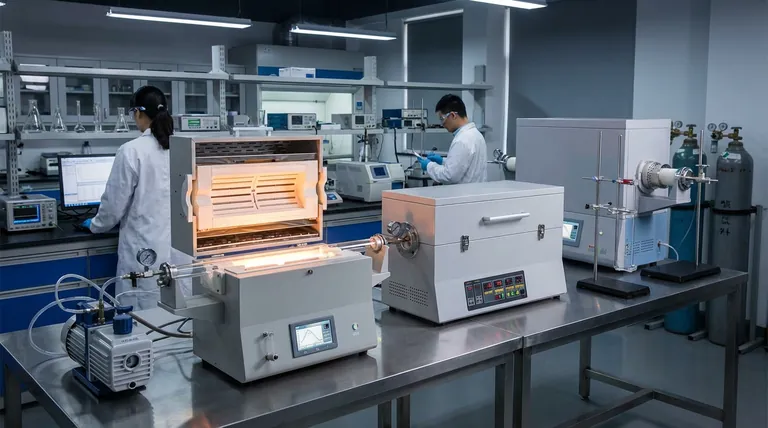
A materials scientist spends weeks synthesizing a novel thin-film semiconductor. The protocol is followed meticulously. Yet, the results are wildly inconsistent. One batch is a breakthrough; the next is useless.
The team hunts for the variable. Was it the precursor chemicals? The timing? The substrate?
The real culprit is invisible: a few parts-per-million of oxygen leaking into the chamber, or a temperature gradient of two degrees across the sample. In the world of advanced materials, progress is not just about having the right idea. It's about eliminating the chaos of the unseen.
This is the psychological core of experimental science: the relentless pursuit of control. We crave certainty and repeatability. In thermal processing, that certainty is embodied by the tube furnace.
The Architecture of Control
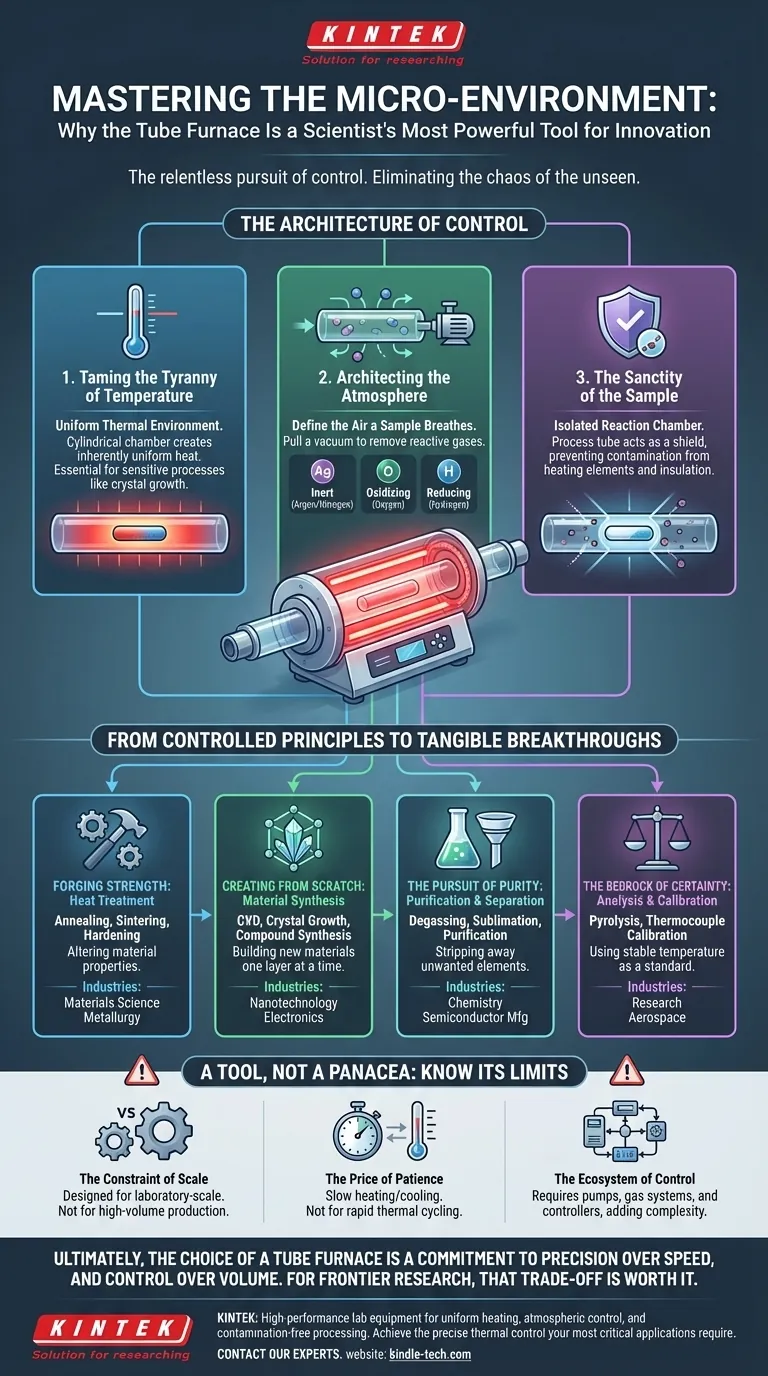
A tube furnace isn't just an oven. It’s a self-contained universe where a scientist can dictate the fundamental rules of temperature and chemistry. Its power comes from three elegant design principles that work in concert to eliminate uncertainty.
1. Taming the Tyranny of Temperature
Heat is notoriously difficult to distribute evenly. A box furnace can have hot and cold spots. But a tube furnace’s cylindrical heating chamber creates an inherently uniform thermal environment along its length.
This thermal uniformity isn't a luxury; it's a prerequisite for success in sensitive processes. When growing a single perfect crystal or calibrating a thermocouple, every part of the sample must experience the exact same temperature. Any deviation introduces a flaw, rendering the work useless. The tube furnace provides this essential consistency.
2. Architecting the Atmosphere
Perhaps its most significant advantage is the power to define the very air a sample breathes. By sealing a process tube (often made of quartz or alumina) , an operator can remove the reactive, unpredictable gases of our atmosphere by pulling a vacuum.
From that clean slate, a new, purpose-built atmosphere can be introduced.
- Inert: An argon or nitrogen bath to prevent any unwanted chemical reactions.
- Oxidizing: A pure oxygen environment to encourage specific reactions.
- Reducing: A hydrogen atmosphere to remove oxygen from a compound.
This capability is the bedrock of modern processes like Chemical Vapor Deposition (CVD), where specific gases must react in a pristine environment to form a perfect film, one atomic layer at a time.
3. The Sanctity of the Sample
In high-purity work, the enemy is contamination. The sample must be isolated from everything, including the furnace's own heating elements and insulation.
The process tube acts as a shield, creating a clean, isolated reaction chamber. This physical separation is non-negotiable in fields like semiconductor development or the purification of fine chemicals, where a single foreign particle can derail an entire process.
From Controlled Principles to Tangible Breakthroughs
These pillars of control unlock a vast range of applications, each one a different way of imposing order on matter.
Forging Strength: The Art of Heat Treatment
This is about fundamentally altering a material's existing properties.
- Annealing: Releasing internal stresses in metals or glass to make them less brittle.
- Sintering: Fusing fine powders into a solid, dense ceramic or metal part.
- Hardening: Rearranging the crystalline structure of steel to make it tougher and more durable.
Creating from Scratch: The Frontier of Synthesis
Here, the furnace is a crucible for creating entirely new materials.
- Crystal Growth: Slowly building a perfect, single-crystal structure for use in optics or electronics.
- Chemical Vapor Deposition (CVD): Synthesizing materials like graphene or diamond films from gaseous precursors.
- Compound Synthesis: Reacting elements at high temperatures to form new inorganic compounds.
The Pursuit of Purity
This involves using heat and atmosphere to strip away unwanted elements.
- Degassing: Removing trapped gases from a material under vacuum, crucial for components used in ultra-high vacuum systems.
- Sublimation: Transitioning a solid directly to a gas to separate it from non-volatile impurities.
- Purification: Driving off contaminants from chemical samples with precise heat.
The Bedrock of Certainty: Analysis & Calibration
The furnace's stability makes it the ultimate reference point.
- Pyrolysis: Decomposing a material in an inert atmosphere to analyze its constituent parts.
- Thermocouple Calibration: Using the furnace's known, stable temperature as a standard to ensure sensors are accurate.
| Application Category | Key Processes | Industries/Sectors |
|---|---|---|
| Heat Treatment | Annealing, Sintering, Hardening | Materials Science, Metallurgy |
| Material Synthesis | CVD, Crystal Growth, Compound Synthesis | Nanotechnology, Electronics |
| Purification & Separation | Degassing, Sublimation, Purification | Chemistry, Semiconductor Manufacturing |
| Analysis & Calibration | Thermal Decomposition, Thermocouple Calibration | Research, Aerospace, Oil & Gas |
A Tool, Not a Panacea: Know Its Limits
Brilliance in engineering is knowing not just how to use a tool, but when. A tube furnace is a master of precision, but it has trade-offs.
- The Constraint of Scale: It is designed for laboratory-scale samples. For high-volume industrial production, a continuous belt furnace is more efficient.
- The Price of Patience: Its high thermal mass means it heats up and cools down slowly. It is not built for applications requiring rapid thermal cycling.
- The Ecosystem of Control: Achieving advanced control requires more than just the furnace. Vacuum pumps, gas delivery systems, and multi-zone controllers add complexity to the setup.
Ultimately, the choice of a tube furnace is a commitment to precision over speed, and control over volume. For the researcher or engineer working on the frontiers of what's possible, that trade-off is almost always worth it.
Laboratories focused on materials science, chemistry, and electronics R&D depend on this level of environmental mastery. At KINTEK, we specialize in providing high-performance lab equipment that delivers the uniform heating, atmospheric control, and contamination-free processing your work demands. We understand that your next breakthrough depends on the perfection of your process. To achieve the precise thermal control your most critical applications require, Contact Our Experts.
Visual Guide
Related Products
- Rotary Tube Furnace Split Multi Heating Zone Rotating Tube Furnace
- Laboratory Vacuum Tilt Rotary Tube Furnace Rotating Tube Furnace
- 1200℃ Split Tube Furnace with Quartz Tube Laboratory Tubular Furnace
- 1400℃ Laboratory High Temperature Tube Furnace with Alumina Tube
- 1700℃ Laboratory High Temperature Tube Furnace with Alumina Tube
Related Articles
- The Geometry of Heat: Why Motion Matters in Material Synthesis
- Exploring the Benefits and Applications of Rotary Furnaces: A Comprehensive Guide
- Exploring the Functions and Advantages of Rotary Tube Furnaces
- Exploring Rotary Tube Furnaces: A Comprehensive Guide
- The Physics of Perfection: How Rotary Furnaces Eliminate Randomness in Material Processing



















