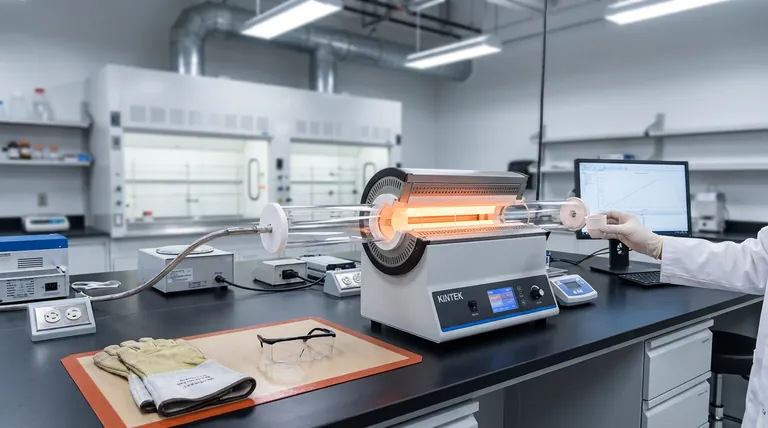
The Psychology of a Cracked Tube
There's a specific sound a lab manager dreads: a sharp tink from inside a cooling tube furnace. It’s the sound of a fractured quartz or alumina tube. It’s the sound of a ruined sample, a delayed project, and an unexpected expense.
This failure is almost never the fault of the furnace itself. It’s a failure of patience.
In a world that prizes speed, the high-temperature furnace operates on a different principle: the unyielding laws of thermodynamics. It rewards discipline and punishes haste. Understanding this is the first step to mastering the instrument, not just operating it.
The Foundation Isn't the Furnace, It's the Environment
Before a single degree of heat is applied, the stage must be set. We often focus on the complex parameters of the experiment, but the furnace's physical and electrical environment is the silent variable that determines success.
Stability Is a Prerequisite
A tube furnace is a precision instrument. Placing it on an unstable or vibrating bench is like trying to perform surgery on a moving train. Over time, micro-vibrations can stress the delicate heating elements and the furnace tube itself.
Ensure the furnace rests on a solid, level surface, in a well-ventilated area away from any flammable materials. This isn’t just about safety; it’s about creating a pocket of stability for a sensitive process.
The Hidden Threat of Moisture
A furnace that has been idle absorbs atmospheric moisture into its refractory insulation. If heated too quickly, this trapped water turns to steam, creating internal pressure that can damage the insulation or even the heating elements.
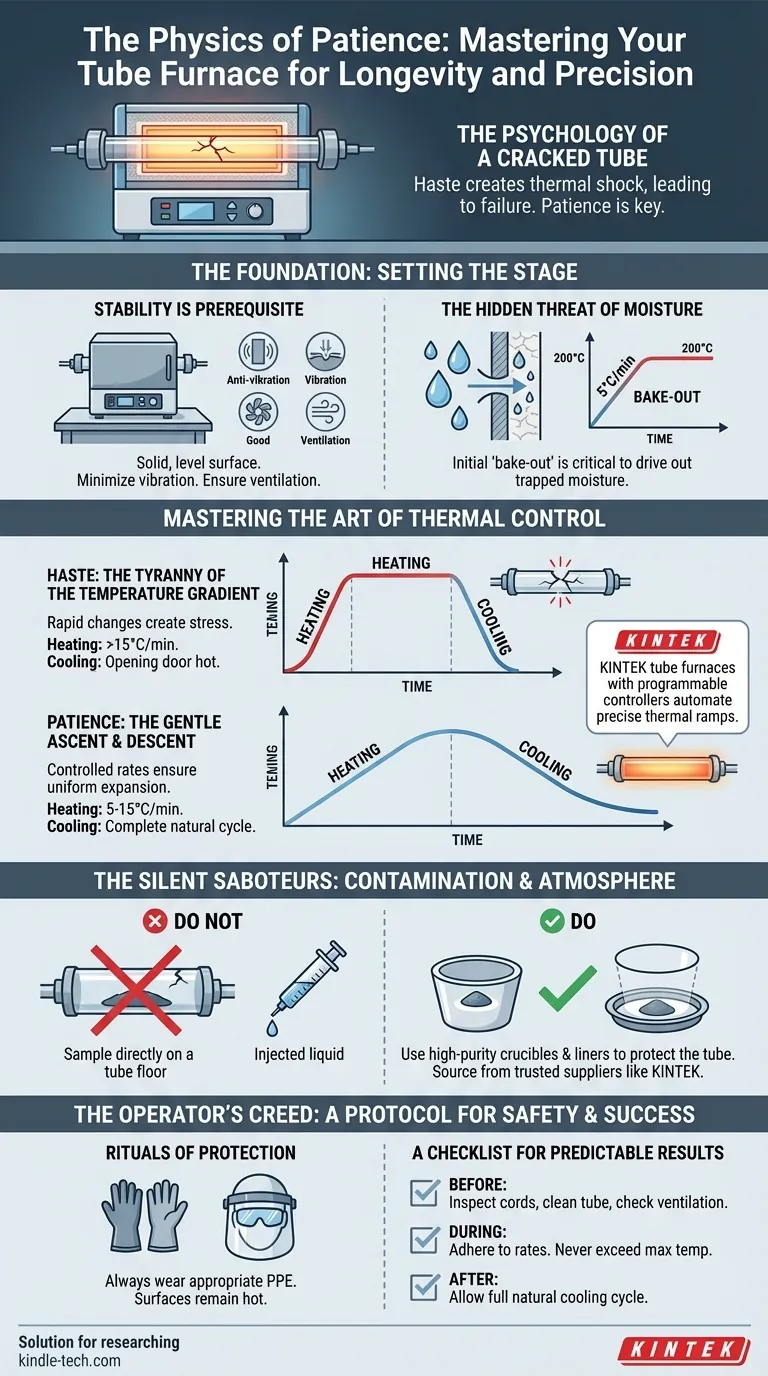
This is why an initial "bake-out" is critical for a new or long-unused furnace. Heating it slowly (around 5°C/minute) to 200°C and holding it there for a couple of hours is a ritual of purification. It gently drives out the moisture, preparing the furnace for the stress of high-temperature work.
Mastering the Art of Thermal Control
The single most common cause of catastrophic furnace failure is thermal shock. It's a simple concept with profound consequences.
The Tyranny of the Temperature Gradient
When you heat or cool a ceramic tube too quickly, you create a temperature gradient. The surface changes temperature faster than the core. This differential causes the material to expand or contract at different rates, building immense internal stress. The tink of a cracked tube is that stress being released.
It's a battle happening at a molecular level, and the only way to win is to not fight it.
- Heating: The Ascent: A controlled heating rate, typically between 5-15°C per minute, allows the entire system to expand uniformly. It respects the material's physical limits.
- Cooling: The Gentle Descent: Cooling is just as, if not more, critical. The temptation to open the furnace door to speed up the process is a cognitive trap—choosing short-term convenience over long-term integrity. This sudden influx of cool air is the most common way to crack a hot tube.
Reliable furnaces are designed to enforce this discipline. The programmable controllers in KINTEK tube furnaces, for example, are engineered to execute these precise thermal ramps, making patience part of the automated process.
The Silent Saboteurs: Contamination and Atmosphere
What you put inside the furnace is as important as how you heat it. Foreign materials can become destructive agents at high temperatures.
Purity in a Hostile Environment
Never place samples directly on the furnace tube floor, and certainly never inject liquids. A spilled or melted sample can chemically etch and permanently damage the tube.
This is where high-purity consumables become essential.
- Crucibles: Always place samples in a suitable crucible, like one made of high-purity alumina, to contain them.
- Liners: Consider using sacrificial liners or mats to protect the tube from aggressive vapors or accidental spills.
These are not mere accessories; they are your primary line of defense. Sourcing high-quality consumables from a trusted supplier like KINTEK ensures your experiment remains pure and your equipment is protected.
The Operator's Creed: A Protocol for Safety and Success
Ultimately, the instrument is an extension of the operator. A disciplined protocol transforms a good process into a great one.
Rituals of Protection
Personal Protective Equipment (PPE) is not bureaucracy; it's a professional ritual that acknowledges the inherent risks.
- Always wear heat-resistant gloves. Surfaces can remain dangerously hot long after the furnace has been turned off.
- Always wear safety glasses or a face shield. Protect your eyes from heat, and potential off-gassing.
A Checklist for Predictable Results
Treat each run like a pre-flight check. This simple discipline prevents the vast majority of common errors.
| Phase | Action | Rationale |
|---|---|---|
| Before | Inspect power cords, confirm tube is clean, check ventilation. | Ensures a safe and stable starting point. |
| During | Adhere to programmed heat/cool rates. Never exceed max temp. | Prevents thermal shock and equipment damage. |
| After | Allow the furnace to complete its full cooling cycle naturally. | Protects the tube and ensures operator safety. |
By treating the tube furnace with the respect it deserves—understanding its physical limits and the psychology of patience—you ensure not only your safety but also the integrity and repeatability of your results. Building a reliable process starts with reliable equipment and a disciplined approach.
To equip your lab with instruments and consumables designed for precision and longevity, Contact Our Experts.
Visual Guide
Related Products
- Rotary Tube Furnace Split Multi Heating Zone Rotating Tube Furnace
- Laboratory Vacuum Tilt Rotary Tube Furnace Rotating Tube Furnace
- 1200℃ Split Tube Furnace with Quartz Tube Laboratory Tubular Furnace
- 1400℃ Laboratory High Temperature Tube Furnace with Alumina Tube
- 1700℃ Laboratory High Temperature Tube Furnace with Alumina Tube
Related Articles
- The Geometry of Heat: Why Motion Matters in Material Synthesis
- Exploring the Advantages of Rotary Tube Furnaces in Industrial and Laboratory Applications
- Exploring Rotary Tube Furnaces: A Comprehensive Guide
- Exploring the Benefits and Applications of Rotary Furnaces: A Comprehensive Guide
- The Physics of Perfection: How Rotary Furnaces Eliminate Randomness in Material Processing



















