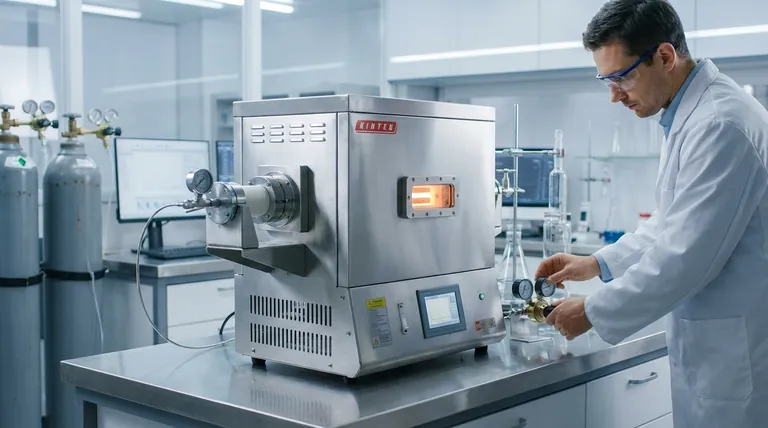
The Difference Between Being Hot and Being Precise
In the world of material science, heat is a blunt instrument. Anyone can build a fire. Anyone can make a box get hot.
But in the laboratory, high temperature is rarely the goal. The goal is repeatability.
If you are heat-treating a metal alloy or synthesizing a new semiconductor, 1,000°C is not a rough target. It is a strict requirement. A deviation of ten degrees—or a rogue oxygen molecule—can turn a breakthrough material into expensive scrap.
This is why the tube furnace exists.
It is not merely an oven. It is an isolation chamber designed to separate your sample from the chaos of the outside world.
The Geometry of Consistency
Most furnaces are boxes.
Boxes are great for volume. They are terrible for uniformity. Corners create dead zones; flat walls radiate heat unevenly.
The tube furnace solves this through geometry. By placing the heating elements around a cylindrical chamber, the heat radiates toward the center from 360 degrees. There are no corners to trap cold air. There are no edges to create hotspots.
The result is a thermal profile of exceptional flatness.
The Multi-Zone Advantage
For advanced applications, simple uniformity isn't enough. You need to sculpt the heat.
Multi-zone tube furnaces utilize independently controlled heating elements along the length of the tube. This allows engineers to do two things:
- Extend the sweet spot: Create a longer zone of perfect temperature uniformity.
- Create a gradient: Deliberately set one end of the tube hotter than the other, forcing materials to migrate or crystallize at specific rates.
Controlling the Invisible
The second defining feature of the tube furnace is its relationship with the air.
In a standard box furnace, your sample is bathing in the lab's atmosphere. It is exposed to oxygen, humidity, and whatever contaminants are floating in the room.
For processes like Chemical Vapor Deposition (CVD) or calcination, oxygen is the enemy.
The tube furnace allows you to change the rules of physics by changing the atmosphere. Because the tube is sealed, you can:
- Remove the air: Run processes in a vacuum.
- Neutralize the environment: Flood the chamber with inert gases like argon or nitrogen to prevent oxidation.
- Introduce reactivity: Pump in specific reactive gases to coat substrates or grow crystals.
The Psychology of Trade-offs
Engineering is the study of trade-offs. You rarely get something for nothing.
The tube furnace offers the ultimate control, but it exacts a price: Volume.
Because the heating elements must surround the tube, the diameter is limited. You cannot process large batches of material. You are limited to what fits inside the cylinder.
Furthermore, it is a batch process. You load, you seal, you heat, you cool, you unload. It is slow.
But this slowness is a feature, not a bug. It forces a focus on quality over quantity.
- Box Furnaces are for production throughput.
- Tube Furnaces are for precision and discovery.
Matching the Tool to the Task
How do you know if a tube furnace is the solution to your problem? It depends on what you are trying to achieve.
1. Material Synthesis & Purification
If you are growing crystals or sintering powders, the chemical environment matters as much as the temperature. You need the vacuum and gas capabilities of a tube furnace.
2. Heat Treatment
For annealing, tempering, or ageing metals, the goal is modifying physical properties. This requires thermal history. If the temperature fluctuates, the material properties will fluctuate. The uniform heating of a tube furnace ensures every millimeter of the sample undergoes the exact same transformation.
3. Advanced Research
In the lab, variables must be eliminated. If an experiment fails, you need to know it was the chemistry, not the equipment. A multi-zone furnace removes the thermal variable.
Summary of Capabilities
| Feature | Primary Goal | The "Why" |
|---|---|---|
| Cylindrical Geometry | Uniformity | Eliminates "cold corners" found in box furnaces. |
| Vacuum/Gas Seal | Purity | Prevents oxidation and allows chemical reactions (CVD). |
| Multi-Zone Heating | Gradient Control | Allows complex thermal profiling for crystal growth. |
| Small Chamber | Precision | Sacrifices volume to gain absolute environmental control. |
The KINTEK Solution
At KINTEK, we understand that "good enough" is the enemy of science.
Whether you are hardening a small batch of aerospace components or synthesizing a delicate catalyst, the equipment should disappear into the background. You should trust your thermal profile implicitly.
We specialize in high-performance tube furnaces that range from standard single-zone models for reliable heat treatment to sophisticated multi-zone systems for complex material synthesis.
If your work demands that you trade the chaos of an open oven for the certainty of a controlled environment, we can help you configure the right system.
Contact our experts today to discuss your specific temperature and atmospheric requirements.
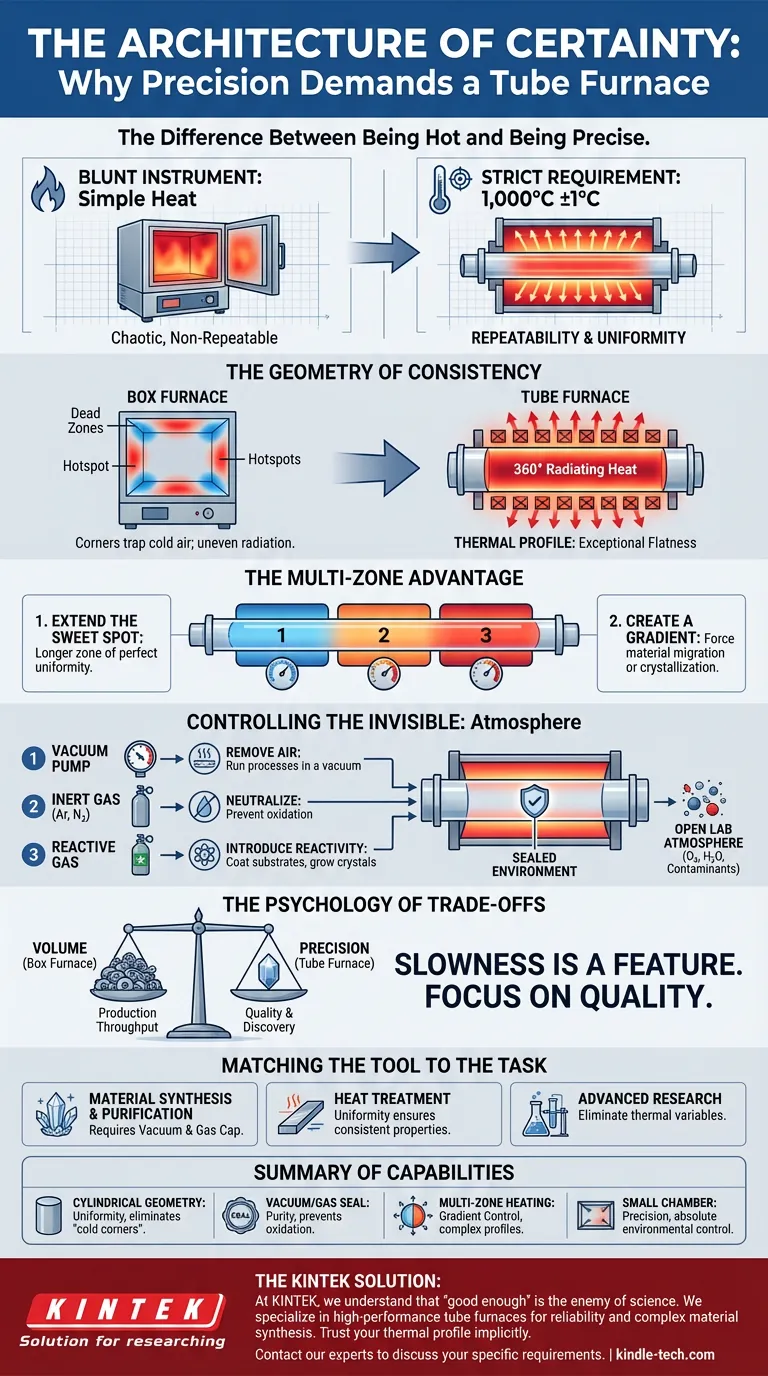
Visual Guide
Related Products
- Rotary Tube Furnace Split Multi Heating Zone Rotating Tube Furnace
- Laboratory Vacuum Tilt Rotary Tube Furnace Rotating Tube Furnace
- 1200℃ Split Tube Furnace with Quartz Tube Laboratory Tubular Furnace
- 1400℃ Laboratory High Temperature Tube Furnace with Alumina Tube
- 1700℃ Laboratory High Temperature Tube Furnace with Alumina Tube
Related Articles
- The Geometry of Heat: Why Motion Matters in Material Synthesis
- Exploring the Benefits and Applications of Rotary Furnaces: A Comprehensive Guide
- Exploring the Functions and Advantages of Rotary Tube Furnaces
- Exploring Rotary Tube Furnaces: A Comprehensive Guide
- The Physics of Perfection: How Rotary Furnaces Eliminate Randomness in Material Processing



















