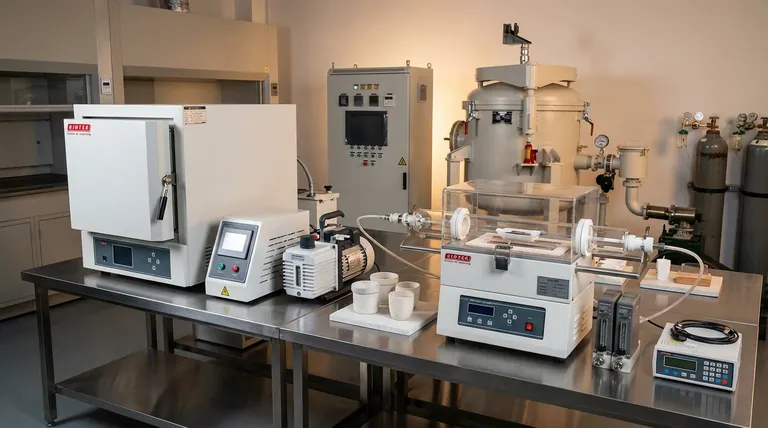
There is a common tendency in engineering—and human psychology—to confuse sophistication with suitability.
When setting up a laboratory, the temptation is to acquire the most complex tool available, assuming that a device capable of complex tasks can easily handle simple ones. In thermal processing, this fallacy often leads researchers to purchase a tube furnace when a muffle furnace is actually the superior tool.
The decision is not about which machine is "better." It is about understanding the fundamental constraints of your experiment.
It comes down to a trade-off between atmospheric control and volumetric capacity.
The Invisible Variable: Atmosphere
Heat is rarely the only variable that matters. In materials science, the environment surrounding the sample is often just as critical as the temperature itself.
This is the dividing line.
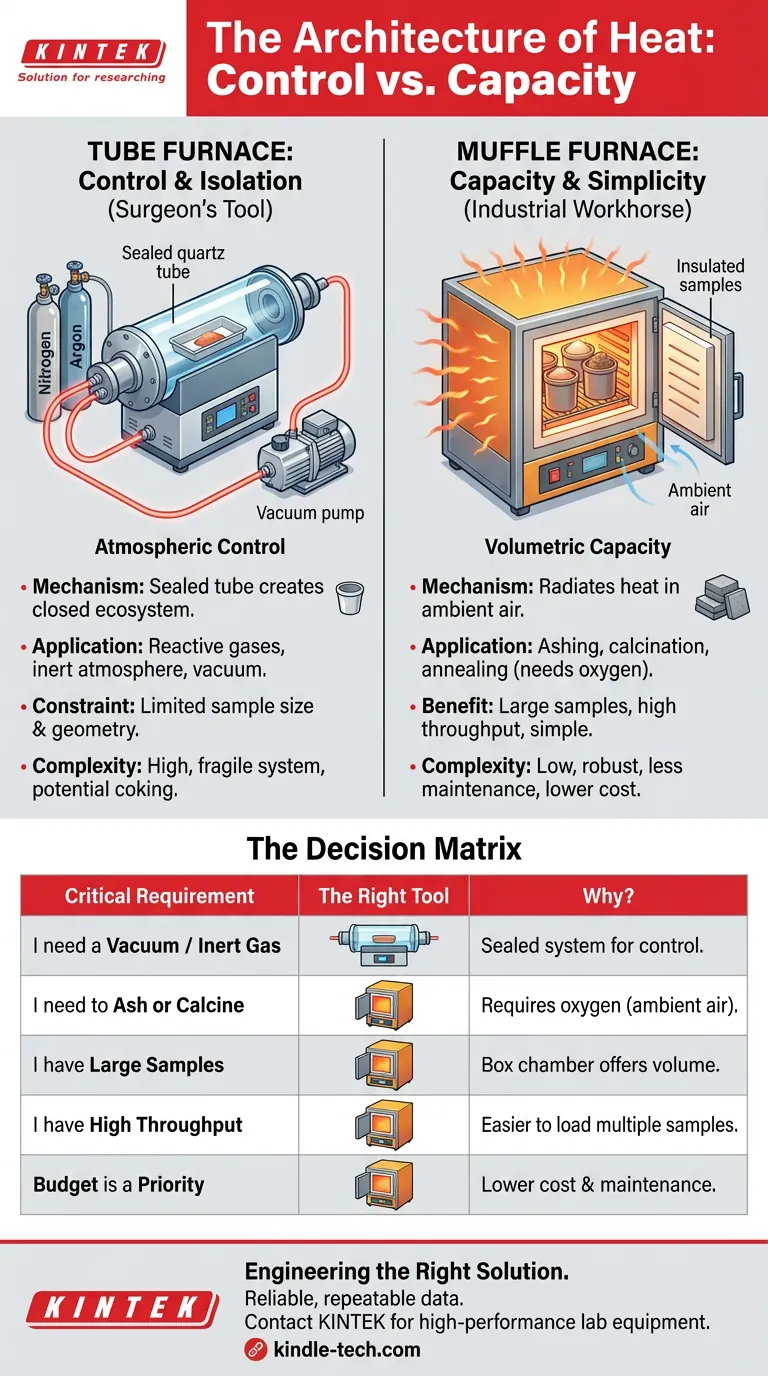
The Tube Furnace is a surgeon’s tool. It is designed for isolation. Its core function is to separate the sample from the chaotic chemistry of the outside world.
- The Mechanism: A sealed tube (quartz or alumina) creates a closed ecosystem.
- The Application: It is the only choice when you need to introduce reactive gases, maintain an inert atmosphere (like Nitrogen or Argon), or pull a vacuum.
The Muffle Furnace is an industrial workhorse. It is an insulated box designed to heat its contents in ambient air.
- The Mechanism: Heating elements radiate heat directly into the chamber.
- The Application: It excels at ashing, calcination, and annealing—processes where oxygen is either required or irrelevant.
The Geometry of Constraints
Every design choice carries a cost. For the tube furnace, the cost of atmospheric precision is physical geometry.
Because the system must be sealed and often pressurized, the sample area is restricted to the diameter of the tube. This creates a significant bottleneck:
- Sample Size: You are limited to small boats or crucibles.
- Throughput: Processing large batches is difficult or impossible.
- Geometry: Oddly shaped components simply won't fit.
Conversely, the muffle furnace prioritizes volume. Its box-shaped chamber allows for:
- Larger Samples: Accommodating bulky materials.
- High Throughput: Running multiple samples simultaneously.
- Simplicity: Loading and unloading is as simple as opening a door.
The Cost of Complexity
Complexity is attractive, but it is also fragile.
A tube furnace is a system of systems. It requires vacuum pumps, gas flow controllers, cooling flanges, and perfect seals. If one O-ring fails, the experiment fails.
Furthermore, the confined space of a tube furnace can be detrimental to certain chemistries. When cracking heavy raw materials, the lack of airflow can promote coking—the buildup of carbon residue. This not only ruins the sample but can permanently damage the tube and heating elements.
A muffle furnace, by contrast, is robust. It is essentially a high-precision heated box. It has fewer failure points, requires less maintenance, and costs significantly less to operate.
The Decision Matrix
To choose the right tool, you must ignore the specifications that might be cool to have, and focus on the specifications that are non-negotiable.
| Critical Requirement | The Right Tool | Why? |
|---|---|---|
| I need a Vacuum / Inert Gas | Tube Furnace | It is a sealed system designed for environmental control. |
| I need to Ash or Calcine | Muffle Furnace | These processes usually require oxygen (ambient air). |
| I have Large Samples | Muffle Furnace | The box chamber offers superior volume. |
| I have High Throughput | Muffle Furnace | Easier to stack and load multiple samples. |
| Budget is a Priority | Muffle Furnace | Lower initial cost and simpler maintenance. |
Engineering the Right Solution
At KINTEK, we believe that the best equipment is the kind you don't have to fight with.
Whether your research demands the pristine isolation of a vacuum tube furnace or the rugged capacity of a muffle furnace, the goal is the same: reliable, repeatable data.
We specialize in high-performance lab equipment designed to fit the specific nuances of your workflow. Don't let over-specification slow down your lab. Let us help you select the precise thermal architecture your materials require.
Visual Guide
Related Products
- Rotary Tube Furnace Split Multi Heating Zone Rotating Tube Furnace
- High Temperature Alumina (Al2O3) Furnace Tube for Engineering Advanced Fine Ceramics
- Laboratory Vacuum Tilt Rotary Tube Furnace Rotating Tube Furnace
- 1200℃ Split Tube Furnace with Quartz Tube Laboratory Tubular Furnace
- 1400℃ Laboratory High Temperature Tube Furnace with Alumina Tube
Related Articles
- The Geometry of Heat: Why Motion Matters in Material Synthesis
- Exploring the Advantages of Rotary Tube Furnaces in Industrial and Laboratory Applications
- The Geometry of Heat: Engineering the Perfect Thermal Environment
- The Physics of Perfection: How Rotary Furnaces Eliminate Randomness in Material Processing
- Exploring Rotary Tube Furnaces: A Comprehensive Guide



















