The Illusion of Simple Heat
In the laboratory, heat is rarely just about temperature. It is about control.
When a materials scientist approaches a thermal process, they aren't looking for a bonfire. They are looking for a specific environment where variables are constrained, and outcomes are predictable. The tube furnace is the vessel for this control.
But "tube furnace" is a broad label that hides a complex taxonomy of engineering decisions.
To the uninitiated, they all look like hot boxes. To the expert, the subtle differences in orientation, mechanical shell, and heating zones represent a map of distinct capabilities.
Choosing the right one is not about buying the most expensive model. It is about matching the architecture of the machine to the physics of your experiment.
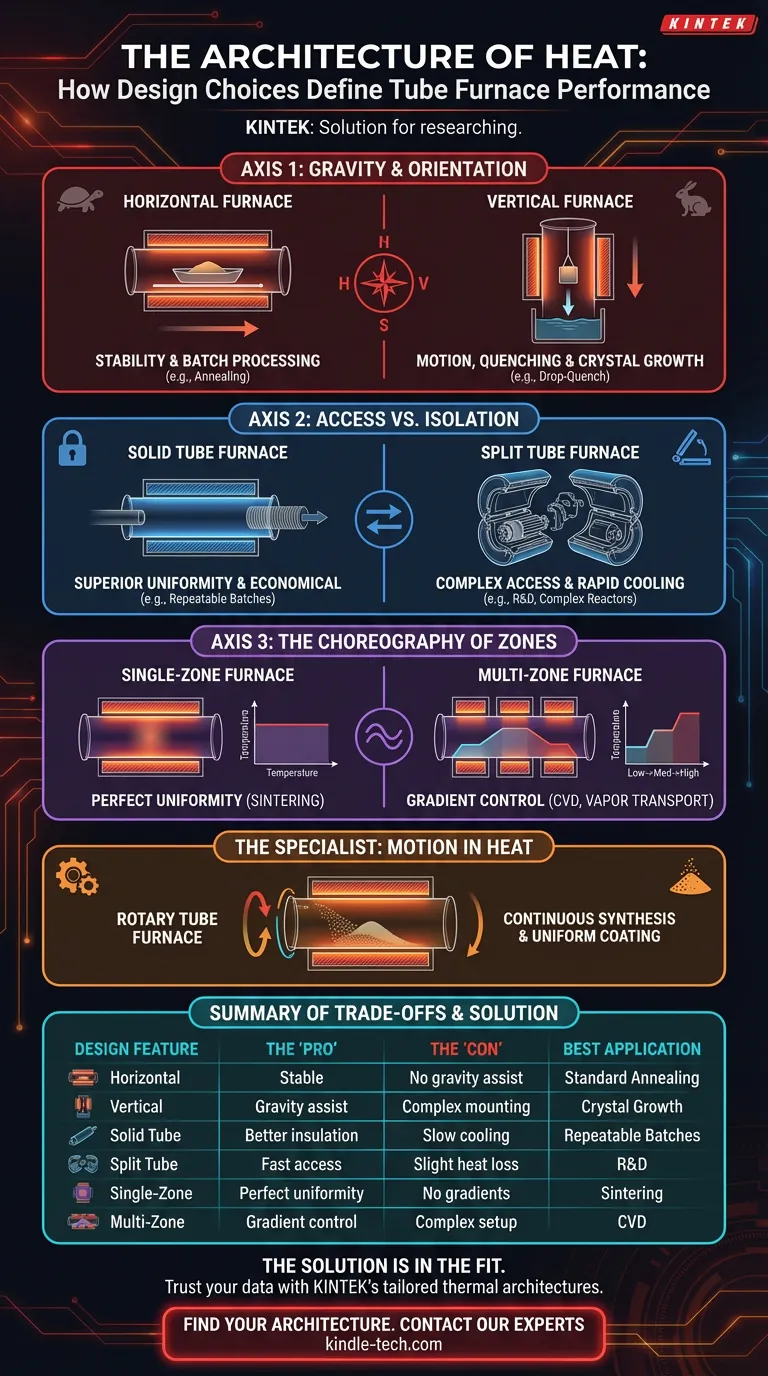
Axis 1: Gravity and Orientation
The first decision is fundamental: How does your sample interact with the earth?
Most thermal processes are static. For these, the Horizontal Furnace is the standard workhorse.
The logic here is stability. Samples rest in ceramic or metal boats, pushed into the center of the thermal envelope. It is simple, robust, and ideal for batch processing tasks like annealing or purification. If your material sits still and changes phase internally, this is the tool you need.
Vertical Furnaces introduce a different force: gravity.
These are not just horizontal furnaces tipped on their sides. They are engineered for motion and isolation.
- The Drop-Quench: In metallurgy, you often need to heat a sample and then instantly cool it. A vertical orientation allows you to hang the sample, heat it, and then drop it directly into a liquid bath below.
- Crystal Growth: For materials that become molten, contact with the tube walls can be catastrophic. Vertical suspension prevents this contact.
Axis 2: Access vs. Isolation
The second trade-off is between the speed of access and the stability of the environment.
Solid Tube Furnaces are built with a continuous insulation body. You must insert the process tube from the end, like threading a needle.
This design favors the "tortoise" approach. Because the insulation is uninterrupted, thermal uniformity is often superior. It is the economical choice for standardized, repeatable processes where the setup rarely changes.
Split Tube Furnaces favor the "hare."
These units are hinged, opening like a clamshell. This mechanical complexity offers two distinct advantages:
- Complex Geometry: If you are using a reactor with wide flanges or complex plumbing that cannot fit through a standard opening, the split furnace is your only option.
- Rapid Cooling: At the end of a cycle, you can open the furnace body to dump heat quickly.
The trade-off? A split furnace creates a seam. While modern insulation minimizes this, it introduces a potential point of heat loss that solid furnaces do not have.
Axis 3: The Choreography of Zones
Heat can be a blanket, or it can be a ladder.
Single-Zone Furnaces are designed to be a blanket. They use one controller to create a single, uniform hot zone in the center of the tube.
For sintering or calcination, this is exactly what you want. You want the entire sample to experience the same reality at the same time.
Multi-Zone Furnaces are for when the sample needs to go on a journey.
By using independent heating elements and controllers along the length of the tube, these furnaces create a temperature gradient.
Consider Chemical Vapor Deposition (CVD). This process is a choreography of gases. You need one temperature to vaporize a precursor at the inlet, and a different, precise temperature downstream to deposit the film onto a substrate. A single-zone furnace cannot perform this dance.
The Specialist: Motion in Heat
Sometimes, static heat is the enemy.
If you are processing powders, a static boat leaves the material in the center insulated by the material on the outside. The reaction is uneven.
The Rotary Tube Furnace is the solution. It is a horizontal furnace that slowly tumbles the process tube.
It ensures that every particle of powder is exposed to the atmosphere and the heat equally. It is a specialized tool for a specific problem: continuous synthesis and uniform coating.
Summary of Trade-offs
Engineering is the art of compromise. There is no "best" furnace, only the one that fits your constraints.
| Design Feature | The "Pro" | The "Con" | Best Application |
|---|---|---|---|
| Horizontal | Simple, robust loading | No gravity assistance | Standard Annealing |
| Vertical | Uses gravity (quenching) | More complex mounting | Crystal Growth |
| Solid Tube | Better insulation/cost | Slow cooling | Repeatable Batches |
| Split Tube | Fast cooling/access | Slight heat loss at seam | R&D, Complex Reactors |
| Single-Zone | Perfect uniformity | No gradients | Sintering |
| Multi-Zone | Gradient control | Complex setup | CVD, Vapor Transport |
The Solution is in the Fit
It is tempting to over-specify—to buy the multi-zone, split-tube vertical furnace "just in case."
But complexity introduces variables. The most elegant experiments often come from the simplest tools applied correctly.
If you need general heat treatment, the Single-Zone Solid Horizontal furnace is a masterpiece of efficiency. If you are pushing the boundaries of materials science with vapor deposition, the Multi-Zone Split furnace becomes non-negotiable.
At KINTEK, we do not just sell boxes that get hot. We build architectures of thermal control.
We understand that you are not just buying a furnace; you are buying the ability to trust your data. Whether you need the tumbling motion of a rotary unit or the precise gradients of a CVD setup, our engineers can help you navigate the trade-offs.
Ready to find the architecture that fits your research?
Visual Guide
Related Products
- Rotary Tube Furnace Split Multi Heating Zone Rotating Tube Furnace
- Laboratory Vacuum Tilt Rotary Tube Furnace Rotating Tube Furnace
- 1200℃ Split Tube Furnace with Quartz Tube Laboratory Tubular Furnace
- 1400℃ Laboratory High Temperature Tube Furnace with Alumina Tube
- 1700℃ Laboratory High Temperature Tube Furnace with Alumina Tube
Related Articles
- The Geometry of Heat: Why Motion Matters in Material Synthesis
- Exploring the Advantages of Rotary Tube Furnaces in Industrial and Laboratory Applications
- Exploring Rotary Tube Furnaces: A Comprehensive Guide
- Exploring the Benefits and Applications of Rotary Furnaces: A Comprehensive Guide
- The Physics of Perfection: How Rotary Furnaces Eliminate Randomness in Material Processing



















