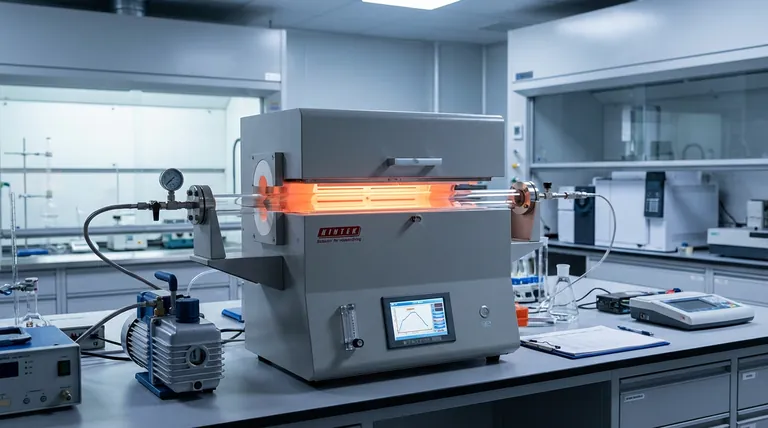
The greatest enemy in materials science is not a lack of imagination. It is noise.
In a laboratory context, noise isn’t sound. It is variables you didn't account for. It is the slight temperature drop near the door of a kiln. It is the microscopic trace of oxygen that ruins a sintering process.
Most heating equipment is designed to get hot. That is a brute force problem, and it is easily solved.
But a tube furnace solves a much more elegant, difficult problem: Isolation.
It creates a micro-cosmos where the rules of the outside world—fluctuating drafts, ambient contaminants, and thermal gradients—no longer apply. For the engineer and the scientist, this device is not just a heater. It is a shield.
The Geometry of Consistency
To understand the tube furnace, you have to appreciate the problem of the "corner."
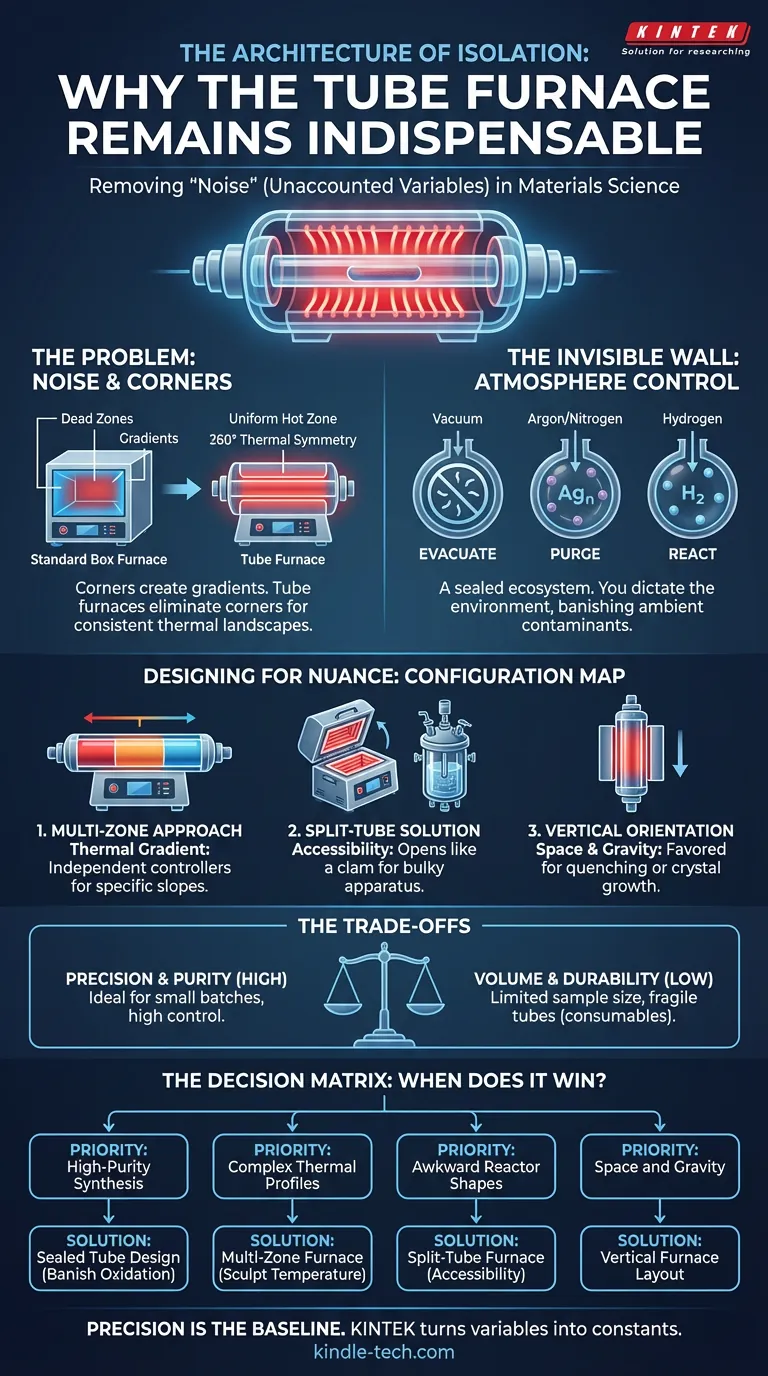
In a standard box furnace, corners are dead zones. They radiate heat differently than the center. They create gradients. If you are baking pottery, this is fine. If you are growing a crystal or annealing a semiconductor, a gradient is a failure.
The tube furnace abandons corners entirely.
By placing the sample inside a cylindrical tube (usually quartz or ceramic) and surrounding it 360 degrees with heating elements, we achieve a level of thermal symmetry that rectangular geometries struggle to match.
The result is a uniform hot zone. The sample is not being heated from the left or the right; it is being bathed in a consistent thermal landscape. This ensures that the material properties at one end of your sample match the properties at the other.
The Invisible Wall: Atmosphere Control
Heat causes molecules to move, but the atmosphere dictates how they react.
This is where the tube furnace distinguishes itself from every other heating solution. It is a sealed ecosystem.
Because the process tube typically has a small diameter and is fitted with vacuum-tight flanges at both ends, the operator becomes a god of that small universe. You can:
- Evacuate: Pull a vacuum to remove air and volatile contaminants.
- Purge: Flood the chamber with Argon or Nitrogen for inert processing.
- React: Introduce Hydrogen or other reactive gases to chemically alter the sample surface.
In a muffle furnace, you are often fighting the ambient air of the room. In a tube furnace, the ambient air doesn't exist.
Designing for Nuance: The Configuration Map
Not all isolation is created equal. Over time, engineers have adapted the basic tube design to solve specific logistical friction points in the lab.
1. The Multi-Zone Approach
Sometimes, you don't want a flat temperature. You want a specific, controlled slope.
Multi-zone furnaces utilize independent controllers along the length of the tube. This allows you to create a thermal gradient—hot at one end, cooler at the other. This is critical for vapor transport deposition or simulating how a material behaves as it moves through different thermal shocks.
2. The Split-Tube Solution
Physics is neat; hardware is messy.
Sometimes your reactor vessel has complex plumbing, wires, or flanges that are simply too large to slide through a narrow ceramic tube.
The split-tube furnace acknowledges this reality. It is hinged. It opens like a clam, allowing you to place your complex apparatus directly into the heating zone, then closes around it. It trades a small amount of thermal efficiency for a massive gain in usability.
3. The Vertical Orientation
Gravity is a variable. By turning the furnace vertical, you change how fluids and powders behave inside the tube. This footprint-saving design is often favored for quenching experiments or specific crystal growth techniques where gravity aids the process.
The Trade-Offs
In engineering, there are no solutions, only trade-offs. The tube furnace is a scalpel, not a sledgehammer.
To gain precision, you sacrifice volume. The restrictive diameter of the process tube means you cannot process bulk materials. You are limited to small batches.
To gain purity, you accept fragility. The tubes are consumables. Whether made of quartz or alumina, they are susceptible to thermal shock and breakage. They are the cost of doing business at high precision.
The Decision Matrix
When does the tube furnace win?
It wins when the cost of a failed experiment is higher than the cost of a specialized tool. It wins when "good enough" temperature control yields useless data.
| If your priority is... | The Solution is... |
|---|---|
| High-purity synthesis | A sealed tube design to banish oxidation. |
| Complex thermal profiles | A multi-zone furnace to sculpt the temperature. |
| Awkward reactor shapes | A split-tube furnace for accessibility. |
| Space and gravity | A vertical furnace layout. |
The Search for Reliability
Precision is not a luxury; it is the baseline requirement for valid scientific inquiry.
At KINTEK, we understand that a furnace is more than coils and insulation. It is a critical node in your research workflow. Whether you require the absolute atmosphere control of a quartz tube system or the flexibility of a split-zone configuration, our equipment is built to turn variables into constants.
If your work demands that you isolate your materials from the chaos of the outside world, we are here to help you build that environment.
Visual Guide
Related Products
- Rotary Tube Furnace Split Multi Heating Zone Rotating Tube Furnace
- Laboratory Vacuum Tilt Rotary Tube Furnace Rotating Tube Furnace
- 1200℃ Split Tube Furnace with Quartz Tube Laboratory Tubular Furnace
- 1400℃ Laboratory High Temperature Tube Furnace with Alumina Tube
- 1700℃ Laboratory High Temperature Tube Furnace with Alumina Tube
Related Articles
- The Geometry of Heat: Why Motion Matters in Material Synthesis
- Exploring Rotary Tube Furnaces: A Comprehensive Guide
- Exploring the Functions and Advantages of Rotary Tube Furnaces
- Exploring the Benefits and Applications of Rotary Furnaces: A Comprehensive Guide
- The Physics of Perfection: How Rotary Furnaces Eliminate Randomness in Material Processing



















