Blog The Art of Isolation: Why Advanced Material Science Demands the Tube Furnace
The Art of Isolation: Why Advanced Material Science Demands the Tube Furnace

The Art of Isolation: Why Advanced Material Science Demands the Tube Furnace

4 hours ago

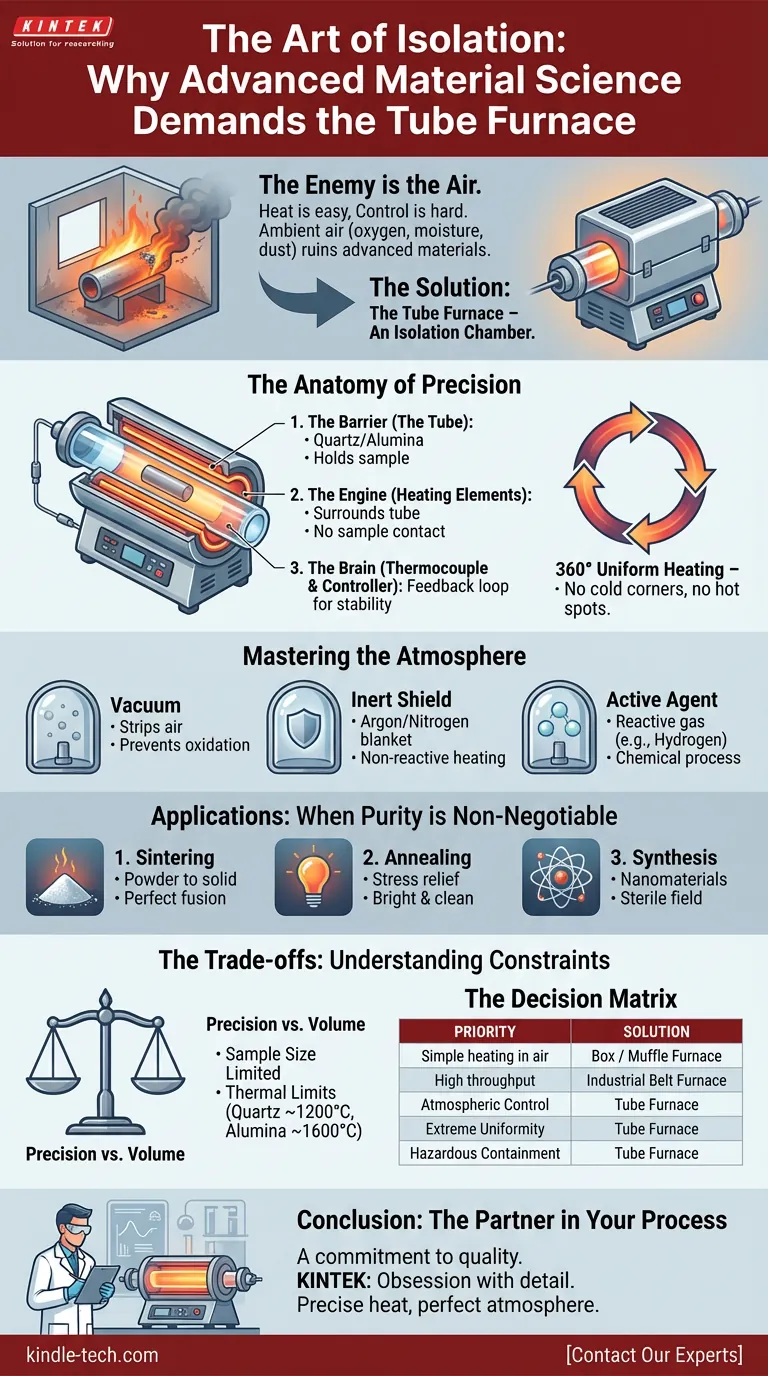
The Enemy is the Air

Heat is easy. Anyone with a match can create heat.

But control is hard.

In the world of advanced materials science, temperature is only half the battle. The other half is the environment. If you heat a piece of titanium to 800°C in an open room, you don't get a stronger metal. You get a useless pile of oxide.

The ambient air—filled with oxygen, moisture, and dust—is the enemy of purity.

This is the specific problem the tube furnace solves. It is not merely a high-temperature oven; it is an isolation chamber. It allows us to separate the chaotic outside world from the delicate sample inside.

Here is why that distinction matters, and how the engineering behind it works.

The Anatomy of Precision

A tube furnace is built around a philosophy of separation. Unlike a standard box furnace, where the heating elements and insulation are exposed to the same chamber as the sample, the tube furnace creates a divide.

It consists of three critical layers:

  1. The Barrier (The Tube): Typically made of quartz or alumina, this cylindrical vessel holds the sample. It is the only thing the sample touches.
  2. The Engine (The Heating Elements): Surrounding the tube, these coils deliver heat. Crucially, they never touch the sample or the atmosphere inside the tube.
  3. The Brain (The Thermocouple & Controller): A feedback loop that monitors temperature and adjusts power to maintain stability.

This design offers a distinct advantage: Uniformity.

Because the heating elements wrap around the cylinder, the sample is bathed in heat from all sides (360 degrees). There are no cold corners. There are no hot spots. Just a perfect, thermal equilibrium.

Mastering the Atmosphere

The true romance of the tube furnace lies in what happens inside the tube.

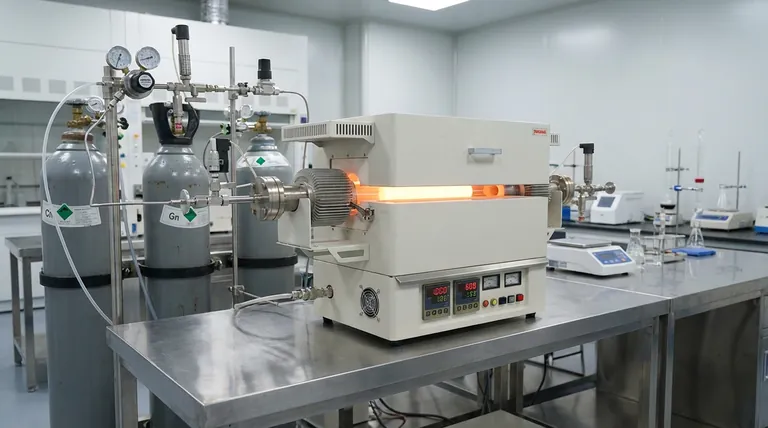
Once you seal the ends of the tube with flanges, you have created a microcosm where the laws of the ambient world no longer apply. You become the architect of the atmosphere.

This control allows for three distinct operating modes:

  • The Vacuum: By attaching a pump, you can strip away the air. In a vacuum, oxidation becomes impossible. Impurities vaporize and are pulled away. It is the cleanest environment possible.
  • The Inert Shield: You can flow gases like Argon or Nitrogen through the tube. This creates a protective blanket, allowing materials to be heated without reacting chemically.
  • The Active Agent: You can introduce reactive gases like Hydrogen. Here, the atmosphere becomes part of the recipe, actively stripping oxygen from metals (reduction) or adding surface layers (nitriding).

Applications: When Purity is Non-Negotiable

Why do we go to this trouble? Because modern technology demands materials that cannot exist in nature.

The tube furnace is the workhorse behind several critical processes:

1. Sintering

In powder metallurgy, we take metal dust and heat it until it fuses into a solid. If oxygen is present, the dust creates a ceramic shell and never bonds. The tube furnace ensures the particles fuse perfectly.

2. Annealing

Metals get stressed. Heating them allows their internal structure to relax. Doing this in a vacuum (bright annealing) ensures the metal comes out stronger and cleaner than when it went in.

3. Synthesis

Creating nanomaterials or growing crystals requires a "sterile field" of heat. A stray dust particle or a spike in oxygen levels can ruin a week's worth of growth.

The Trade-offs: Understanding Constraints

Every engineering decision involves a trade-off. The tube furnace gains precision, but it sacrifices volume.

  • Sample Size: You are limited by the diameter of the tube. This is a tool for research, prototyping, or small-batch high-value production. It is not for mass manufacturing large automotive parts.
  • Thermal Limits: The tube is the weak link. Quartz creates a beautiful, transparent window but fails around 1200°C. Alumina takes you to 1600°C+ but is brittle and sensitive to thermal shock.

You cannot force a tube furnace to be a blast furnace. You must respect its delicate nature.

The Decision Matrix

Should you invest in a tube furnace? It depends on what you value most.

If your priority is... Then the solution is...
Simple heating in air Box / Muffle Furnace
High throughput / Large parts Industrial Belt Furnace
Atmospheric Control (Vacuum/Gas) Tube Furnace
Extreme Temperature Uniformity Tube Furnace
Hazardous Material Containment Tube Furnace

Conclusion: The Partner in Your Process

The tube furnace represents a commitment to quality. It is an acknowledgment that the details matter—that the invisible molecules in the air can determine the success or failure of a physical product.

At KINTEK, we share that obsession with detail.

We don't just supply equipment; we supply the capability to explore the unknown. Whether you are annealing quantum computing components or sintering next-generation ceramics, our tube furnaces are designed to disappear into the background, leaving you with nothing but precise heat and a perfect atmosphere.

Do not let the environment dictate your results. Take control.

Contact Our Experts

Visual Guide

The Art of Isolation: Why Advanced Material Science Demands the Tube Furnace Visual Guide

Related Products

Related Articles

Related Products

Laboratory High Pressure Vacuum Tube Furnace

Laboratory High Pressure Vacuum Tube Furnace

KT-PTF High Pressure Tube Furnace: Compact split tube furnace with strong positive pressure resistance. Working temp up to 1100°C and pressure up to 15Mpa. Also works under controller atmosphere or high vacuum.

1700℃ Laboratory High Temperature Tube Furnace with Alumina Tube

1700℃ Laboratory High Temperature Tube Furnace with Alumina Tube

Looking for a high-temperature tube furnace? Check out our 1700℃ Tube Furnace with Alumina Tube. Perfect for research and industrial applications up to 1700C.

1700℃ Controlled Atmosphere Furnace Nitrogen Inert Atmosphere Furnace

1700℃ Controlled Atmosphere Furnace Nitrogen Inert Atmosphere Furnace

KT-17A Controlled atmosphere furnace: 1700℃ heating, vacuum sealing technology, PID temperature control, and versatile TFT smart touch screen controller for laboratory and industrial use.

Vacuum Heat Treat and Molybdenum Wire Sintering Furnace for Vacuum Sintering

Vacuum Heat Treat and Molybdenum Wire Sintering Furnace for Vacuum Sintering

A vacuum molybdenum wire sintering furnace is a vertical or bedroom structure, which is suitable for withdrawal, brazing, sintering and degassing of metal materials under high vacuum and high temperature conditions. It is also suitable for dehydroxylation treatment of quartz materials.

Laboratory Rapid Thermal Processing (RTP) Quartz Tube Furnace

Laboratory Rapid Thermal Processing (RTP) Quartz Tube Furnace

Get lightning-fast heating with our RTP Rapid Heating Tube Furnace. Designed for precise, high-speed heating and cooling with convenient sliding rail and TFT touch screen controller. Order now for ideal thermal processing!

1200℃ Controlled Atmosphere Furnace Nitrogen Inert Atmosphere Furnace

1200℃ Controlled Atmosphere Furnace Nitrogen Inert Atmosphere Furnace

Discover our KT-12A Pro Controlled atmosphere furnace - high precision, heavy duty vacuum chamber, versatile smart touch screen controller, and excellent temperature uniformity up to 1200C. Ideal for both laboratory and industrial application.

1200℃ Split Tube Furnace with Quartz Tube Laboratory Tubular Furnace

1200℃ Split Tube Furnace with Quartz Tube Laboratory Tubular Furnace

KT-TF12 split tube furnace: high-purity insulation, embedded heating wire coils, and max. 1200C. Widely used for new materials and chemical vapour deposition.

Vacuum Heat Treat and Sintering Furnace with 9MPa Air Pressure

Vacuum Heat Treat and Sintering Furnace with 9MPa Air Pressure

The air pressure sintering furnace is a high-tech equipment commonly used for the sintering of advanced ceramic materials. It combines vacuum sintering and pressure sintering techniques to achieve high-density and high-strength ceramics.

2200 ℃ Graphite Vacuum Heat Treat Furnace

2200 ℃ Graphite Vacuum Heat Treat Furnace

Discover the power of the KT-VG Graphite Vacuum Furnace - with a maximum working temperature of 2200℃, it's perfect for vacuum sintering of various materials. Learn more now.

1800℃ Muffle Oven Furnace for Laboratory

1800℃ Muffle Oven Furnace for Laboratory

KT-18 muffle furnace with Japan Al2O3 polycrystalline fibe and Silicon Molybdenum heating element, up to 1900℃, PID temperature control and 7" smart touch screen. Compact design, low heat loss, and high energy efficiency. Safety interlock system and versatile functions.

2200 ℃ Tungsten Vacuum Heat Treat and Sintering Furnace

2200 ℃ Tungsten Vacuum Heat Treat and Sintering Furnace

Experience the ultimate refractory metal furnace with our Tungsten vacuum furnace. Capable of reaching 2200℃, perfect for sintering advanced ceramics and refractory metals. Order now for high-quality results.

Molybdenum Vacuum Heat Treat Furnace

Molybdenum Vacuum Heat Treat Furnace

Discover the benefits of a high-configuration molybdenum vacuum furnace with heat shield insulation. Ideal for high-purity, vacuum environments like sapphire crystal growth and heat treatment.

1700℃ Muffle Oven Furnace for Laboratory

1700℃ Muffle Oven Furnace for Laboratory

Get superior heat control with our 1700℃ Muffle Furnace. Equipped with intelligent temperature microprocessor, TFT touch screen controller & advanced insulation materials for precise heating up to 1700C. Order now!

1400℃ Muffle Oven Furnace for Laboratory

1400℃ Muffle Oven Furnace for Laboratory

Get precise high-temperature control up to 1500℃ with KT-14M Muffle furnace. Equipped with a smart touch screen controller and advanced insulation materials.

Horizontal High Temperature Graphite Vacuum Graphitization Furnace

Horizontal High Temperature Graphite Vacuum Graphitization Furnace

Horizontal Graphitization Furnace: This type of furnace is designed with the heating elements placed horizontally, allowing for uniform heating of the sample. It's well-suited for graphitizing large or bulky samples that require precise temperature control and uniformity.

Vertical High Temperature Graphite Vacuum Graphitization Furnace

Vertical High Temperature Graphite Vacuum Graphitization Furnace

Vertical high temperature graphitization furnace for carbonization and graphitization of carbon materials up to 3100℃.Suitable for shaped graphitization of carbon fiber filaments and other materials sintered in a carbon environment.Applications in metallurgy, electronics, and aerospace for producing high-quality graphite products like electrodes and crucibles.

Controlled Nitrogen Inert Hydrogen Atmosphere Furnace

Controlled Nitrogen Inert Hydrogen Atmosphere Furnace

KT-AH Hydrogen atmosphere furnace - induction gas furnace for sintering/annealing with built-in safety features, dual housing design, and energy-saving efficiency. Ideal for lab and industrial use.

Laboratory Vacuum Tilt Rotary Tube Furnace Rotating Tube Furnace

Laboratory Vacuum Tilt Rotary Tube Furnace Rotating Tube Furnace

Discover the versatility of Laboratory Rotary Furnace: Ideal for calcination, drying, sintering, and high-temperature reactions. Adjustable rotating and tilting functions for optimal heating. Suitable for vacuum and controlled atmosphere environments. Learn more now!

Vacuum Heat Treat Sintering Brazing Furnace

Vacuum Heat Treat Sintering Brazing Furnace

A vacuum brazing furnace is a type of industrial furnace used for brazing, a metalworking process that joins two pieces of metal using a filler metal that melts at a lower temperature than the base metals. Vacuum brazing furnaces are typically used for high-quality applications where a strong, clean joint is required.

Vacuum Heat Treat Furnace with Ceramic Fiber Liner

Vacuum Heat Treat Furnace with Ceramic Fiber Liner

Vacuum furnace with polycrystalline ceramic fiber insulation liner for excellent heat insulation and uniform temperature field. Choose from 1200℃ or 1700℃ max. working temperature with high vacuum performance and precise temperature control.


Leave Your Message