Blog The Art of the Void: Engineering Perfection in a Vacuum
The Art of the Void: Engineering Perfection in a Vacuum

The Art of the Void: Engineering Perfection in a Vacuum

4 hours ago

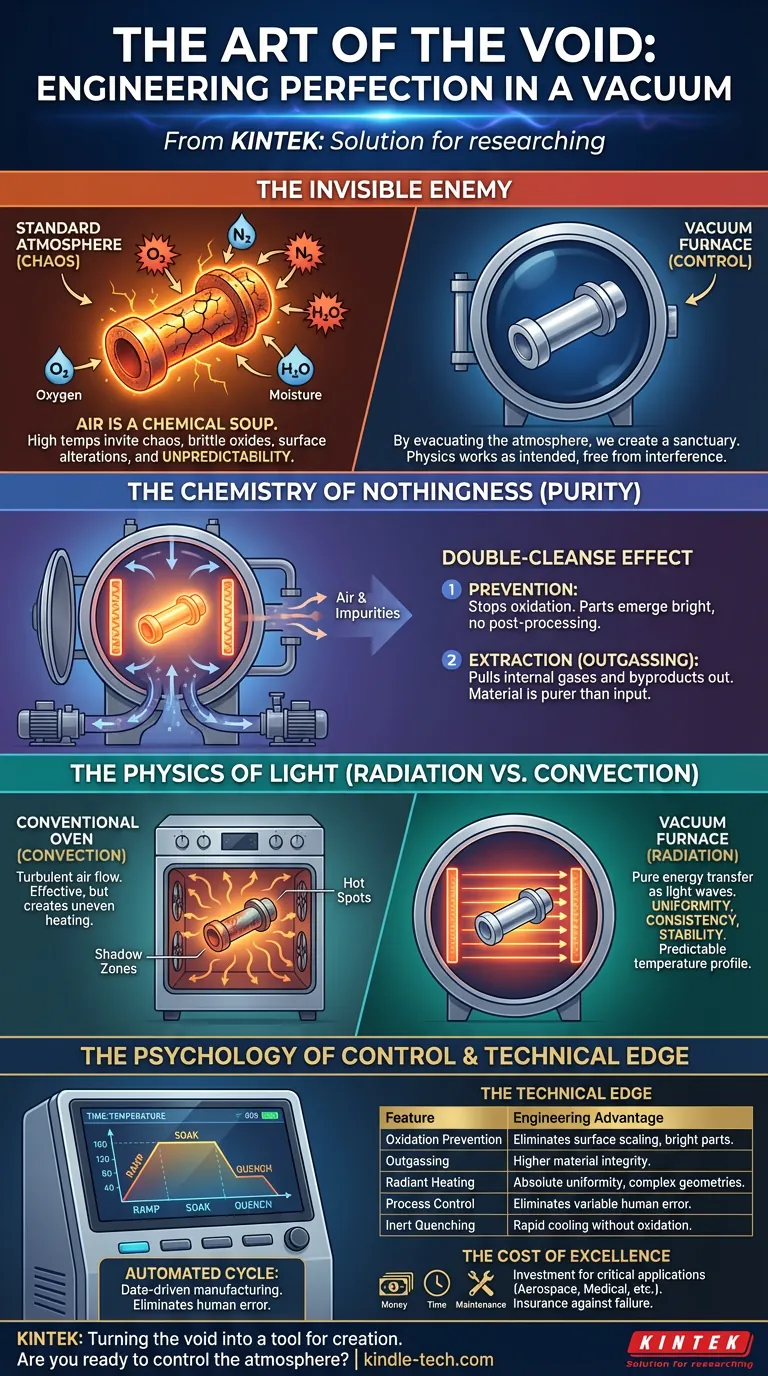
The Invisible Enemy

In the world of material science, air is not a neutral medium. It is a chemical soup.

When you heat a metal in a standard atmosphere, you are inviting chaos into the process. Oxygen, nitrogen, and moisture are aggressive actors. At high temperatures, they don't just surround the material; they attack it. They form brittle oxides. They alter surface chemistry. They introduce the one thing an engineer fears most: unpredictability.

To achieve perfection, you must first remove the variables.

This is the philosophy behind the vacuum furnace. It is not merely a tool for making things hot. It is a mechanism for control. By evacuating the atmosphere, we create a sanctuary where physics works exactly as we intend, free from the interference of nature.

The Chemistry of Nothingness

The primary argument for using a vacuum furnace is simple: Purity.

In a standard oven, heat acts as a catalyst for oxidation. The hotter the part gets, the faster a layer of scale forms on its surface. For a simple bracket, this might be acceptable. For a medical implant or an aerospace component, it is catastrophic.

A vacuum furnace creates a chemically inert environment by physically removing the air.

The Double-Cleanse Effect

The vacuum process works on two levels:

  1. Prevention: It stops oxygen from reaching the surface, ensuring the part emerges bright and clean, with no need for post-processing acid baths or scrubbing.
  2. Extraction: It actively pulls impurities out of the material. This is known as "outgassing." As the material heats up, trapped internal gases and manufacturing byproducts vaporize. The vacuum pumps immediately sweep these contaminants away.

The result is a material that is often purer than when it entered the chamber.

The Physics of Light: Radiation vs. Convection

How do you heat something when there is no air to carry the heat?

In a conventional oven, fans blow hot air over the part. This is convection. It is effective, but it is turbulent. It creates hot spots and shadow zones.

In a vacuum, convection is impossible. Instead, heat travels via radiation.

This is the engineer's romance: heat transferring as pure energy, light waves traveling from the heating elements directly to the workpiece. This physics dictates a superior outcome:

  • Uniformity: Radiation heats the entire zone evenly.
  • Consistency: There are no drafts or currents to cool edges prematurely.
  • Stability: The temperature profile becomes predictable, critical for minimizing warping in complex geometries.

The Psychology of Control

Reliability is the absence of surprise.

In high-stakes laboratory and industrial settings, "good enough" is indistinguishable from failure. You need a process that produces the exact same result on the 100th run as it did on the first.

Modern vacuum furnaces, like the systems engineered by KINTEK, substitute human intuition for computer-driven precision.

The Automated Cycle

The operator does not guess. They program a cycle. The system manages:

  • Ramp rates: How fast the temperature rises.
  • Soak times: How long the temperature holds.
  • Quenching: The rapid backfilling of inert gas (like argon or nitrogen) to cool parts instantly, locking in specific metallurgical hardness.

This is data-driven manufacturing. It turns heat treatment from an art form into a repeatable science.

The Cost of Excellence

We must be objective. Perfection has a price tag.

If you are annealing a cast iron fence post, a vacuum furnace is financial overkill. The technology requires investment.

The Constraints:

  • Capital Cost: High-vacuum pumps and sealed chambers are complex engineering feats, making them more expensive than atmospheric ovens.
  • Time: You cannot just open the door and throw a part in. You must wait for the chamber to pump down to a vacuum state.
  • Maintenance: Seals must be tight. Pumps must be oiled. The system demands respect and care.

However, for critical applications, these are not costs; they are insurance premiums against failure.

Summary: The Technical Edge

For those deciding between atmospheric and vacuum processing, here is the breakdown of value:

Feature The Engineering Advantage
Oxidation Prevention Eliminates surface scaling; parts emerge bright and clean.
Outgassing Actively removes internal impurities for higher material integrity.
Radiant Heating Ensures absolute temperature uniformity across complex geometries.
Process Control Computerized cycles eliminate variable human error.
Inert Quenching Allows for rapid cooling without oxidation risks.

Conclusion

The vacuum furnace is a testament to the idea that sometimes, the best way to solve a problem is to remove everything else. By eliminating the atmosphere, we eliminate the error.

At KINTEK, we understand that for our clients—whether in aerospace, medical research, or advanced materials—the environment determines the outcome. Our vacuum furnaces are built to provide the ultimate control, turning the void into a tool for creation.

Are you ready to stop fighting the atmosphere and start controlling it?

Contact our experts today to discuss how KINTEK can bring precision to your laboratory.

Visual Guide
The Art of the Void: Engineering Perfection in a Vacuum Visual Guide

Related Products

Related Articles

Related Products

Laboratory Vacuum Tilt Rotary Tube Furnace Rotating Tube Furnace

Laboratory Vacuum Tilt Rotary Tube Furnace Rotating Tube Furnace

Discover the versatility of Laboratory Rotary Furnace: Ideal for calcination, drying, sintering, and high-temperature reactions. Adjustable rotating and tilting functions for optimal heating. Suitable for vacuum and controlled atmosphere environments. Learn more now!

Laboratory High Pressure Vacuum Tube Furnace

Laboratory High Pressure Vacuum Tube Furnace

KT-PTF High Pressure Tube Furnace: Compact split tube furnace with strong positive pressure resistance. Working temp up to 1100°C and pressure up to 15Mpa. Also works under controller atmosphere or high vacuum.

Molybdenum Vacuum Heat Treat Furnace

Molybdenum Vacuum Heat Treat Furnace

Discover the benefits of a high-configuration molybdenum vacuum furnace with heat shield insulation. Ideal for high-purity, vacuum environments like sapphire crystal growth and heat treatment.

Vacuum Heat Treat Sintering Brazing Furnace

Vacuum Heat Treat Sintering Brazing Furnace

A vacuum brazing furnace is a type of industrial furnace used for brazing, a metalworking process that joins two pieces of metal using a filler metal that melts at a lower temperature than the base metals. Vacuum brazing furnaces are typically used for high-quality applications where a strong, clean joint is required.

Vacuum Heat Treat and Molybdenum Wire Sintering Furnace for Vacuum Sintering

Vacuum Heat Treat and Molybdenum Wire Sintering Furnace for Vacuum Sintering

A vacuum molybdenum wire sintering furnace is a vertical or bedroom structure, which is suitable for withdrawal, brazing, sintering and degassing of metal materials under high vacuum and high temperature conditions. It is also suitable for dehydroxylation treatment of quartz materials.

Ultra-High Temperature Graphite Vacuum Graphitization Furnace

Ultra-High Temperature Graphite Vacuum Graphitization Furnace

The ultra-high temperature graphitization furnace utilizes medium frequency induction heating in a vacuum or inert gas environment. The induction coil generates an alternating magnetic field, inducing eddy currents in the graphite crucible, which heats up and radiates heat to the workpiece, bringing it to the desired temperature. This furnace is primarily used for graphitization and sintering of carbon materials, carbon fiber materials, and other composite materials.

Vacuum Dental Porcelain Sintering Furnace

Vacuum Dental Porcelain Sintering Furnace

Get precise and reliable results with KinTek's Vacuum Porcelain Furnace. Suitable for all porcelain powders, it features hyperbolic ceramic furnace function, voice prompt, and automatic temperature calibration.

Horizontal High Temperature Graphite Vacuum Graphitization Furnace

Horizontal High Temperature Graphite Vacuum Graphitization Furnace

Horizontal Graphitization Furnace: This type of furnace is designed with the heating elements placed horizontally, allowing for uniform heating of the sample. It's well-suited for graphitizing large or bulky samples that require precise temperature control and uniformity.

Vacuum Hot Press Furnace Heated Vacuum Press Machine Tube Furnace

Vacuum Hot Press Furnace Heated Vacuum Press Machine Tube Furnace

Reduce forming pressure & shorten sintering time with Vacuum Tube Hot Press Furnace for high-density, fine-grain materials. Ideal for refractory metals.

1200℃ Controlled Atmosphere Furnace Nitrogen Inert Atmosphere Furnace

1200℃ Controlled Atmosphere Furnace Nitrogen Inert Atmosphere Furnace

Discover our KT-12A Pro Controlled atmosphere furnace - high precision, heavy duty vacuum chamber, versatile smart touch screen controller, and excellent temperature uniformity up to 1200C. Ideal for both laboratory and industrial application.

2200 ℃ Tungsten Vacuum Heat Treat and Sintering Furnace

2200 ℃ Tungsten Vacuum Heat Treat and Sintering Furnace

Experience the ultimate refractory metal furnace with our Tungsten vacuum furnace. Capable of reaching 2200℃, perfect for sintering advanced ceramics and refractory metals. Order now for high-quality results.

Laboratory Rapid Thermal Processing (RTP) Quartz Tube Furnace

Laboratory Rapid Thermal Processing (RTP) Quartz Tube Furnace

Get lightning-fast heating with our RTP Rapid Heating Tube Furnace. Designed for precise, high-speed heating and cooling with convenient sliding rail and TFT touch screen controller. Order now for ideal thermal processing!

600T Vacuum Induction Hot Press Furnace for Heat Treat and Sintering

600T Vacuum Induction Hot Press Furnace for Heat Treat and Sintering

Discover the 600T Vacuum Induction Hot Press Furnace, designed for high-temperature sintering experiments in vacuum or protected atmospheres. Its precise temperature and pressure control, adjustable working pressure, and advanced safety features make it ideal for nonmetal materials, carbon composites, ceramics, and metal powders.

Graphite Vacuum Furnace IGBT Experimental Graphitization Furnace

Graphite Vacuum Furnace IGBT Experimental Graphitization Furnace

IGBT experimental graphitization furnace, a tailored solution for universities and research institutions, with high heating efficiency, user-friendliness, and precise temperature control.

1400℃ Laboratory High Temperature Tube Furnace with Alumina Tube

1400℃ Laboratory High Temperature Tube Furnace with Alumina Tube

Looking for a tube furnace for high-temperature applications? Our 1400℃ Tube Furnace with Alumina Tube is perfect for research and industrial use.

Vacuum Heat Treat and Sintering Furnace with 9MPa Air Pressure

Vacuum Heat Treat and Sintering Furnace with 9MPa Air Pressure

The air pressure sintering furnace is a high-tech equipment commonly used for the sintering of advanced ceramic materials. It combines vacuum sintering and pressure sintering techniques to achieve high-density and high-strength ceramics.

1200℃ Split Tube Furnace with Quartz Tube Laboratory Tubular Furnace

1200℃ Split Tube Furnace with Quartz Tube Laboratory Tubular Furnace

KT-TF12 split tube furnace: high-purity insulation, embedded heating wire coils, and max. 1200C. Widely used for new materials and chemical vapour deposition.

1700℃ Laboratory High Temperature Tube Furnace with Alumina Tube

1700℃ Laboratory High Temperature Tube Furnace with Alumina Tube

Looking for a high-temperature tube furnace? Check out our 1700℃ Tube Furnace with Alumina Tube. Perfect for research and industrial applications up to 1700C.

1700℃ Controlled Atmosphere Furnace Nitrogen Inert Atmosphere Furnace

1700℃ Controlled Atmosphere Furnace Nitrogen Inert Atmosphere Furnace

KT-17A Controlled atmosphere furnace: 1700℃ heating, vacuum sealing technology, PID temperature control, and versatile TFT smart touch screen controller for laboratory and industrial use.

1800℃ Muffle Oven Furnace for Laboratory

1800℃ Muffle Oven Furnace for Laboratory

KT-18 muffle furnace with Japan Al2O3 polycrystalline fibe and Silicon Molybdenum heating element, up to 1900℃, PID temperature control and 7" smart touch screen. Compact design, low heat loss, and high energy efficiency. Safety interlock system and versatile functions.


Leave Your Message