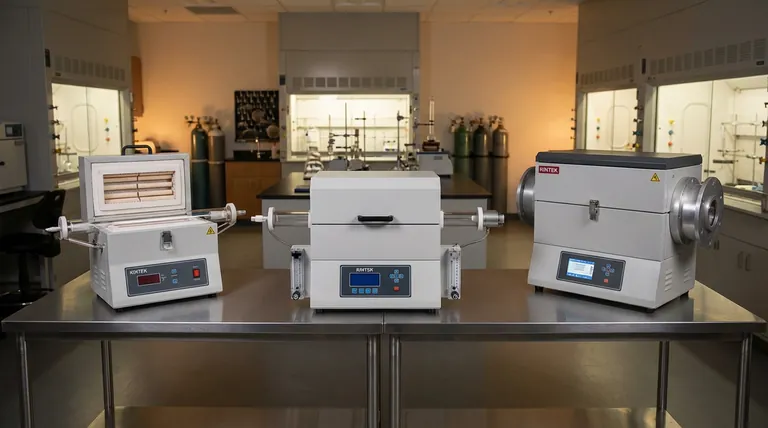
The Allure of the Highest Number
In any complex purchase, we are drawn to the biggest, fastest, or most powerful option. It’s a cognitive shortcut. We see a furnace rated to 1700°C and instinctively feel it's "better" than one rated to 1200°C, even if our process never exceeds 1100°C.
This is the classic mistake in selecting scientific instrumentation. The goal is not to acquire the most capable machine on the market, but the most aligned one.
A tube furnace is more than a heater; it is a self-contained universe where you dictate the fundamental conditions for creating new materials. Choosing one requires a first-principles approach, breaking the decision down into four non-negotiable questions about your specific process.
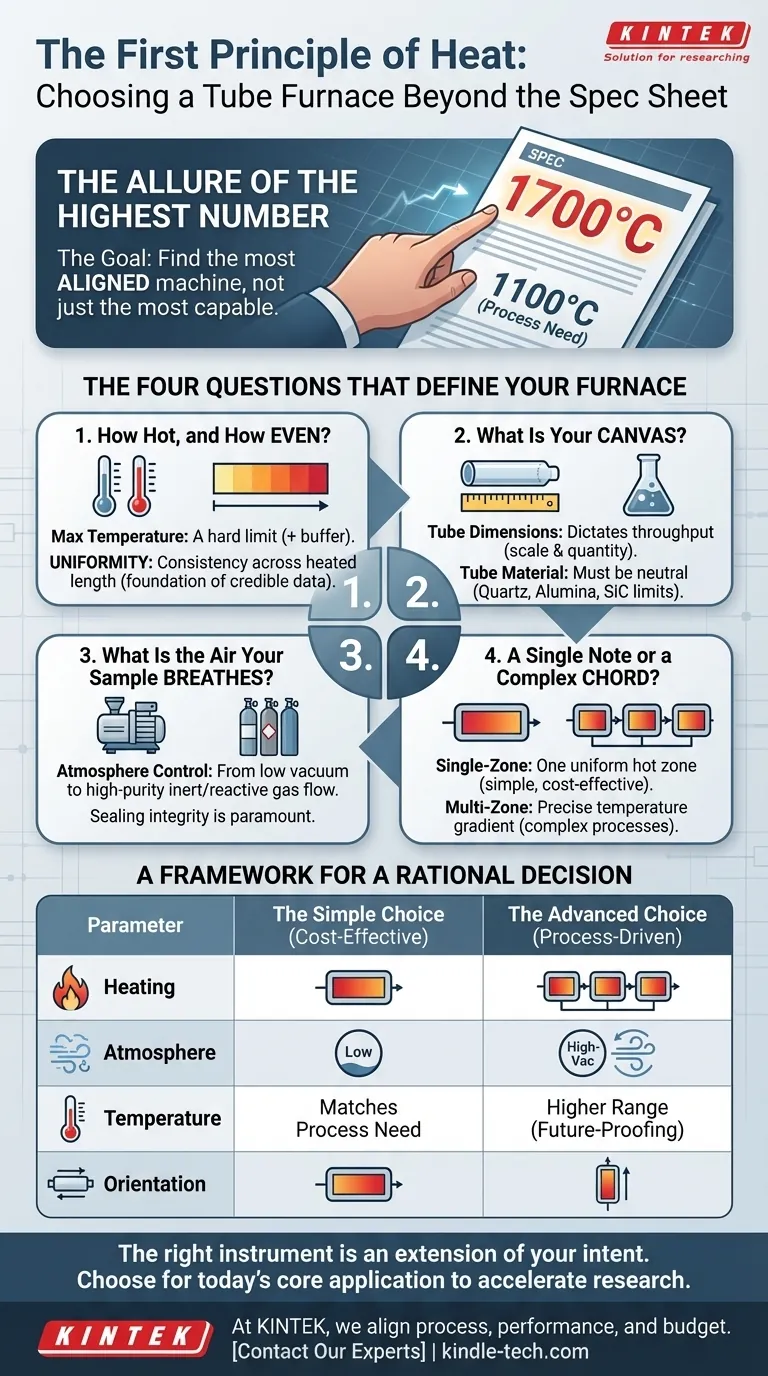
The Four Questions That Define Your Furnace
Every heat treatment, synthesis, or annealing process is defined by a unique recipe of conditions. Your furnace is the instrument that executes this recipe. To choose the right one, you must answer these four questions first.
1. How Hot, and How Even?
The maximum temperature is the headline specification, but for a scientist, uniformity is often the more important story.
- Maximum Temperature: This is determined by the heating elements. It's a hard limit you cannot cross. Define the absolute highest temperature your process requires and add a small buffer.
- Temperature Uniformity: This is the consistency of temperature across the heated length of the tube. Poor uniformity means one end of your sample is living in a different thermal reality than the other. For repeatable results in crystallization or sintering, a uniform hot zone isn't a luxury; it's the foundation of credible data.
Chasing a higher maximum temperature than you need often means compromising on budget or other features, while ignoring uniformity can invalidate your entire experiment.
2. What Is Your Canvas?
The process tube is not just a container; it is the stage for your reaction. Its dimensions and material dictate the scale and chemistry of your work.
- Tube Dimensions (Diameter & Length): These parameters directly define your throughput. How large is your sample? How many samples do you need to process per run? This simple calculation will guide you to the required tube size.
- Tube Material: The tube must be a neutral party in your experiment. It must withstand your target temperature and chemical atmosphere without cracking, melting, or reacting. Quartz, alumina, and silicon carbide each have different thermal and chemical limits. The tube material is an active choice, not an afterthought.
3. What Is the Air Your Sample Breathes?
Many of modern science's most exciting materials cannot be born in ambient air. The atmosphere inside the tube is often a critical reactant or a necessary void.
Atmosphere control can range from a simple low vacuum to purge oxygen, to a high vacuum for ultra-pure environments, or the precise introduction of an inert (Argon) or reactive (Hydrogen) gas.
The integrity of your furnace's seals and the capability of its vacuum and gas delivery systems are paramount. An imperceptible leak can be the silent variable that ruins a month's work.
4. A Single Note or a Complex Chord?
Finally, consider how you need to apply heat. Do you need a single, stable temperature, or a carefully orchestrated thermal landscape?
- Single-Zone Furnace: This is the workhorse for creating one uniform hot zone. It's simpler, more cost-effective, and perfect for the vast majority of annealing, tempering, and sintering applications. It plays one, perfect note.
- Multi-Zone Furnace: With independent controllers for (typically) three or more zones, this furnace allows you to create a precise temperature gradient. This is essential for advanced processes like chemical vapor deposition (CVD) or directional crystal growth, where you are not just heating a sample but guiding a physical transformation along a path. It plays a complex chord.
A Framework for a Rational Decision
Choosing a furnace is a series of trade-offs. Resisting the urge to over-specify for a future you can't predict is key to making a sound investment.
| Parameter | The Simple Choice (Cost-Effective) | The Advanced Choice (Process-Driven) |
|---|---|---|
| Heating | Single-Zone (Uniformity) | Multi-Zone (Gradients) |
| Atmosphere | Low Vacuum / Gas Flow | High-Vacuum / Mass Flow Control |
| Temperature | Matches Process Need (e.g., 1200°C) | Higher Range for Future-Proofing (e.g., 1700°C) |
| Orientation | Horizontal (Easy Loading) | Vertical (Saves Space, Specific Processes) |
The right instrument is an extension of your intent. It should solve the problems you have today, not the ones you imagine for tomorrow. A clear-eyed assessment of your core application—be it routine sintering or complex materials growth—is the only path to selecting a tool that will accelerate, not complicate, your research.
At KINTEK, we understand that this is more than just an equipment purchase; it's a critical decision for the future of your lab. We specialize in helping researchers navigate these specifications to find the perfect alignment between process, performance, and budget. Contact Our Experts
Visual Guide
Related Products
- Rotary Tube Furnace Split Multi Heating Zone Rotating Tube Furnace
- Laboratory Vacuum Tilt Rotary Tube Furnace Rotating Tube Furnace
- 1200℃ Split Tube Furnace with Quartz Tube Laboratory Tubular Furnace
- 1400℃ Laboratory High Temperature Tube Furnace with Alumina Tube
- 1700℃ Laboratory High Temperature Tube Furnace with Alumina Tube
Related Articles
- The Geometry of Heat: Why Motion Matters in Material Synthesis
- Exploring the Advantages of Rotary Tube Furnaces in Industrial and Laboratory Applications
- Exploring Rotary Tube Furnaces: A Comprehensive Guide
- Exploring the Benefits and Applications of Rotary Furnaces: A Comprehensive Guide
- The Physics of Perfection: How Rotary Furnaces Eliminate Randomness in Material Processing



















