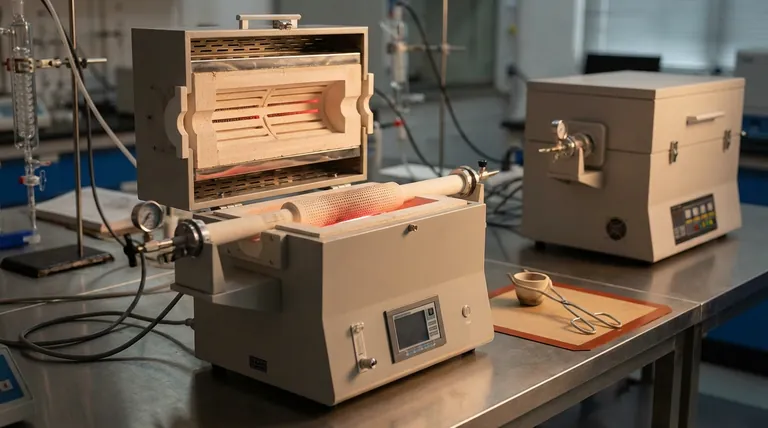
The Illusion of Invincibility
A tube furnace feels like a monument of industrial strength. It masters temperatures that can melt steel and forge new materials. We see its robust exterior and assume the interior is equally resilient.
This is a dangerous psychological trap.
Inside its insulated shell lies a delicate ecosystem of brittle ceramics and sensitive heating elements. Treating it like a simple oven is the fastest path to catastrophic failure, compromised experiments, and costly repairs. True mastery of high-temperature processes begins with understanding this paradox: the immense power of the furnace is entirely dependent on its internal fragility.
Anatomy of a Failure
Before we clean, we must understand what we are trying to protect. The risks are not theoretical; they are baked into the physics of the materials.
The Brittle Heart of the Machine
The core components—heating elements like silicon carbide rods and the furnace tube itself—are often made of refractory ceramics. These materials are champions of heat resistance but are mechanically brittle, much like glass.
A sharp tap with a hard tool or an accidental drop of a crucible isn't a minor incident. It can create micro-fractures that propagate with each thermal cycle, leading to sudden, complete failure weeks later.
The Memory of Heat
Materials have a kind of memory. When a furnace is hot, its components are in an expanded, high-energy state. Introducing a room-temperature object or even a blast of cool air is not just cleaning; it's an assault.
This rapid temperature change creates thermal shock, a violent contraction that the brittle ceramic cannot withstand. The result is cracking and shattering. Patience during the cooldown phase isn't just a safety recommendation; it is a fundamental law of thermal dynamics that cannot be ignored.
The Hidden Contaminant
It’s tempting to use a damp cloth to wipe away residue. But introducing moisture inside the furnace chamber is a critical error.
The porous insulation will absorb the water. During the next heating cycle, that trapped water turns to high-pressure steam, which can physically damage the insulation and introduce unwanted atmospheric variables into your carefully controlled process.
A Protocol for Precision
Effective maintenance is not a chore; it is a deliberate ritual that preserves the integrity of your instrument and your research. It is a system of care.
Principle 1: Respect the Cooldown
The first step is always to wait. The furnace must return to ambient temperature—fully and completely.
Once cool, the absolute non-negotiable next action is to disconnect it from its power source. This removes the twin risks of electric shock and accidental startup. This period of quiet patience is the most important part of the entire process.
Principle 2: The Gentle Touch
The goal is to remove process residue, not to scour the furnace. Aggression is the enemy.
- Use a soft-bristled brush. Gently loosen any particulate matter from the inner walls of the furnace tube.
- Follow with a vacuum cleaner. A narrow attachment allows you to extract the loose debris without making physical contact with the heating elements.
Never use compressed air. It can drive fine particles into the insulation or damage delicate thermocouple wiring. The gentle vacuum method is both more effective and infinitely safer.
Principle 3: The Diagnostic Eye
Cleaning is an opportunity for inspection. Look closely at the furnace tube and heating elements.
Small, hairline cracks in refractory ceramics can be normal signs of aging from thousands of expansion and contraction cycles. However, deeper cracks, spalling, or visible erosion are early warnings of impending failure. Documenting these changes allows you to plan for replacements, not react to disasters.
The Prophylactic Mindset
The best maintenance strategy is to minimize the need for cleaning in the first place. This requires shifting your focus from reactive cleaning to proactive process control.
| Maintenance Focus | Key Action | Rationale |
|---|---|---|
| Routine Upkeep | Perform gentle brush & vacuum after complete cooldown. | Prevents significant residue buildup over time. |
| Maximizing Lifespan | Adhere to ramp rates (e.g., <10°C/min); handle components gently. | Prevents thermal shock and mechanical damage from the start. |
| Operator Safety | Always ensure complete cooldown and power disconnection first. | Eliminates the primary risks of burns and electric shock. |
By controlling heating and cooling rates, you prevent materials from spattering onto the furnace walls. By managing the process atmosphere to exclude water vapor, you protect components from corrosion. By treating the furnace door with care—and never lifting the unit by it—you preserve its mechanical integrity.
A well-maintained tube furnace is more than just a piece of equipment; it's a reliable partner in discovery. The consistency of your results depends directly on the consistency of your maintenance. High-quality equipment, like the furnaces and consumables provided by KINTEK, forms the foundation of excellent research, but it's the meticulous care protocol that unlocks its true potential for repeatable, trustworthy science.
To ensure your lab's equipment operates with the precision and safety it was designed for, establishing the right maintenance culture is key. Contact Our Experts
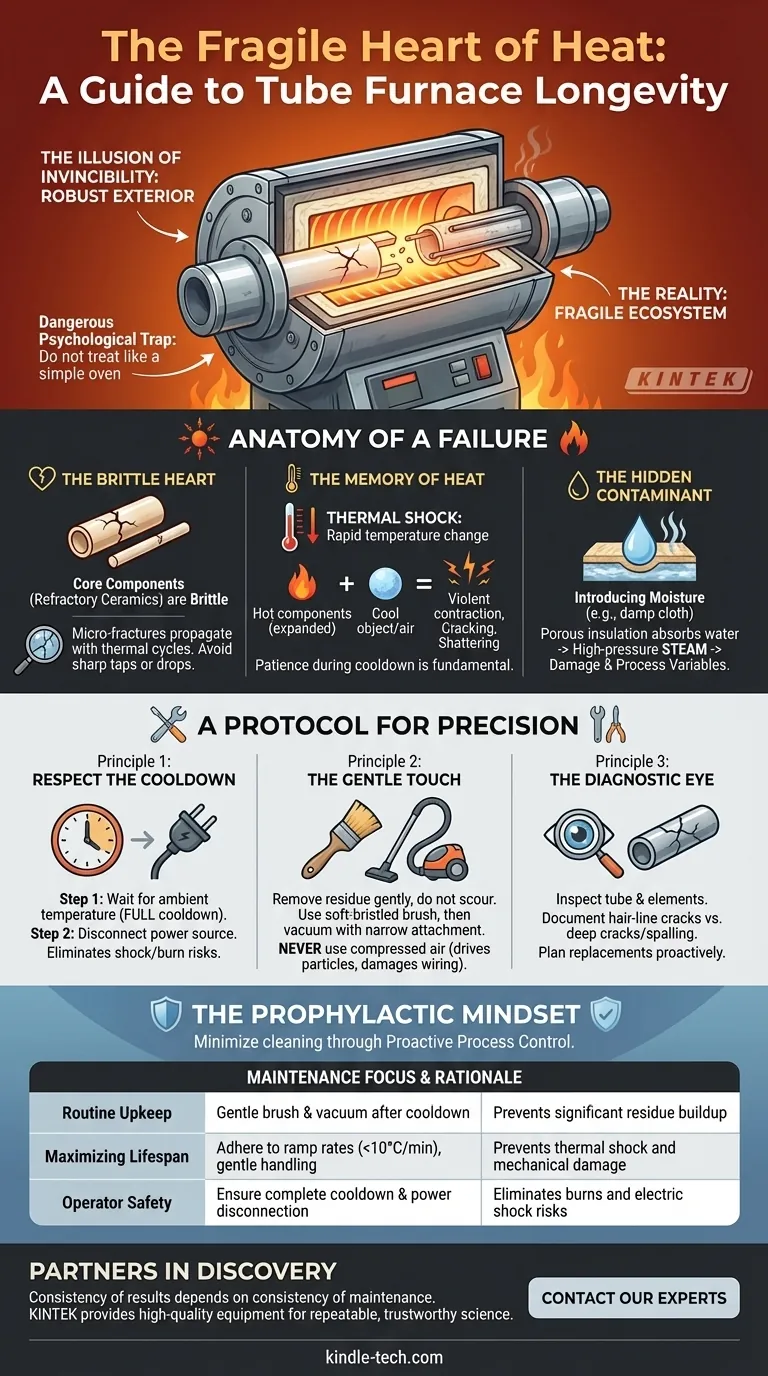
Visual Guide
Related Products
- Rotary Tube Furnace Split Multi Heating Zone Rotating Tube Furnace
- Laboratory Vacuum Tilt Rotary Tube Furnace Rotating Tube Furnace
- 1200℃ Split Tube Furnace with Quartz Tube Laboratory Tubular Furnace
- 1400℃ Laboratory High Temperature Tube Furnace with Alumina Tube
- 1700℃ Laboratory High Temperature Tube Furnace with Alumina Tube
Related Articles
- The Geometry of Heat: Why Motion Matters in Material Synthesis
- Exploring the Advantages of Rotary Tube Furnaces in Industrial and Laboratory Applications
- Exploring Rotary Tube Furnaces: A Comprehensive Guide
- Exploring the Benefits and Applications of Rotary Furnaces: A Comprehensive Guide
- The Physics of Perfection: How Rotary Furnaces Eliminate Randomness in Material Processing



















