Blog The Fragile Heart of Synthesis: Mastering the Physics of Tube Furnace Pressure
The Fragile Heart of Synthesis: Mastering the Physics of Tube Furnace Pressure

The Fragile Heart of Synthesis: Mastering the Physics of Tube Furnace Pressure

30 minutes ago

The Allure of Pushing the Envelope

In a laboratory, progress often feels like it's about pushing boundaries. A higher temperature, a novel catalyst, a slightly different pressure. It’s a natural impulse for any researcher trying to synthesize a new material or perfect a process.

You seal the process tube in your furnace, program the temperature ramp, and watch the controller. It’s tempting to see this sealed environment as a robust reactor, a vessel that can contain a more aggressive reaction.

This mental model, however, is a dangerous one.

A tube furnace is fundamentally an instrument of control and finesse, not brute force. Its operational limits aren't arbitrary suggestions; they are hard physical laws dictated by the fragile heart of the system: the process tube itself. Understanding these limits isn't just about following a manual—it's about understanding the invisible physics at play.

Why Pressure Is the Enemy (And It's a Feature, Not a Bug)

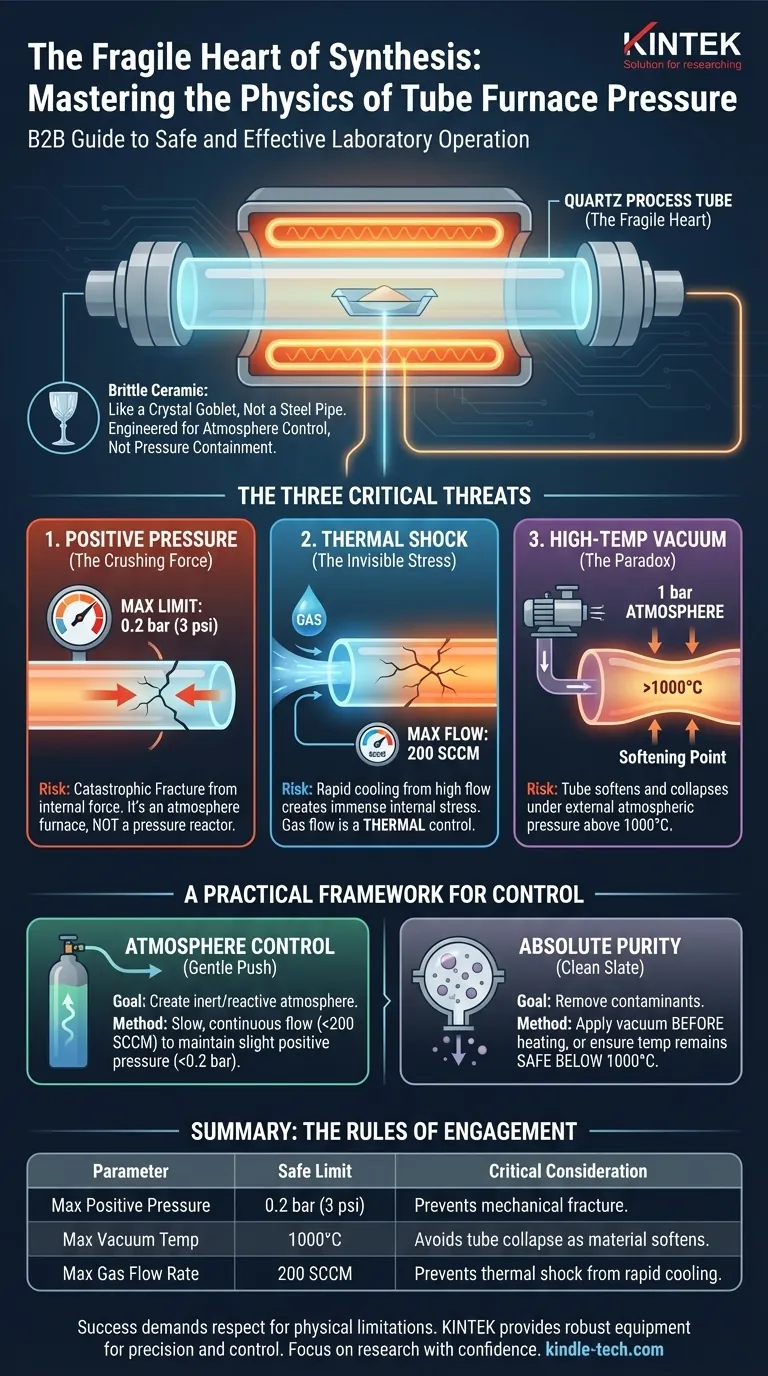
The strict pressure limits of a tube furnace—typically no more than 0.2 bar (3 psi) of positive pressure—are a direct consequence of its design. The system is engineered for atmospheric control, not pressure containment.

The Glass Heart: Material Science of Quartz

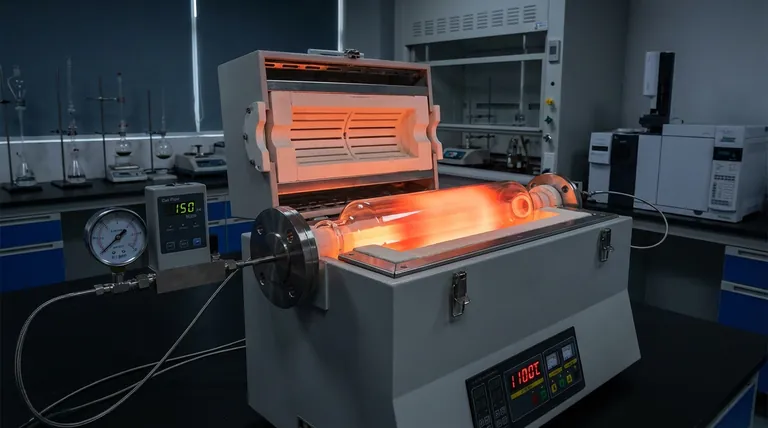
The ubiquitous quartz tube is chosen for its phenomenal thermal stability and chemical inertness. It can glow at 1200°C without breaking a sweat.

But it is also a brittle ceramic.

Think of it less like a steel pipe and more like a crystal goblet. It can handle the heat, but it was never designed to manage a significant pressure difference between its interior and the outside world. That 0.2 bar limit is the engineering safety margin before you risk a catastrophic fracture.

The Invisible Stress of Thermal Shock

Even more insidious than static pressure is the stress from rapid temperature change, or thermal shock.

Imagine injecting a cool process gas at a high flow rate into a furnace tube glowing at 1000°C. That localized cooling creates immense internal stress within the quartz material, a common and immediate cause of failure.

This is why gas flow must be treated as a thermal control. The recommended limit of 200 SCCM (Standard Cubic Centimeters per Minute) is not about the volume of gas itself, but about giving that gas enough time to warm up before it hits the tube's hottest zone. It’s a rule of thermal respect.

The High-Temperature Paradox: When Vacuum Becomes a Threat

To achieve ultimate purity, pulling a vacuum seems like the obvious first step. It removes every trace of atmospheric gas and contaminants.

But here, a paradox emerges. Above 1000°C, quartz begins to soften. It loses its structural rigidity. Suddenly, the 1 bar of atmospheric pressure outside the tube becomes a massive crushing force on the now-softened vacuum-filled tube.

Operating under vacuum is therefore considered unsafe above 1000°C. You must choose between maximum temperature and maximum purity—you cannot have both simultaneously under vacuum.

A Practical Framework for Control

Your experimental goal dictates how you manipulate these forces. Safe and repeatable results depend on using the right strategy for the right reason.

The Gentle Push: Positive Pressure for Atmosphere Control

  • Goal: Create an inert or reactive gas atmosphere, purging ambient air.
  • Method: Use a slow, continuous gas flow (<200 SCCM) to maintain a slight positive pressure (<0.2 bar). The goal is to gently displace the air, not pressurize the system.

The Clean Slate: Vacuum for Absolute Purity

  • Goal: Remove all atmospheric contaminants before a sensitive reaction.
  • Method: Apply a vacuum before heating, or ensure your process temperature remains safely below 1000°C. This is a non-negotiable safety link.

Avoiding the Mental Traps of Lab Work

Mistakes often happen not from faulty equipment, but from a faulty mental model of how that equipment works.

The single biggest error is the Reactor Fallacy—seeing a sealed tube and thinking it can handle pressure. A tube furnace is an atmosphere furnace. This distinction is everything.

The second trap is linear thinking—adjusting temperature, pressure, and flow as independent variables. As we've seen, they are a deeply interconnected system where a change in one dramatically affects the safety and integrity of the others.

Mastering a tube furnace is about mastering this system.

Summary: The Rules of Engagement

Parameter Safe Limit Critical Consideration
Maximum Positive Pressure 0.2 bar (3 psi, 0.02 MPa) Prevents mechanical fracture of the quartz tube.
Maximum Vacuum Temperature 1000°C Avoids tube collapse as the material softens.
Maximum Gas Flow Rate 200 SCCM (200 ml/min) Prevents thermal shock from rapid cooling.

Success in thermal processing demands not only a clear scientific objective but also the right tools and a deep respect for their physical limitations. At KINTEK, we provide robust, reliable lab equipment designed for precision and control, allowing you to focus on your research with confidence in your instruments.

Achieving precise, safe, and repeatable outcomes starts with the right foundation. Contact Our Experts

Visual Guide
The Fragile Heart of Synthesis: Mastering the Physics of Tube Furnace Pressure Visual Guide

Related Products

Related Articles

Related Products

Rotary Tube Furnace Split Multi Heating Zone Rotating Tube Furnace

Rotary Tube Furnace Split Multi Heating Zone Rotating Tube Furnace

Multi zone rotary furnace for high-precision temperature control with 2-8 independent heating zones. Ideal for lithium ion battery electrode materials and high-temperature reactions. Can work under vacuum and controlled atmosphere.

Laboratory Vacuum Tilt Rotary Tube Furnace Rotating Tube Furnace

Laboratory Vacuum Tilt Rotary Tube Furnace Rotating Tube Furnace

Discover the versatility of Laboratory Rotary Furnace: Ideal for calcination, drying, sintering, and high-temperature reactions. Adjustable rotating and tilting functions for optimal heating. Suitable for vacuum and controlled atmosphere environments. Learn more now!

1200℃ Split Tube Furnace with Quartz Tube Laboratory Tubular Furnace

1200℃ Split Tube Furnace with Quartz Tube Laboratory Tubular Furnace

KT-TF12 split tube furnace: high-purity insulation, embedded heating wire coils, and max. 1200C. Widely used for new materials and chemical vapour deposition.

1400℃ Laboratory High Temperature Tube Furnace with Alumina Tube

1400℃ Laboratory High Temperature Tube Furnace with Alumina Tube

Looking for a tube furnace for high-temperature applications? Our 1400℃ Tube Furnace with Alumina Tube is perfect for research and industrial use.

1700℃ Laboratory High Temperature Tube Furnace with Alumina Tube

1700℃ Laboratory High Temperature Tube Furnace with Alumina Tube

Looking for a high-temperature tube furnace? Check out our 1700℃ Tube Furnace with Alumina Tube. Perfect for research and industrial applications up to 1700C.

Vacuum Sealed Continuous Working Rotary Tube Furnace Rotating Tube Furnace

Vacuum Sealed Continuous Working Rotary Tube Furnace Rotating Tube Furnace

Experience efficient material processing with our vacuum-sealed rotary tube furnace. Perfect for experiments or industrial production, equipped with optional features for controlled feeding and optimized results. Order now.

High Temperature Alumina (Al2O3) Furnace Tube for Engineering Advanced Fine Ceramics

High Temperature Alumina (Al2O3) Furnace Tube for Engineering Advanced Fine Ceramics

High temperature alumina furnace tube combines the advantages of high hardness of alumina, good chemical inertness and steel, and has excellent wear resistance, thermal shock resistance and mechanical shock resistance.

Laboratory High Pressure Vacuum Tube Furnace

Laboratory High Pressure Vacuum Tube Furnace

KT-PTF High Pressure Tube Furnace: Compact split tube furnace with strong positive pressure resistance. Working temp up to 1100°C and pressure up to 15Mpa. Also works under controller atmosphere or high vacuum.

Customer Made Versatile CVD Tube Furnace Chemical Vapor Deposition Chamber System Equipment

Customer Made Versatile CVD Tube Furnace Chemical Vapor Deposition Chamber System Equipment

Get your exclusive CVD furnace with KT-CTF16 Customer Made Versatile Furnace. Customizable sliding, rotating, and tilting functions for precise reactions. Order now!

Laboratory Rapid Thermal Processing (RTP) Quartz Tube Furnace

Laboratory Rapid Thermal Processing (RTP) Quartz Tube Furnace

Get lightning-fast heating with our RTP Rapid Heating Tube Furnace. Designed for precise, high-speed heating and cooling with convenient sliding rail and TFT touch screen controller. Order now for ideal thermal processing!

Vertical Laboratory Tube Furnace

Vertical Laboratory Tube Furnace

Elevate your experiments with our Vertical Tube Furnace. Versatile design allows for operation under various environments and heat treatment applications. Order now for precise results!

Multi-zone Laboratory Tube Furnace

Multi-zone Laboratory Tube Furnace

Experience precise, efficient thermal testing with our Multi Zone Tube Furnace. Independent heating zones and temperature sensors allow for controlled high-temperature gradient heating fields. Order now for advanced thermal analysis!

Multi Heating Zones CVD Tube Furnace Machine Chemical Vapor Deposition Chamber System Equipment

Multi Heating Zones CVD Tube Furnace Machine Chemical Vapor Deposition Chamber System Equipment

KT-CTF14 Multi Heating Zones CVD Furnace - Precise Temperature Control and Gas Flow for Advanced Applications. Max temp up to 1200℃, 4 channels MFC mass flow meter, and 7" TFT touch screen controller.

1200℃ Controlled Atmosphere Furnace Nitrogen Inert Atmosphere Furnace

1200℃ Controlled Atmosphere Furnace Nitrogen Inert Atmosphere Furnace

Discover our KT-12A Pro Controlled atmosphere furnace - high precision, heavy duty vacuum chamber, versatile smart touch screen controller, and excellent temperature uniformity up to 1200C. Ideal for both laboratory and industrial application.

1700℃ Controlled Atmosphere Furnace Nitrogen Inert Atmosphere Furnace

1700℃ Controlled Atmosphere Furnace Nitrogen Inert Atmosphere Furnace

KT-17A Controlled atmosphere furnace: 1700℃ heating, vacuum sealing technology, PID temperature control, and versatile TFT smart touch screen controller for laboratory and industrial use.

1400℃ Muffle Oven Furnace for Laboratory

1400℃ Muffle Oven Furnace for Laboratory

Get precise high-temperature control up to 1500℃ with KT-14M Muffle furnace. Equipped with a smart touch screen controller and advanced insulation materials.

High Temperature Muffle Oven Furnace for Laboratory Debinding and Pre Sintering

High Temperature Muffle Oven Furnace for Laboratory Debinding and Pre Sintering

KT-MD High temperature debinding and pre-sintering furnace for ceramic materials with various molding processes. Ideal for electronic components such as MLCC and NFC.

Vacuum Heat Treat and Molybdenum Wire Sintering Furnace for Vacuum Sintering

Vacuum Heat Treat and Molybdenum Wire Sintering Furnace for Vacuum Sintering

A vacuum molybdenum wire sintering furnace is a vertical or bedroom structure, which is suitable for withdrawal, brazing, sintering and degassing of metal materials under high vacuum and high temperature conditions. It is also suitable for dehydroxylation treatment of quartz materials.

Molybdenum Vacuum Heat Treat Furnace

Molybdenum Vacuum Heat Treat Furnace

Discover the benefits of a high-configuration molybdenum vacuum furnace with heat shield insulation. Ideal for high-purity, vacuum environments like sapphire crystal growth and heat treatment.

Small Vacuum Heat Treat and Tungsten Wire Sintering Furnace

Small Vacuum Heat Treat and Tungsten Wire Sintering Furnace

The small vacuum tungsten wire sintering furnace is a compact experimental vacuum furnace specially designed for universities and scientific research institutes. The furnace features a CNC welded shell and vacuum piping to ensure leak-free operation. Quick-connect electrical connections facilitate relocation and debugging, and the standard electrical control cabinet is safe and convenient to operate.


Leave Your Message



















