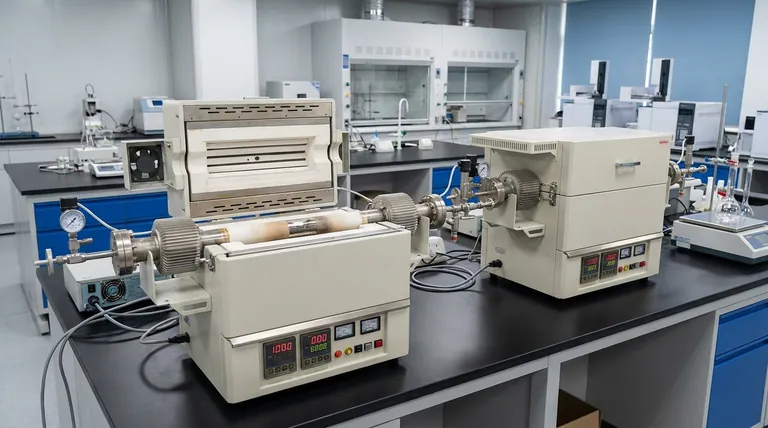
Blog The Geometry of Consistency: Why the Tube Furnace Remains Indispensable
The Geometry of Consistency: Why the Tube Furnace Remains Indispensable

The Geometry of Consistency: Why the Tube Furnace Remains Indispensable

2 weeks ago

The Enemy of Science is Variance

In the laboratory, the most dangerous variable is the one you believe you are controlling but aren't.

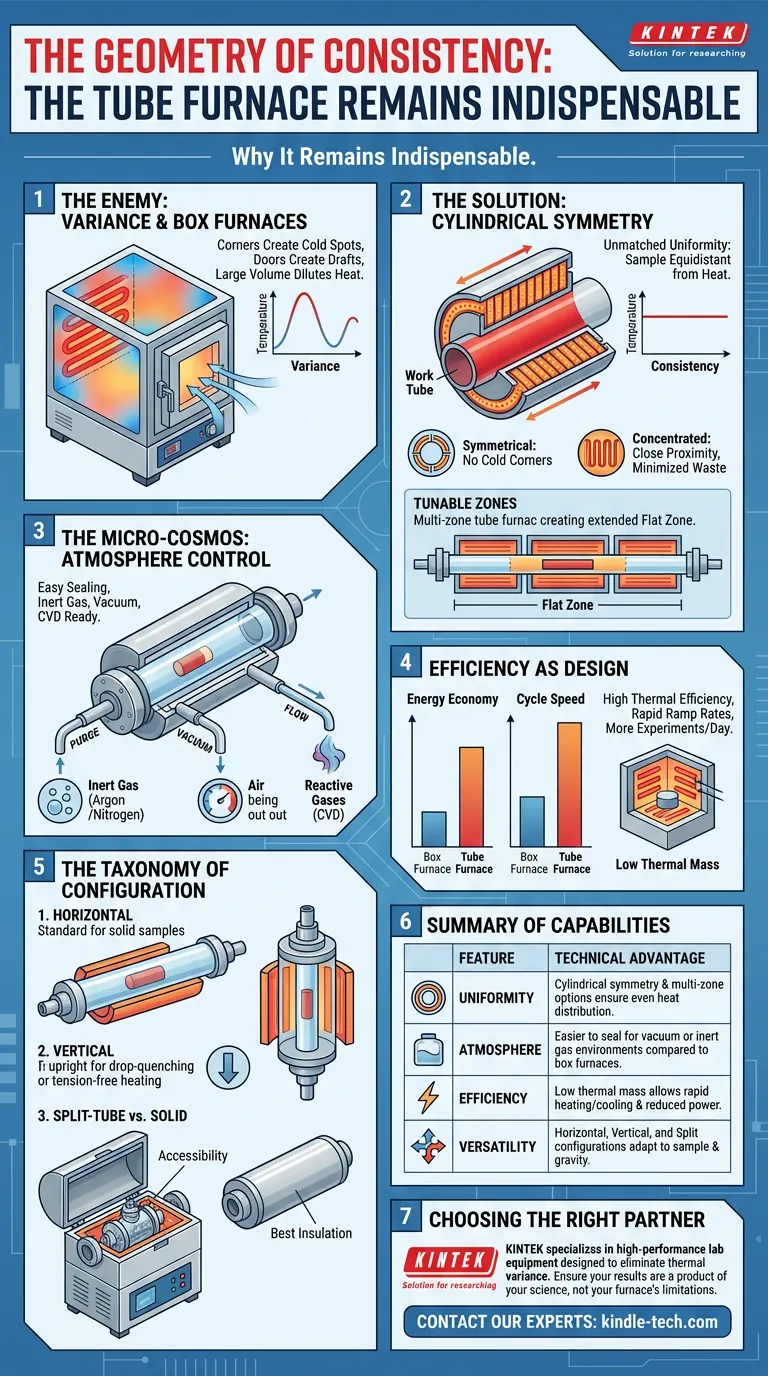
When you heat a material sample to 1,000°C, the number on the controller is a promise. In many standard heating devices, that promise is broken by physics. Corners create cold spots. Doors create drafts. The sheer volume of the chamber dilutes the intensity of the heat.

For general drying, this margin of error is acceptable. But for materials science, semiconductor research, and precision chemistry, a variation of a few degrees acts like compound interest—a small error at the start creates a massive divergence in the final result.

This is why the tube furnace persists.

It is not just a heater; it is a solution to the problem of variance, designed around the most thermally efficient shape in nature: the cylinder.

The Engineering of Symmetry

The core argument for the tube furnace is unmatched temperature uniformity.

In a standard box furnace, heat radiates from the walls, struggling to fill a cubic void evenly. The corners are always cooler than the center.

A tube furnace solves this through symmetry. The heating elements wrap 360 degrees around the work tube. The sample, sitting in the center, is equidistant from the heat source on all sides.

This creates a thermal environment that is:

  • Symmetrical: Eliminating "cold corners."
  • Concentrated: The heating elements are positioned close to the sample, minimizing wasted energy.
  • Tunable: Advanced models use multi-zone heating, allowing you to create an extended "flat zone" of perfect uniformity, or conversely, a precise temperature gradient to study how a material changes across different thermal states.

The Micro-Cosmos: Atmosphere Control

Heat is rarely the only variable. Usually, it is heat plus chemistry.

Many advanced materials oxidize instantly when heated in air. To process them, you don't just need a furnace; you need a sealed world.

The tube furnace excels here because of its geometry. Sealing a small, cylindrical tube is mechanically simple and highly effective compared to sealing a large rectangular door.

By using end-caps and seals, the work tube becomes a distinct micro-cosmos. You can:

  1. Purge: Flush the tube with inert gases like argon or nitrogen to prevent oxidation.
  2. Vacuum: Remove the atmosphere entirely for clean processing.
  3. Flow: Pass reactive gases over the sample for chemical vapor deposition (CVD).

This capability makes the tube furnace indispensable for semiconductor fabrication and battery research.

Efficiency as a Design Feature

There is a psychological comfort in using massive equipment, but in thermal processing, excess volume is waste.

Tube furnaces are defined by their high thermal efficiency. Because the heating chamber is small and the elements are close to the load, the system heats up and cools down rapidly.

This offers two systemic benefits:

  • Energy Economy: You aren't paying to heat dead space.
  • Cycle Speed: Faster ramp rates mean you can run more experiments in a single day.

The Taxonomy of Configuration

The tube furnace is a category, not a single product. The correct configuration depends entirely on the physical state of your sample and the forces acting upon it.

1. The Horizontal Furnace

The standard configuration. It is the workhorse for solid samples that are physically stable. It offers the longest heated zones and the most straightforward operation.

2. The Vertical Furnace

Gravity is a relentless force. If you are heating a powder that might settle, or a wire that might sag under its own weight when hot, horizontal heating fails.

Vertical furnaces align with gravity. They are essential for:

  • Drop-quenching: Where a sample must be heated and then immediately dropped into a cooling medium.
  • Tension-free heating: Hanging wires or rods so they remain straight.

3. Split-Tube vs. Solid

  • Solid (Non-Split): The tube slides into a fixed cylinder. This offers the best insulation and thermal stability.
  • Split-Tube: The furnace opens like a clamshell. This is a concession to utility. If you have complex reactor vessels or flanges that are larger than the tube diameter, a split furnace is the only way to load the sample.

The Trade-offs

Engineering is the art of compromise. The tube furnace gains precision by sacrificing volume.

It is not the right tool for bulky items. The internal diameter is restrictive. Furthermore, the "end effects"—where temperature drops off near the tube openings—must be managed, either through insulation plugs or by using multi-zone controllers to boost heat at the edges.

Loading a sample into the center of a long, narrow tube also requires a steady hand and specific tools, unlike the simple motion of opening an oven door.

Summary of Capabilities

Feature The Technical Advantage
Uniformity Cylindrical symmetry ensures even heat distribution; multi-zone options eliminate end-loss.
Atmosphere Naturally easier to seal for vacuum or inert gas environments compared to box furnaces.
Efficiency Low thermal mass allows for rapid heating/cooling cycles and reduced power consumption.
Versatility Vertical, Horizontal, and Split configurations adapt to sample geometry and gravity.

Choosing the Right Partner

In research, equipment should be the constant, not the variable.

The decision to use a tube furnace is a decision to prioritize control. Whether you require the gravitational assistance of a vertical system, the accessibility of a split-tube design, or the pure precision of a multi-zone horizontal unit, the hardware must match the rigor of your hypothesis.

KINTEK understands this balance. We specialize in high-performance lab equipment designed to eliminate thermal variance, ensuring that your results are a product of your science, not your furnace's limitations.

Contact Our Experts to discuss your specific thermal requirements and find the configuration that fits your research goals.

Visual Guide
The Geometry of Consistency: Why the Tube Furnace Remains Indispensable Visual Guide

Related Products

Related Articles

Related Products

Laboratory High Pressure Vacuum Tube Furnace

Laboratory High Pressure Vacuum Tube Furnace

KT-PTF High Pressure Tube Furnace: Compact split tube furnace with strong positive pressure resistance. Working temp up to 1100°C and pressure up to 15Mpa. Also works under controller atmosphere or high vacuum.

1700℃ Laboratory High Temperature Tube Furnace with Alumina Tube

1700℃ Laboratory High Temperature Tube Furnace with Alumina Tube

Looking for a high-temperature tube furnace? Check out our 1700℃ Tube Furnace with Alumina Tube. Perfect for research and industrial applications up to 1700C.

1400℃ Laboratory High Temperature Tube Furnace with Alumina Tube

1400℃ Laboratory High Temperature Tube Furnace with Alumina Tube

Looking for a tube furnace for high-temperature applications? Our 1400℃ Tube Furnace with Alumina Tube is perfect for research and industrial use.

1200℃ Split Tube Furnace with Quartz Tube Laboratory Tubular Furnace

1200℃ Split Tube Furnace with Quartz Tube Laboratory Tubular Furnace

KT-TF12 split tube furnace: high-purity insulation, embedded heating wire coils, and max. 1200C. Widely used for new materials and chemical vapour deposition.

Laboratory Rapid Thermal Processing (RTP) Quartz Tube Furnace

Laboratory Rapid Thermal Processing (RTP) Quartz Tube Furnace

Get lightning-fast heating with our RTP Rapid Heating Tube Furnace. Designed for precise, high-speed heating and cooling with convenient sliding rail and TFT touch screen controller. Order now for ideal thermal processing!

1700℃ Controlled Atmosphere Furnace Nitrogen Inert Atmosphere Furnace

1700℃ Controlled Atmosphere Furnace Nitrogen Inert Atmosphere Furnace

KT-17A Controlled atmosphere furnace: 1700℃ heating, vacuum sealing technology, PID temperature control, and versatile TFT smart touch screen controller for laboratory and industrial use.

Multi Heating Zones CVD Tube Furnace Machine Chemical Vapor Deposition Chamber System Equipment

Multi Heating Zones CVD Tube Furnace Machine Chemical Vapor Deposition Chamber System Equipment

KT-CTF14 Multi Heating Zones CVD Furnace - Precise Temperature Control and Gas Flow for Advanced Applications. Max temp up to 1200℃, 4 channels MFC mass flow meter, and 7" TFT touch screen controller.

Laboratory Vacuum Tilt Rotary Tube Furnace Rotating Tube Furnace

Laboratory Vacuum Tilt Rotary Tube Furnace Rotating Tube Furnace

Discover the versatility of Laboratory Rotary Furnace: Ideal for calcination, drying, sintering, and high-temperature reactions. Adjustable rotating and tilting functions for optimal heating. Suitable for vacuum and controlled atmosphere environments. Learn more now!

1700℃ Muffle Oven Furnace for Laboratory

1700℃ Muffle Oven Furnace for Laboratory

Get superior heat control with our 1700℃ Muffle Furnace. Equipped with intelligent temperature microprocessor, TFT touch screen controller & advanced insulation materials for precise heating up to 1700C. Order now!

1200℃ Controlled Atmosphere Furnace Nitrogen Inert Atmosphere Furnace

1200℃ Controlled Atmosphere Furnace Nitrogen Inert Atmosphere Furnace

Discover our KT-12A Pro Controlled atmosphere furnace - high precision, heavy duty vacuum chamber, versatile smart touch screen controller, and excellent temperature uniformity up to 1200C. Ideal for both laboratory and industrial application.

Vacuum Heat Treat and Molybdenum Wire Sintering Furnace for Vacuum Sintering

Vacuum Heat Treat and Molybdenum Wire Sintering Furnace for Vacuum Sintering

A vacuum molybdenum wire sintering furnace is a vertical or bedroom structure, which is suitable for withdrawal, brazing, sintering and degassing of metal materials under high vacuum and high temperature conditions. It is also suitable for dehydroxylation treatment of quartz materials.

1800℃ Muffle Oven Furnace for Laboratory

1800℃ Muffle Oven Furnace for Laboratory

KT-18 muffle furnace with Japan Al2O3 polycrystalline fibe and Silicon Molybdenum heating element, up to 1900℃, PID temperature control and 7" smart touch screen. Compact design, low heat loss, and high energy efficiency. Safety interlock system and versatile functions.

Ultra-High Temperature Graphite Vacuum Graphitization Furnace

Ultra-High Temperature Graphite Vacuum Graphitization Furnace

The ultra-high temperature graphitization furnace utilizes medium frequency induction heating in a vacuum or inert gas environment. The induction coil generates an alternating magnetic field, inducing eddy currents in the graphite crucible, which heats up and radiates heat to the workpiece, bringing it to the desired temperature. This furnace is primarily used for graphitization and sintering of carbon materials, carbon fiber materials, and other composite materials.

Molybdenum Vacuum Heat Treat Furnace

Molybdenum Vacuum Heat Treat Furnace

Discover the benefits of a high-configuration molybdenum vacuum furnace with heat shield insulation. Ideal for high-purity, vacuum environments like sapphire crystal growth and heat treatment.

Horizontal High Temperature Graphite Vacuum Graphitization Furnace

Horizontal High Temperature Graphite Vacuum Graphitization Furnace

Horizontal Graphitization Furnace: This type of furnace is designed with the heating elements placed horizontally, allowing for uniform heating of the sample. It's well-suited for graphitizing large or bulky samples that require precise temperature control and uniformity.

Vertical High Temperature Graphite Vacuum Graphitization Furnace

Vertical High Temperature Graphite Vacuum Graphitization Furnace

Vertical high temperature graphitization furnace for carbonization and graphitization of carbon materials up to 3100℃.Suitable for shaped graphitization of carbon fiber filaments and other materials sintered in a carbon environment.Applications in metallurgy, electronics, and aerospace for producing high-quality graphite products like electrodes and crucibles.

1400℃ Muffle Oven Furnace for Laboratory

1400℃ Muffle Oven Furnace for Laboratory

Get precise high-temperature control up to 1500℃ with KT-14M Muffle furnace. Equipped with a smart touch screen controller and advanced insulation materials.

Laboratory Muffle Oven Furnace Bottom Lifting Muffle Furnace

Laboratory Muffle Oven Furnace Bottom Lifting Muffle Furnace

Efficiently produce batches with excellent temperature uniformity using our Bottom Lifting Furnace. Features two electric lifting stages and advanced temperature control up to 1600℃.

Vacuum Hot Press Furnace Heated Vacuum Press Machine Tube Furnace

Vacuum Hot Press Furnace Heated Vacuum Press Machine Tube Furnace

Reduce forming pressure & shorten sintering time with Vacuum Tube Hot Press Furnace for high-density, fine-grain materials. Ideal for refractory metals.

Controlled Nitrogen Inert Hydrogen Atmosphere Furnace

Controlled Nitrogen Inert Hydrogen Atmosphere Furnace

KT-AH Hydrogen atmosphere furnace - induction gas furnace for sintering/annealing with built-in safety features, dual housing design, and energy-saving efficiency. Ideal for lab and industrial use.


Leave Your Message



















