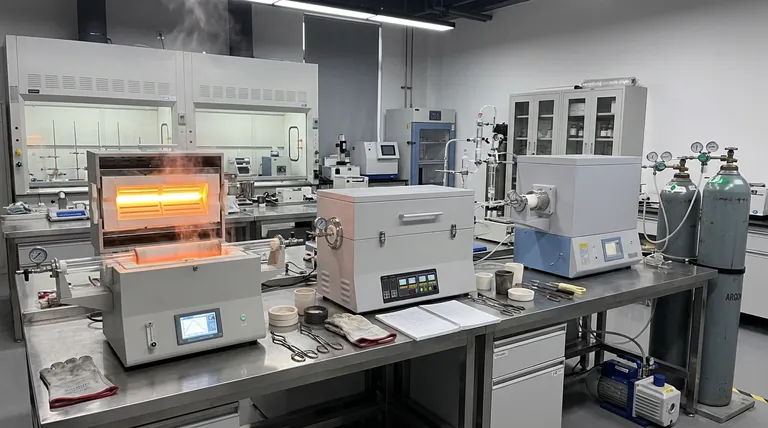
The Illusion of a Simple Choice
Imagine a materials scientist staring at a crucible of gray, oxidized powder. The experiment failed. The goal was to synthesize a novel alloy under a pure argon shield, but the sample looks like it was left out in the rain.
The cause wasn't a flaw in the chemistry, but a flaw in the mental model used to select the equipment. The lab's new, powerful furnace was chosen because it was "better"—it had a larger chamber and higher power. But in engineering and science, "better" is a dangerous illusion. The only thing that matters is "fit-for-purpose."
This is the central dilemma when choosing between a muffle furnace and a tube furnace. It’s not a question of which is superior, but a profound question of geometry and intention.
The Shape of Your World
At its heart, a furnace isn't just a heater; it's a tool for creating a controlled world for your sample. The shape of that world—the chamber—dictates everything.
The Muffle Furnace: A Universe in a Box
A muffle furnace is built around a simple, powerful idea: volume. Its box-shaped chamber is a workhorse, designed for accessibility and throughput.
Think of annealing dozens of ceramic parts, ashing organic samples for analysis, or heat-treating components in bulk. The process is straightforward: open the door, arrange the samples, and heat them in air. It is the perfect tool when the ambient atmosphere is not your enemy. Its value lies in its honest simplicity and capacity.
The Tube Furnace: A Controlled Corridor
A tube furnace operates on a different philosophy entirely: precision. The sample lives inside a narrow, cylindrical tube, a corridor that can be perfectly isolated from the outside world.
This geometry is not a limitation; it is its greatest strength. The small, sealed environment is the key to mastering the atmosphere. It's designed for the chemist growing a single, perfect crystal or the engineer depositing a nanometer-thin film—processes where a single stray oxygen molecule can mean failure.
The Atmosphere is Everything
The most critical distinction between these furnaces is how they manage the invisible. For many advanced processes, the air we breathe is a contaminant.
Muffle furnaces are designed to work with air. Their doors and chamber construction make it nearly impossible to achieve the hermetic seal required for a true vacuum or a pure inert gas environment. They are an "open-air market" for heat.
Tube furnaces, however, are atmospheric cleanrooms. By sealing the ends of the process tube with flanges, a scientist gains total control.
- Inert Gas: Purge the tube with argon or nitrogen to create an oxygen-free world, protecting sensitive materials from oxidation.
- Vacuum: Evacuate the tube completely to remove all gases, essential for processes sensitive to any atmospheric interaction.
- Reactive Gas: Introduce specific gases to drive chemical reactions, like in chemical vapor deposition (CVD).
The tube's geometry makes this control possible. The corridor can be purged, filled, and maintained with a precision the box can never match.
Uniformity vs. Gradient: The Nuances of Heat
While both furnaces get hot, how they manage that heat is fundamentally different.
The large chamber of a muffle furnace is excellent for bringing a bulk load to a target temperature. While generally uniform, minor temperature variations are inherent to its large volume. For many applications, this is perfectly acceptable.
A tube furnace offers a higher level of precision. Its confined space allows for exceptionally uniform heating in a specific zone. More importantly, its linear shape is perfect for intentionally creating a temperature gradient—a controlled temperature change along the length of the tube. This is not a bug; it's a critical feature for advanced synthesis, like zone refining or crystal growth, where you are guiding a physical process along a path.
The Mental Calculus: A Framework for Choosing
Your choice depends on the constraints you are willing to accept to achieve your primary goal. The most expensive furnace is the one that cannot perform the one task you need.
| Core Question | Choose a Muffle Furnace If... | Choose a Tube Furnace If... |
|---|---|---|
| What is my relationship with air? | ...your process requires or is tolerant of an air atmosphere. | ...you must prevent oxidation or control the gas environment. |
| Am I optimizing for volume or purity? | ...throughput and sample size are your main priorities. | ...the purity and integrity of a single sample are paramount. |
| How precise must my heating be? | ...general, uniform heating for bulk materials is sufficient. | ...you need pinpoint uniformity or a controlled temperature gradient. |
| What is my tolerance for complexity? | ...you need a simple, straightforward, "plug-and-play" solution. | ...you are prepared to manage flanges, seals, and gas/vacuum lines. |
The Right Tool Unlocks New Possibilities
Choosing a furnace is not just a procurement decision; it’s a strategic choice about the kind of work you want to enable. The geometry of the tool you select will define the boundaries of your research and production.
At KINTEK, we understand that you aren't just buying lab equipment; you're acquiring a capability. Whether your work demands the robust, high-volume capacity of a muffle furnace or the precise atmospheric control of a tube furnace, our focus is on matching the instrument's design to your scientific intent. We help you choose the right geometry for your heat.
To ensure your next experiment or production run is built on the right foundation, Contact Our Experts
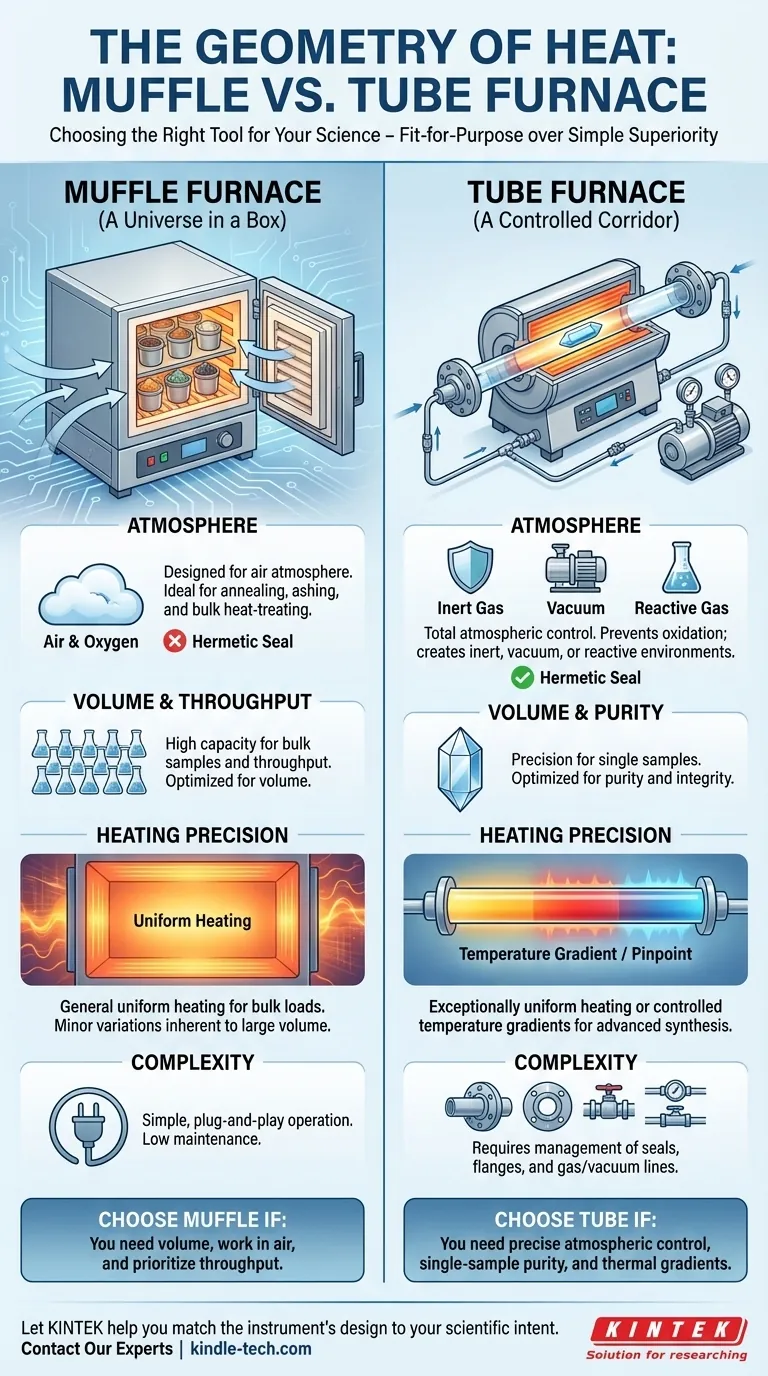
Visual Guide
Related Products
- 1200℃ Muffle Furnace Oven for Laboratory
- 1800℃ Muffle Oven Furnace for Laboratory
- 1400℃ Muffle Oven Furnace for Laboratory
- 1700℃ Muffle Oven Furnace for Laboratory
- High Temperature Muffle Oven Furnace for Laboratory Debinding and Pre Sintering
Related Articles
- Calibration Methods for High-Temperature Muffle Furnaces
- Substances Suitable for Calcination in a High-Temperature Muffle Furnace
- Temperature Control Accuracy of High Temperature Experimental Chamber Muffle Furnace
- Laboratory Muffle Furnace Safety and Usage Guidelines
- Comprehensive Guide to Muffle Furnaces: Types, Uses, and Maintenance



















