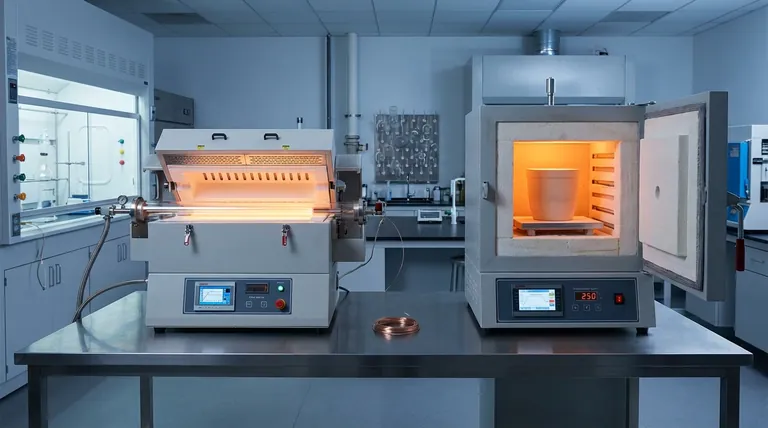
The Geometry of Heat: Navigating the Choice Between Tube and Box Furnaces
In laboratory engineering, temperature is often viewed as a simple metric. You need 1200°C, so you buy a machine that reaches 1200°C.
But this simplifies a complex reality. The critical variable in thermal processing isn't just heat; it is time and motion.
The choice between a tube furnace and a box furnace is not merely a choice between two shapes of metal. It is a choice between two distinct philosophies of production: the continuous flow and the static batch.
The Philosophy of Flow vs. Stasis
At its core, the distinction lies in the relationship between the sample and the heating element.
A tube furnace is an engine of flow. It is designed for materials that are going somewhere—passing through a heated zone on a journey from Point A to Point B.
A box furnace is a vessel of stasis. It is a vault where materials are placed, sealed off from the world, and transformed in isolation before returning to the operator.
Understanding this fundamental difference in workflow is more important than comparing wattage or insulation thickness.
The Tube Furnace: The Engineer’s Romance of the Line
There is an elegance to the tube furnace. It is built around a central cylindrical pathway, with heating elements wrapping the exterior.
This design serves a specific geometric purpose: it accommodates the infinite line.
The Continuous Journey
Tube furnaces are ideal for "in-line" processes. If you are annealing wire, treating fibers, or calcining powders that can be pushed through a system, the tube furnace is unrivaled.
The material enters, experiences a precise thermal gradient, and exits. There is no "batch." There is only the stream of production.
The Dynamic Atmosphere
Because the volume is small and the geometry is tubular, these furnaces excel at managing flowing gases. You can push nitrogen or argon through the tube along with the sample, creating a dynamic, protective environment that moves as the sample moves.
The Constraint
The trade-off is geometry. If your sample is wide, bulky, or oddly shaped, the tube furnace rejects it. It is a specialist tool, demanding that the material conform to the furnace, not the other way around.
The Box Furnace: The Sanctuary of the Batch
If the tube furnace is a river, the box furnace is a lake.
Also known as muffle furnaces, these are the heavy lifters of the laboratory world. They prioritize volume and accessibility over flow.
The Static Soak
In a box furnace, the environment is static. You load the chamber, seal the heavy insulated door, and the entire volume heats as one unit.
This offers superior uniformity for stationary objects. The sample sits in the center of the heat, bathed in energy from the walls.
The Universal Recipient
The box furnace is the ultimate generalist. It does not care about the shape of your sample.
- Large crucibles? Yes.
- Bulky automotive components? Yes.
- Trays of loose powder? Yes.
Because of this versatility, the box furnace is often the safer bet for R&D labs where the project requirements change month to month.
The Hidden Trade-offs: Efficiency vs. Flexibility
When selecting equipment, we often fall into the trap of buying for the "best case" scenario rather than the "daily use" scenario.
Here is how the trade-offs play out in the real world:
1. Energy and Motion
A tube furnace is more energy-efficient for high-volume production because it stays hot while materials move through it. You don't waste energy heating and cooling the massive refractory brick of a chamber repeatedly.
A box furnace requires a thermal cycle for every batch. Heat up. Process. Cool down. Unload. It is less efficient for mass production but infinitely more flexible for one-off jobs.
2. Complexity of Operation
Box furnaces are mechanically simple. They are insulated boxes with heaters.
Tube furnaces can become complex systems. They often require feeding mechanisms, precise gas flow controllers, and automated integration. Complexity increases maintenance, but it buys you automation.
Summary Comparison
| Feature | Tube Furnace | Box Furnace |
|---|---|---|
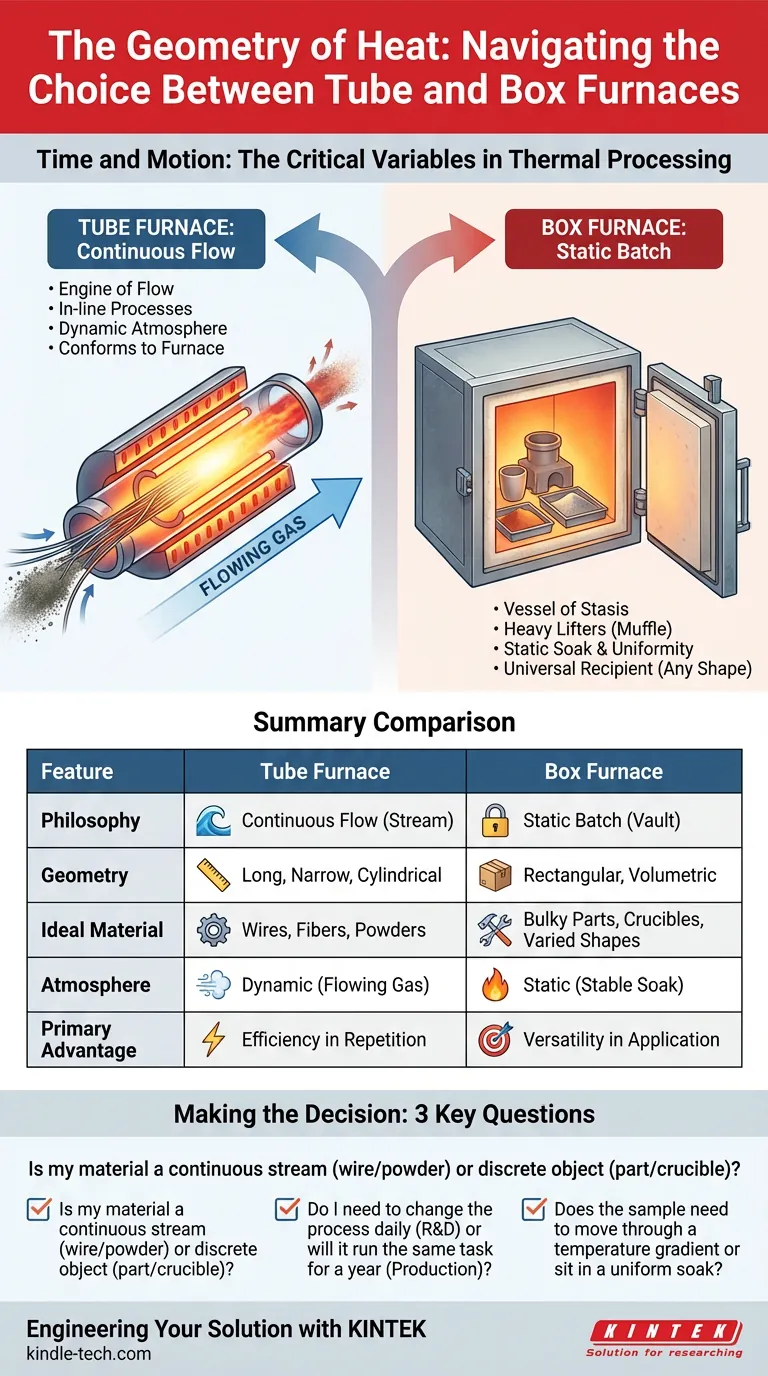
| Philosophy | Continuous Flow | Static Batch |
| Geometry | Long, narrow, cylindrical | Rectangular, volumetric |
| Ideal Material | Wires, fibers, powders | Bulky parts, crucibles, varied shapes |
| Atmosphere | Dynamic (flowing gas) | Static (stable soak) |
| Primary Advantage | Efficiency in repetition | Versatility in application |
Making the Decision
The mistake most labs make is buying a tube furnace because it looks sophisticated, only to realize they mostly process bulky crucibles. Or, conversely, buying a box furnace for a wire annealing project and realizing the batch process creates a production bottleneck.
Ask yourself three questions:
- Is my material a continuous stream (wire/powder) or a discrete object (part/crucible)?
- Do I need to change the process daily (R&D), or will this run the same task for a year (Production)?
- Does the sample need to move through a temperature gradient, or sit in a uniform soak?
Engineering Your Solution
At KINTEK, we appreciate the nuances of thermal processing. We know that a furnace is not just a hot box; it is the heart of your experimental or production workflow.
Whether you need the continuous precision of a tube furnace or the robust versatility of a box furnace, our engineers can help you match the hardware to your specific geometry and goals.
Visual Guide
Related Products
- Rotary Tube Furnace Split Multi Heating Zone Rotating Tube Furnace
- Laboratory Vacuum Tilt Rotary Tube Furnace Rotating Tube Furnace
- 1200℃ Split Tube Furnace with Quartz Tube Laboratory Tubular Furnace
- 1400℃ Laboratory High Temperature Tube Furnace with Alumina Tube
- 1700℃ Laboratory High Temperature Tube Furnace with Alumina Tube
Related Articles
- The Geometry of Heat: Why Motion Matters in Material Synthesis
- Exploring the Functions and Advantages of Rotary Tube Furnaces
- Exploring the Benefits and Applications of Rotary Furnaces: A Comprehensive Guide
- The Physics of Perfection: How Rotary Furnaces Eliminate Randomness in Material Processing
- The Geometry of Heat: Engineering the Perfect Thermal Environment



















