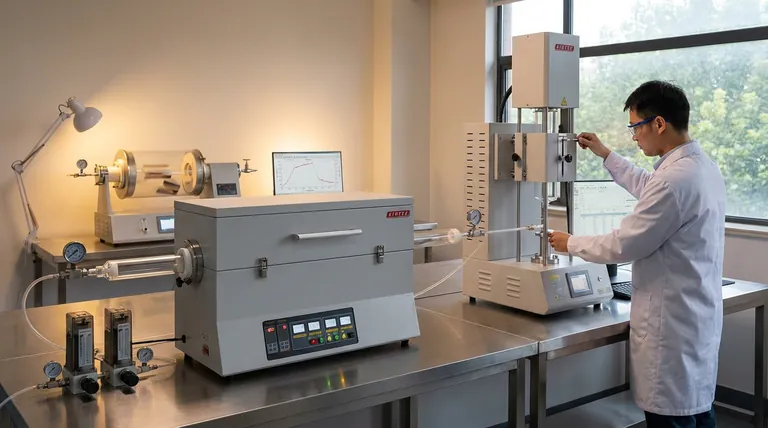
The Unseen Architect of Your Experiment
In a laboratory, we obsess over variables we can dial in: temperature, pressure, gas flow. We often overlook the constants, the fixed architectures of our equipment.
The orientation of a tube furnace—whether it lies flat or stands tall—seems like a simple design choice. It is not. It is the physical embodiment of an experimental philosophy. It dictates how gravity interacts with your sample, how heat distributes itself through convection, and ultimately, the integrity of your results.
Choosing a furnace orientation is not a matter of preference. It's a fundamental decision about how you intend to control matter and energy.
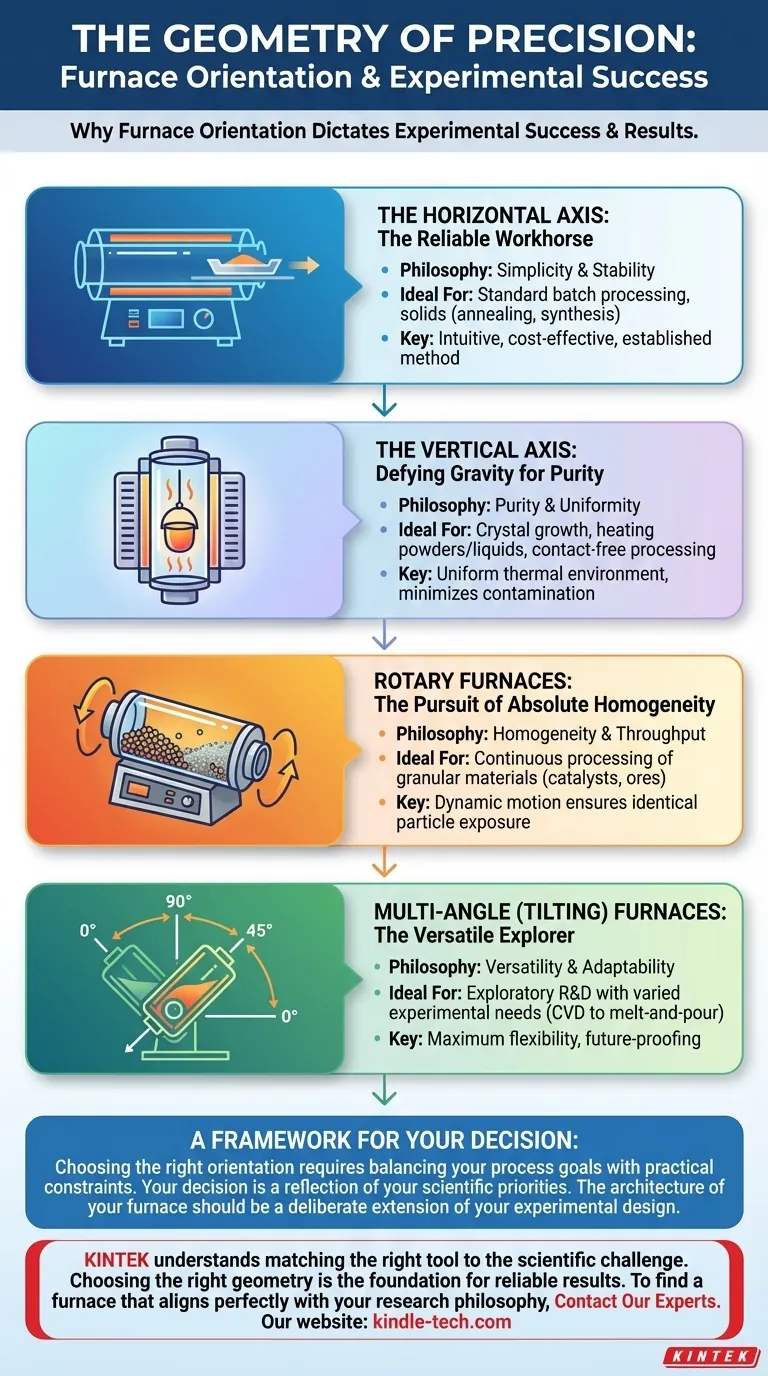
The Horizontal Axis: The Reliable Workhorse
The horizontal tube furnace is the most recognizable configuration in any lab. A researcher carefully places a sample-filled quartz boat, sliding it into the heart of the heating zone. The process is direct, intuitive, and mechanically simple.
This design is the standard for a reason. For countless applications involving solid samples—annealing, calcination, synthesis—it is a robust and cost-effective solution. Its strength lies in its simplicity.
Psychologically, the horizontal furnace represents stability and predictability. It is the default path, the established method for batch processing. But the easiest path is not always the optimal one.
The Vertical Axis: Defying Gravity for Purity
Now, picture a different scenario. Your goal is to grow a perfect crystal, or to heat a fine powder without it reacting with the tube walls. Here, gravity is not a passive force; it's a variable to be managed.
In a vertical tube furnace, the upright orientation transforms gravity from a potential problem into a powerful tool.
- Uniformity by Nature: As heat rises, natural convection creates a highly stable and uniform thermal environment, often superior to a horizontal setup.
- Contact-Free Processing: Samples in crucibles can be suspended, eliminating contact with the tube walls. This is critical for high-purity processes and preventing unwanted reactions.
- Ideal for Powders and Liquids: Gravity ensures powders and liquids settle evenly at the bottom of a crucible, preventing the sample from spreading out and ensuring consistent heating.
The vertical orientation is a choice for the purist—the researcher who requires uncompromising control and minimal contamination.
When Static Is Not Enough: The Dynamics of Motion
Some processes require more than static heat. They demand agitation to ensure every particle experiences the exact same conditions.
Rotary Furnaces: The Pursuit of Absolute Homogeneity
For continuous industrial processes like catalyst coating or ore roasting, treating every granule of a powder identically is paramount. A static pile will always have a cool core and a hot exterior.
A rotary tube furnace solves this by slowly tumbling the material. This constant motion guarantees that every particle is uniformly exposed to the heat source. It’s a design that acknowledges that, for some systems, equilibrium is a dynamic state, not a static one.
Multi-Angle (Tilting) Furnaces: The Versatile Explorer
What if you don't know what next month's experiment will be? One day it's a horizontal CVD process; the next, it's a vertical melt-and-pour.
The multi-angle, or tilting, furnace is the Swiss Army knife of thermal processing. It can operate horizontally, vertically, or at any angle in between. This flexibility is invaluable in R&D labs where adaptability is key. It's a bet on versatility over specialization, allowing a single instrument to serve a multitude of research paths.
A Framework for Your Decision
Choosing the right orientation requires balancing your process goals with practical constraints. Your decision is a reflection of your scientific priorities.
| Orientation | Primary Philosophy | Ideal For... | Key Consideration |
|---|---|---|---|
| Horizontal | Simplicity & Reliability | Standard batch processing of solid samples | Ease of use and loading |
| Vertical | Purity & Uniformity | Crystal growth, heating powders/liquids | Minimizing contamination |
| Rotary | Homogeneity & Throughput | Continuous processing of granular materials | Ensuring every particle is identical |
| Multi-Angle | Versatility & Adaptability | Exploratory R&D with varied experimental needs | Maximum future-proofing |
The architecture of your furnace should be a deliberate extension of your experimental design. A furnace is more than a box that gets hot; it is a carefully engineered environment. As a specialized supplier of laboratory equipment, KINTEK understands that matching the right tool to the scientific challenge is the first step toward discovery.
Choosing the right geometry is the foundation for reliable results. To find a furnace that aligns perfectly with your research philosophy, Contact Our Experts.
Visual Guide
Related Products
- Rotary Tube Furnace Split Multi Heating Zone Rotating Tube Furnace
- Laboratory Vacuum Tilt Rotary Tube Furnace Rotating Tube Furnace
- 1200℃ Split Tube Furnace with Quartz Tube Laboratory Tubular Furnace
- 1400℃ Laboratory High Temperature Tube Furnace with Alumina Tube
- 1700℃ Laboratory High Temperature Tube Furnace with Alumina Tube
Related Articles
- The Geometry of Heat: Why Motion Matters in Material Synthesis
- The Geometry of Heat: Engineering the Perfect Thermal Environment
- Exploring the Functions and Advantages of Rotary Tube Furnaces
- Exploring Rotary Tube Furnaces: A Comprehensive Guide
- Exploring the Advantages of Rotary Tube Furnaces in Industrial and Laboratory Applications



















