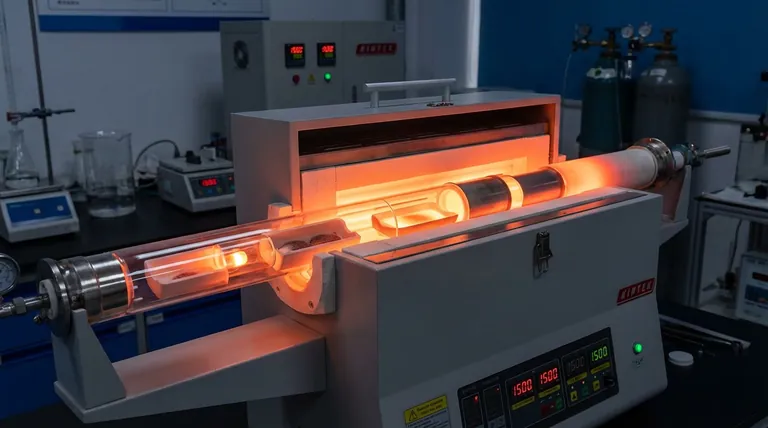
Imagine this: hours into a critical synthesis, a faint crack appears. The carefully controlled atmosphere is compromised. The sample, once pristine, is now contaminated. The experiment is a failure.
This scenario isn't a random accident. It's often the direct result of a single, overlooked decision: the material chosen for the furnace's work tube.
The work tube is not a passive container. It is the heart of the furnace—the crucible where temperature, atmosphere, and material science converge. Its properties don’t just influence the experiment; they define its absolute limits. Selecting a tube material is less about browsing a catalog and more about designing the very foundation of your experimental success.
The Anatomy of a Critical Decision
The work tube is the component that must endure the most extreme thermal stress while containing your sample and controlling the processing atmosphere.
Therefore, its material composition dictates the furnace's operational ceiling. It sets the maximum temperature, the chemical environments you can safely create, and the long-term reliability of your entire setup. Choosing incorrectly isn't just inefficient; it's a risk to your research integrity.
The Three Archetypes of Furnace Tubes
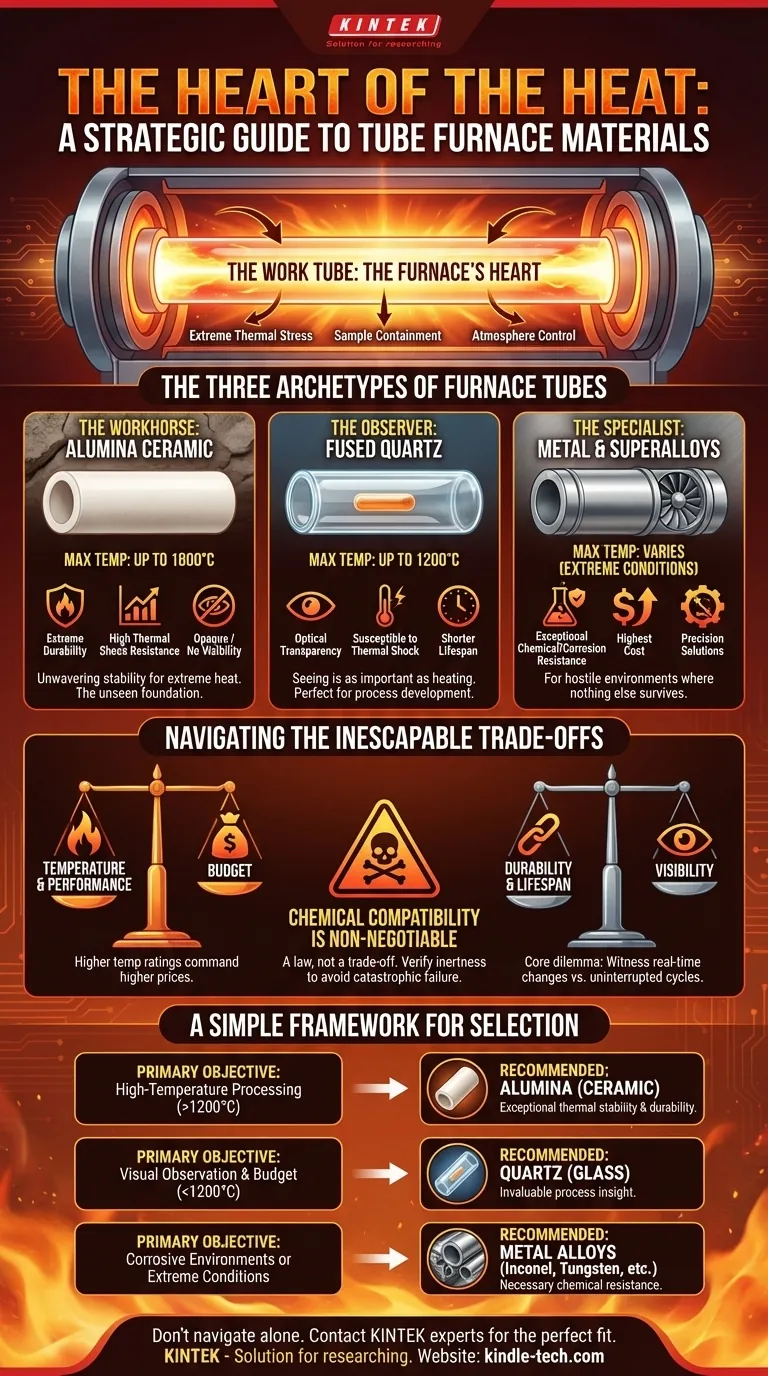
Work tubes are typically built from one of three material classes. Each represents a distinct philosophy of use, with its own strengths and inherent compromises.
The Workhorse: Alumina Ceramic
When your primary goal is achieving high temperatures with unwavering stability, recrystallized alumina (RCA) is the industry standard.
- Maximum Temperature: Up to 1800°C
- Key Trait: Extreme durability and high resistance to thermal shock.
- The Trade-off: Alumina is opaque. You sacrifice the ability to see your sample for the assurance of reaching and sustaining extreme heat over countless cycles. It is the unseen, unyielding foundation of high-temperature material science.
The Observer: Fused Quartz
When seeing is as important as heating, fused quartz is the material of choice.
- Maximum Temperature: Up to 1200°C
- Key Trait: Optical transparency.
- The Trade-off: Quartz is more susceptible to thermal shock and has a shorter operational lifespan than alumina. It offers the invaluable gift of direct visual observation—perfect for process development or teaching—but demands more careful handling. It’s a sprinter, not a marathon runner.
The Specialist: Metal & Superalloys
When the environment is as hostile as the heat, you need a specialist.
- Maximum Temperature: Varies, but built for extreme conditions.
- Key Trait: Exceptional chemical and corrosion resistance.
- The Trade-off: These materials—like Inconel for jet engine research or tungsten for processing corrosive materials—represent the highest cost. They are not general-purpose tools but precision solutions for the most demanding applications where nothing else will survive.
Navigating the Inescapable Trade-offs
Choosing a material is an exercise in balancing competing priorities. Understanding the psychology behind these choices can prevent costly errors.
Temperature vs. Budget
There is a clear correlation: higher temperature ratings command higher prices. Quartz is the most accessible option for work below 1200°C. Alumina and specialty alloys are significant investments, justified only by the need for their superior performance. Focusing solely on initial cost is a common cognitive trap that ignores the long-term cost of failed experiments.
Durability vs. Visibility
This is the core dilemma for many researchers. Do you need to witness a phase transition in real-time, or do you need to run hundreds of annealing cycles without interruption? Your answer defines your choice between quartz and alumina. It's a fundamental decision about your research methodology.
Chemical Compatibility is Non-Negotiable
This is not a trade-off; it is a law. Ignoring the potential chemical reactions between your sample, its off-gassing, and the tube material can lead to catastrophic failure. It can destroy your equipment and, more importantly, poison your results with contaminants. Always verify inertness.
A Simple Framework for Selection
Your application dictates the ideal material. Let your primary objective be your guide.
| Primary Objective | Recommended Material | Why It's the Right Choice |
|---|---|---|
| High-Temperature Processing (>1200°C) | Alumina (Ceramic) | Its exceptional thermal stability and durability ensure reliable, repeatable results at extreme temperatures. |
| Visual Observation & Budget Applications (<1200°C) | Quartz (Glass) | Its transparency offers invaluable process insight at a lower initial cost. |
| Corrosive Environments or Extreme Conditions | Metal Alloys (Inconel, Tungsten, etc.) | Provides the necessary chemical resistance to maintain experimental integrity and safety. |
Making the right choice requires a clear understanding of your scientific goals matched with a deep knowledge of material properties. This decision goes beyond a simple spec sheet; it's about building a reliable system for discovery. At KINTEK, we specialize in providing not just lab equipment, but the expertise to ensure it's the perfect fit for your research.
If you're navigating these trade-offs, don't do it alone. Contact Our Experts to ensure your furnace is perfectly configured for the breakthroughs you're aiming for.
Visual Guide
Related Products
- Rotary Tube Furnace Split Multi Heating Zone Rotating Tube Furnace
- Laboratory Vacuum Tilt Rotary Tube Furnace Rotating Tube Furnace
- 1200℃ Split Tube Furnace with Quartz Tube Laboratory Tubular Furnace
- 1400℃ Laboratory High Temperature Tube Furnace with Alumina Tube
- 1700℃ Laboratory High Temperature Tube Furnace with Alumina Tube
Related Articles
- The Geometry of Heat: Why Motion Matters in Material Synthesis
- The Geometry of Heat: Engineering the Perfect Thermal Environment
- Exploring the Advantages of Rotary Tube Furnaces in Industrial and Laboratory Applications
- The Physics of Perfection: How Rotary Furnaces Eliminate Randomness in Material Processing
- Exploring Rotary Tube Furnaces: A Comprehensive Guide



















