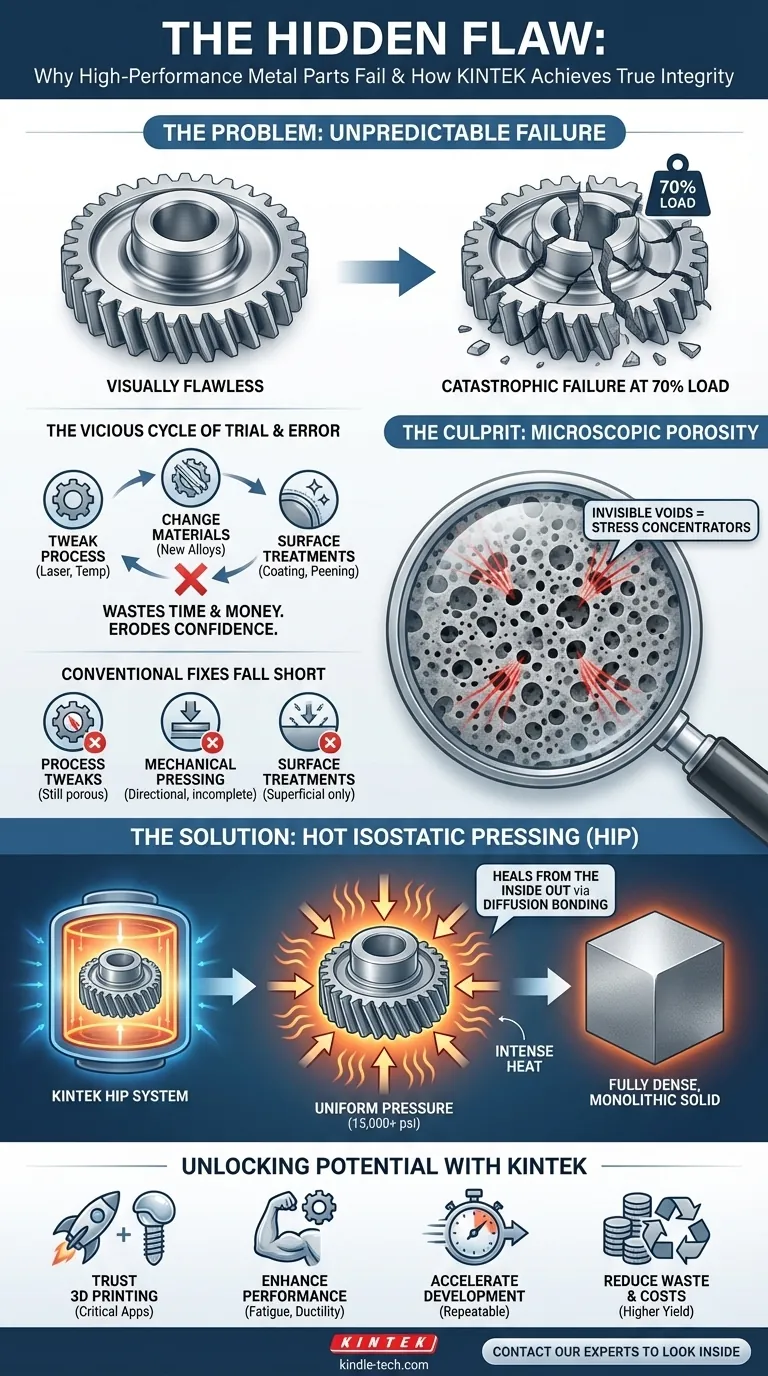
You’ve just produced a batch of mission-critical metal components. Maybe they were intricately 3D-printed or precision-cast. Visually, they are flawless. They pass every dimensional check. But when the stress test results come back, it's a disaster. One part performs beautifully, while the next one fractures at 70% of its expected load. You're left with a frustrating, expensive question: why are my seemingly perfect parts so dangerously unpredictable?
The Vicious Cycle of Trial and Error
If this scenario sounds familiar, you're not alone. In industries from aerospace to medical implants, engineers grapple with this exact problem. The common response is to dive into a costly cycle of troubleshooting:
- Tweak the Process: You adjust the 3D printer's laser power, modify the casting temperature, or change the cooling rate. The results improve slightly, but the inconsistency remains.
- Change the Materials: You switch to a different, often more expensive, metal powder or alloy, hoping a new material will solve the problem. It doesn't.
- Add Surface Treatments: You try shot peening or coating the parts, assuming the weakness lies on the surface. Yet, they still fail from the inside.
Each of these attempts consumes weeks of time, wastes valuable materials, and delays critical projects. The most significant business consequence is a loss of confidence. You can't fully trust advanced manufacturing methods like 3D printing for your most demanding applications, forcing you to stick with slower, more expensive, and less complex traditional methods. This invisible barrier doesn't just cost money; it stifles innovation.
Revealing the Invisible Enemy: Microscopic Porosity
The reason these efforts fail is that they are all aimed at the wrong target. The problem isn't something you can see on the surface or fix by adjusting a high-level process parameter. The true culprit is an invisible enemy lurking deep within the material: microscopic porosity.
Processes like casting and additive manufacturing (3D printing) build parts by solidifying liquid metal or fusing layers of powder. No matter how precise the machine, this process almost always leaves behind tiny, microscopic voids—like a bucket of tightly packed sand versus a solid block of glass. While the part appears solid, it is internally riddled with these imperceptible weak points.
Under stress, these voids act as "stress concentrators." They are the starting points from which catastrophic cracks can form and spread, causing the part to fail well below its theoretical strength.
Why Conventional Fixes Fall Short
Now it’s clear why the common solutions don't work.
- Process Tweaks might reduce the number or size of pores, but they cannot eliminate them with the 100% certainty required for critical components. You are simply playing a game of chance.
- Mechanical Pressing only applies force from one or two directions. It can't reach and collapse voids trapped deep inside a part with complex geometry.
- Surface Treatments are entirely superficial. They do nothing to fix the internal structural flaws where failures truly begin.
To solve this problem, you don't need to treat the surface. You need to heal the material from the inside out.
The Solution: Healing Metal from the Inside Out
To eliminate internal porosity, you need a method that can do two things simultaneously:
- Heat the material until it becomes soft and malleable on a microscopic level.
- Apply immense, perfectly uniform pressure from all directions at once to squeeze the part and collapse every internal void.
This is precisely what Hot Isostatic Pressing (HIP) is engineered to do. It’s not a brute-force press; it’s a sophisticated thermal process that fundamentally re-engineers the material's internal structure.
KINTEK's HIP Systems: Designed for Density
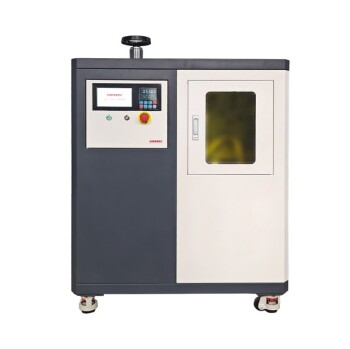
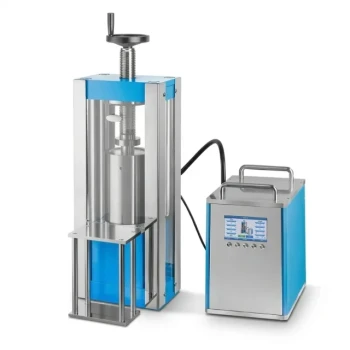
A Hot Isostatic Press isn't just a high-temperature oven. It's a precision-controlled system designed to solve the exact problem of internal porosity. Inside a KINTEK HIP system, your components are heated in a sealed chamber filled with an inert gas, typically argon. This gas is then pressurized to extreme levels—often over 15,000 psi.
This high-pressure gas acts like a fluid, pushing with equal force on every single surface of your part, no matter how complex its shape. The combination of intense heat and uniform pressure forces the microscopic voids to collapse. The material then bonds together at an atomic level in a process called "diffusion bonding," effectively erasing the boundaries between particles.
The result is no longer a part with hidden weaknesses. It is a fully dense, monolithic solid with a uniform internal structure, transforming it from unpredictable to completely reliable.
Beyond a Fix: Unlocking New Manufacturing Potential
Once you can reliably eliminate internal porosity, Hot Isostatic Pressing becomes more than just a fix for a nagging problem. It becomes an enabler of true innovation. With a predictable and dependable process for creating fully dense parts, you can:
- Trust 3D Printing for Critical Applications: Confidently use lighter, more complex 3D-printed parts for aerospace, medical, and automotive components where failure is not an option.
- Enhance Performance: Dramatically improve the fatigue life, ductility, and impact strength of your parts, allowing them to perform under more extreme conditions.
- Accelerate Development: Stop chasing random failures and move forward with a repeatable manufacturing process, shortening your time-to-market for new products.
- Reduce Waste and Costs: Drastically increase the yield of usable parts from every manufacturing run, directly improving your bottom line.
Solving the problem of internal porosity isn’t just about making better parts; it’s about unlocking the full potential of advanced manufacturing and building the products of the future with confidence. If your team is struggling with inconsistent part performance, the issue may be deeper than you think. We can help you look inside. Contact Our Experts.
Visual Guide
Related Products
- Warm Isostatic Press for Solid State Battery Research
- Electric Split Lab Cold Isostatic Press CIP Machine for Cold Isostatic Pressing
- Manual Cold Isostatic Pressing Machine CIP Pellet Press
- Automatic High Temperature Heated Hydraulic Press Machine with Heated Plates for Lab
- Isostatic Molding Pressing Molds for Lab
Related Articles
- WIP – Warm Isostatic Press Equipment: Design, Features, and Benefits
- Beyond the Spec Sheet: Mastering the Thermal Dynamics of Warm Isostatic Pressing
- Warm Isostatic Pressing An Overview of the Process and Equipment
- Warm Isostatic Pressing: An Advanced Manufacturing Technology
- Choosing the Right Warm Isostatic Press: Key Factors to Consider