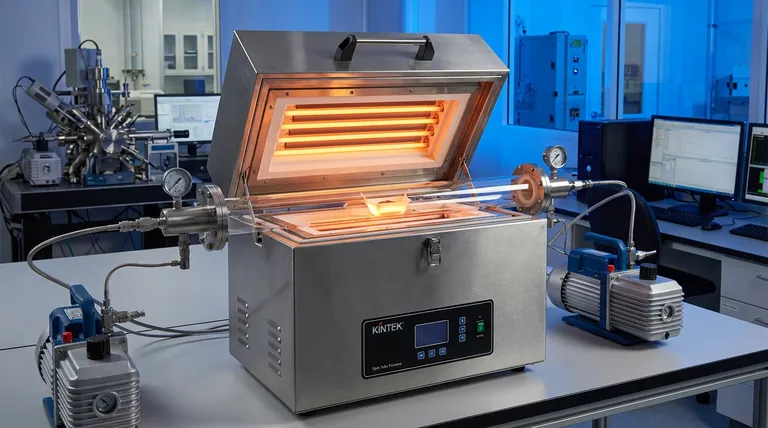
The Illusion of Simple Heat
Imagine a materials scientist attempting to grow a perfect, single-crystal semiconductor. The goal is atomic-level order. The temperature must be exact. But the greatest enemy isn't a faulty controller; it's the air we breathe.
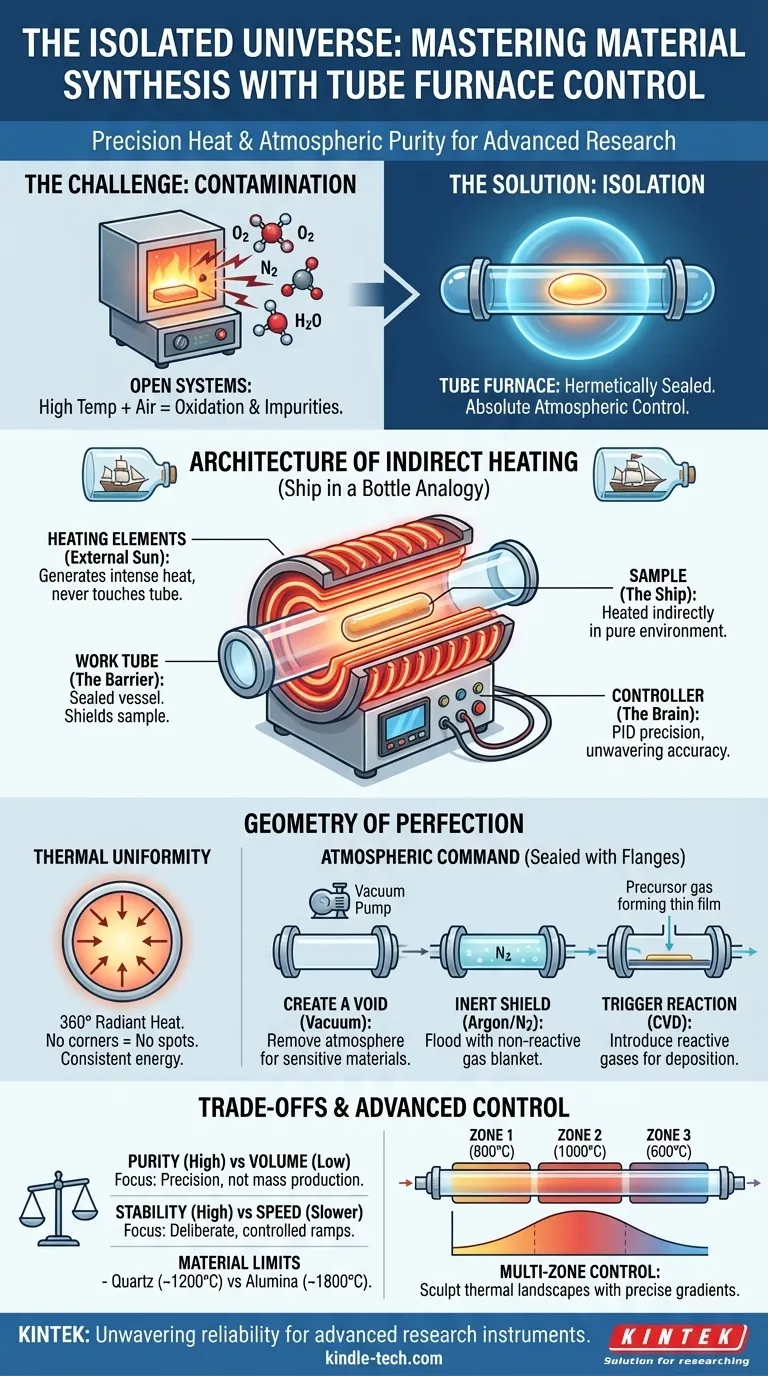
Oxygen, nitrogen, and water vapor are aggressive contaminants at high temperatures. They react, they oxidize, they destroy the delicate structures you're trying to build. Most heating methods—like an open flame or a simple box furnace—are messy. They heat the sample, but they also expose it to this uncontrolled chemical chaos.
The core psychological drive behind the invention of the tube furnace is the need for absolute control. It’s the realization that to create something pure, you must first create a pure, isolated universe for it to exist in.
The Architecture of Isolation
A tube furnace doesn't just heat a sample. It creates a hermetically sealed environment and then heats it from the outside. The operating principle is one of elegant indirection.
Think of it as building a ship in a bottle, where the sample is the ship and the work tube is the bottle. The heat is applied to the glass, not the ship directly. This simple separation is the source of its power.
- Heating Elements: The external sun. Coils made of high-resistance alloys wrap around a chamber, generating intense heat without ever touching the work tube.
- The Work Tube: The barrier. A ceramic or quartz cylinder slides through the center of the heating chamber. It is the vessel, the atmosphere container, the shield against contamination.
- The Controller: The brain. A thermocouple measures the temperature, and a PID controller precisely modulates power to the elements, executing the user's pre-programmed thermal profile with unwavering accuracy.
This design isn't just about getting hot. It’s about getting hot cleanly and predictably.
Why a Cylinder? The Geometry of Perfection
The choice of a tube is not arbitrary. Its geometry is fundamental to achieving two types of perfection: thermal and atmospheric.
Uniformity as a Default State
Heat radiates inward from all 360 degrees of the heating chamber wall, converging on the sample at the center. This creates a naturally uniform temperature zone along the tube's central axis. A box furnace has corners and faces, leading to inherent cold and hot spots. A cylinder has no corners. It is the most efficient shape for delivering consistent thermal energy.
The Power of a Controlled Atmosphere
More importantly, a tube is trivial to seal. By adding flanges to both ends, the furnace is transformed from a simple oven into a sophisticated chemical reactor. This unlocks complete command over the gaseous environment.
- Creating a Void: You can pull a vacuum, removing the atmosphere entirely. This is essential for processes like degassing or creating materials that are hyper-sensitive to oxidation.
- Building an Inert Shield: You can flood the tube with inert gases like Argon or Nitrogen. These heavy, non-reactive gases act as a protective blanket, preventing unwanted chemical reactions.
- Triggering a Reaction: You can introduce reactive gases for processes like Chemical Vapor Deposition (CVD), where the gas itself is a precursor that decomposes on the hot sample to form a thin film.
Choosing Your Instrument: The Trade-offs of Control
No engineering solution is without its trade-offs. The tube furnace's strengths are born from its limitations. Understanding them is key to making the right choice.
Purity Over Volume
The diameter of the work tube inherently limits your sample size. This isn't a flaw; it's a deliberate focus. You sacrifice the high-volume capacity of a box furnace to gain near-perfect environmental purity. It is a tool for precision, not mass production.
Patience for Precision
Because heat must first saturate the work tube before reaching the sample, heating and cooling cycles can be slower. This is the price paid for thermal stability. The system is designed for deliberate, controlled ramps, not instantaneous temperature spikes.
Material Boundaries
The maximum temperature is defined by the work tube itself. Quartz is versatile and offers excellent vacuum integrity but typically maxes out around 1200°C. High-purity alumina or mullite tubes can push into the 1600-1800°C range, but may be more brittle. The vessel you choose dictates the limits of your exploration.
| Component | Primary Function | Core Benefit |
|---|---|---|
| Work Tube | Isolates the sample inside a sealed chamber | Enables complete atmospheric and purity control |
| Heating Coils | Heat the work tube from the outside | Provides indirect, uniform thermal radiation |
| Controller | Executes precise temperature/time profiles | Ensures process repeatability and accuracy |
| Sealing Flanges | Seal the ends of the tube for gas or vacuum | Transforms the furnace into a chemical reactor |
From a Single Hot Zone to a Thermal Landscape
The simplest tube furnace has one set of heating elements, creating a single, stable hot zone. This is the workhorse for annealing, crystallizing, and sintering.
But for more complex processes, a multi-zone furnace is required. With two, three, or even five independently controlled heating zones along its length, you are no longer just setting a temperature; you are sculpting a thermal landscape. This allows you to create precise temperature gradients, essential for advanced crystal growth or specialized chemical deposition where different reactions must occur at specific points along the sample.
The Right Tool for the Right Mindset
Ultimately, the choice of a furnace reflects a scientific priority.
- The Purist, focused on atomic-level integrity, requires the absolute atmospheric control of a sealed tube furnace.
- The Producer, focused on throughput and scale, is better served by the large capacity of a box furnace.
- The Architect, focused on designing complex thermal environments, needs the granular control of a multi-zone tube furnace.
At KINTEK, we understand that a furnace is an instrument of creation. Our laboratory equipment is engineered to provide the unwavering reliability and precision that advanced research demands. Whether you require the steadfast consistency of a single-zone system or the intricate control of a multi-zone furnace, our solutions provide the foundation for your next discovery. Contact Our Experts
Visual Guide
Related Products
- Rotary Tube Furnace Split Multi Heating Zone Rotating Tube Furnace
- Laboratory Vacuum Tilt Rotary Tube Furnace Rotating Tube Furnace
- 1200℃ Split Tube Furnace with Quartz Tube Laboratory Tubular Furnace
- 1400℃ Laboratory High Temperature Tube Furnace with Alumina Tube
- 1700℃ Laboratory High Temperature Tube Furnace with Alumina Tube
Related Articles
- The Geometry of Heat: Why Motion Matters in Material Synthesis
- Exploring the Advantages of Rotary Tube Furnaces in Industrial and Laboratory Applications
- The Geometry of Heat: Engineering the Perfect Thermal Environment
- Exploring the Functions and Advantages of Rotary Tube Furnaces
- Exploring Rotary Tube Furnaces: A Comprehensive Guide



















