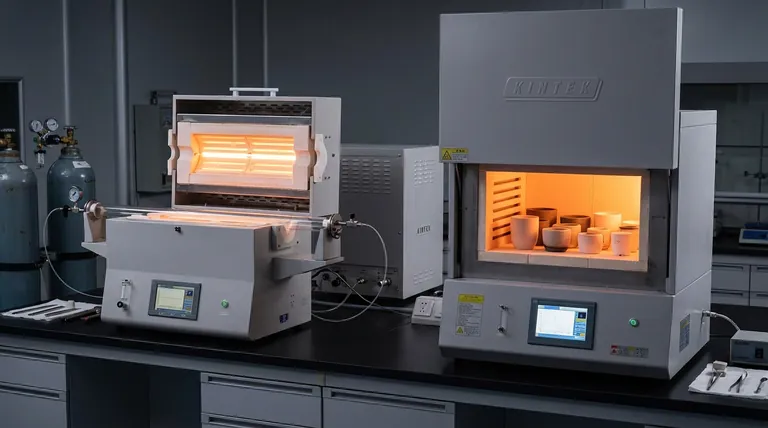
The Core Philosophy: A Journey or a Destination?
In thermal processing, every material undergoes a transformation. The fundamental question is how it gets there.
Does your material need to take a continuous journey through a controlled thermal landscape? Or does it need to arrive at a discrete, static destination where it can be held in a perfect, uniform state?
This isn't a trivial distinction. It's a choice between two entirely different philosophies of work, and it’s the single most important factor when choosing between a tube furnace and a box furnace. The decision is not about the equipment's shape, but about the nature of your process.
How Design Follows Philosophy
The physical form of each furnace is a direct consequence of its intended workflow. One is built for movement; the other is built for stasis.
The Tube Furnace: The Path of Continuity
A tube furnace is the embodiment of a continuous process. It's designed around a narrow, cylindrical path.
Materials—be it wires, fibers, or powders—enter one end, travel through a precise hot zone, and exit the other. The entire design is optimized for this linear flow. Its narrow footprint is a byproduct of its purpose: to create an efficient, in-line heating journey, not to hold a large volume.
This makes it the specialist's tool for processes that require a dynamic, flowing gas environment, where the atmosphere moves with the material.
The Box Furnace: The Controlled Environment
A box furnace, also known as a muffle furnace, is a self-contained world. It's a static chamber designed to create a perfectly uniform and stable environment.
You place your samples inside, seal the door, and the entire batch is heated as one. Its design prioritizes internal volume and accessibility to accommodate a wide variety of shapes and sizes. It excels at creating a highly stable, static atmosphere, where conditions remain constant for the duration of the process.
It is the versatile workhorse for when the material's destination—a specific, unwavering temperature and atmosphere—is what matters most.
The Critical Trade-Off: Specialization vs. Versatility
Your choice reflects a commitment. Are you investing in hyper-efficiency for a known task, or are you investing in flexibility for an unknown future?
The Specialist's Efficiency
A tube furnace is like a scalpel. For its intended purpose—high-volume, continuous production—its efficiency is unmatched. It minimizes the energy waste of heating and cooling cycles inherent in batch work and integrates seamlessly into automated production lines.
It is the perfect instrument for a single, well-defined job. But it lacks the flexibility to adapt to wildly different tasks.
The Generalist's Freedom
A box furnace is the lab's Swiss Army knife. Its value lies in its profound versatility. One day it might be used for annealing large components; the next, for heat-treating dozens of small crucibles.
This flexibility is essential for research and development, job shops, or any environment where the next task is unpredictable. It trades the in-line efficiency of a tube furnace for the freedom to say "yes" to nearly any batch heating challenge.
Making the Right Decision for Your Lab
To choose correctly, don't start with temperature specs. Start by defining your workflow. Ask yourself:
- Is my process continuous? For high-volume production of uniform materials like wires, fibers, or powders, a tube furnace is built for your in-line needs.
- Is my work varied? For multi-purpose heat treatment of diverse sample sizes and shapes, a box furnace provides essential versatility.
- Is atmospheric stability critical? For processes requiring a perfectly uniform and static gas environment, a sealed box furnace offers superior control.
- Am I simulating a continuous process? For R&D on long, thin samples or pilot-scale continuous experiments, a laboratory tube furnace is the ideal choice.
Quick Comparison: At a Glance
| Feature | Tube Furnace | Box Furnace |
|---|---|---|
| Processing Method | Continuous, in-line | Batch, static |
| Ideal For | Wires, fibers, powders | Various shapes & sizes |
| Atmosphere Control | Flowing gas environment | Stable, static atmosphere |
| Primary Strength | Specialized process efficiency | Versatile, multi-purpose |
| Best Environment | High-volume production | R&D, varied job shops |
This decision is about more than just equipment; it's about aligning your tools with your scientific or production goals. At KINTEK, we understand that the right furnace is the one that seamlessly integrates with your workflow, enhancing both efficiency and results.
Whether your work requires a continuous journey or a controlled destination, we can help you find the perfect thermal processing solution. Contact Our Experts
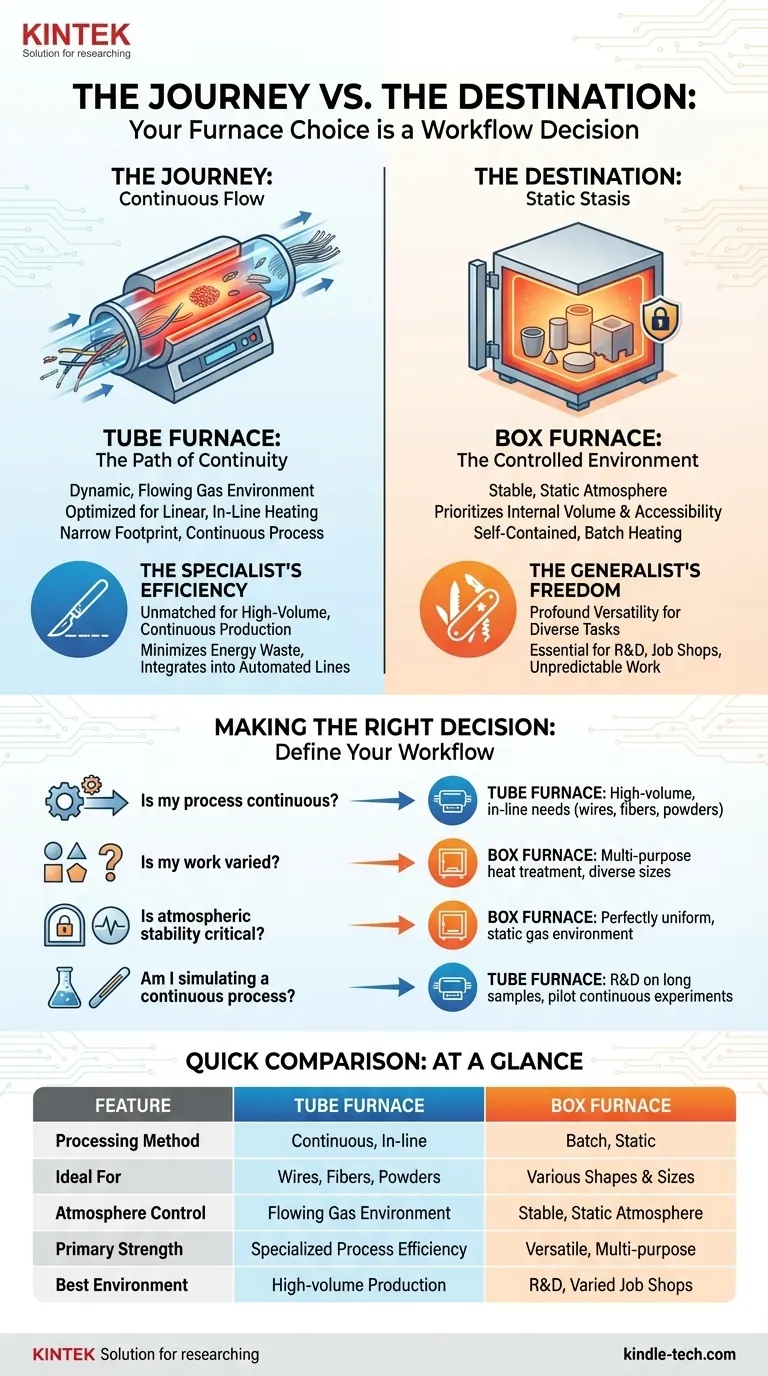
Visual Guide
Related Products
- Rotary Tube Furnace Split Multi Heating Zone Rotating Tube Furnace
- Laboratory Vacuum Tilt Rotary Tube Furnace Rotating Tube Furnace
- 1200℃ Split Tube Furnace with Quartz Tube Laboratory Tubular Furnace
- 1400℃ Laboratory High Temperature Tube Furnace with Alumina Tube
- 1700℃ Laboratory High Temperature Tube Furnace with Alumina Tube
Related Articles
- The Geometry of Heat: Why Motion Matters in Material Synthesis
- Exploring the Benefits and Applications of Rotary Furnaces: A Comprehensive Guide
- Exploring the Functions and Advantages of Rotary Tube Furnaces
- Exploring Rotary Tube Furnaces: A Comprehensive Guide
- The Physics of Perfection: How Rotary Furnaces Eliminate Randomness in Material Processing



















