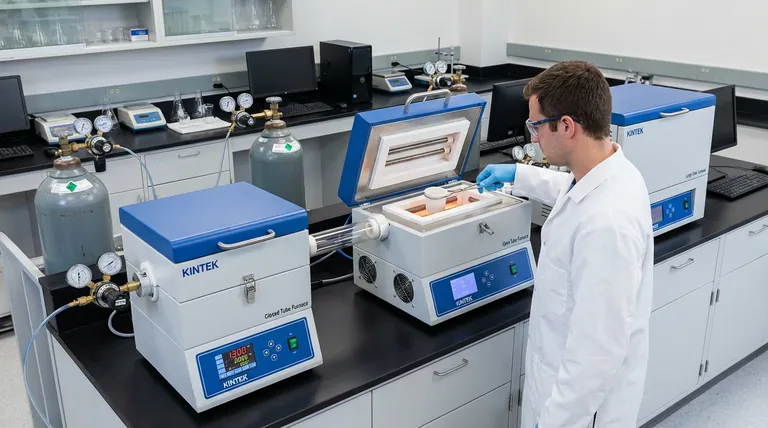
The Pursuit of the Perfect Variable
In materials science, chemistry, and engineering, the goal is often to eliminate variables. A researcher trying to grow a flawless single crystal or anneal a new alloy is in a constant battle against uncontrolled factors—a stray wisp of oxygen, a one-degree temperature fluctuation, a subtle thermal gradient.
These aren't minor annoyances; they are the difference between a breakthrough and a failed experiment.
The environment in which a sample is heated is the most critical variable of all. This is where the simple, elegant design of the tube furnace becomes not just a piece of equipment, but a fundamental instrument of control. Its entire purpose is to create a small pocket of thermal and atmospheric perfection.
The Physics of a Controlled World
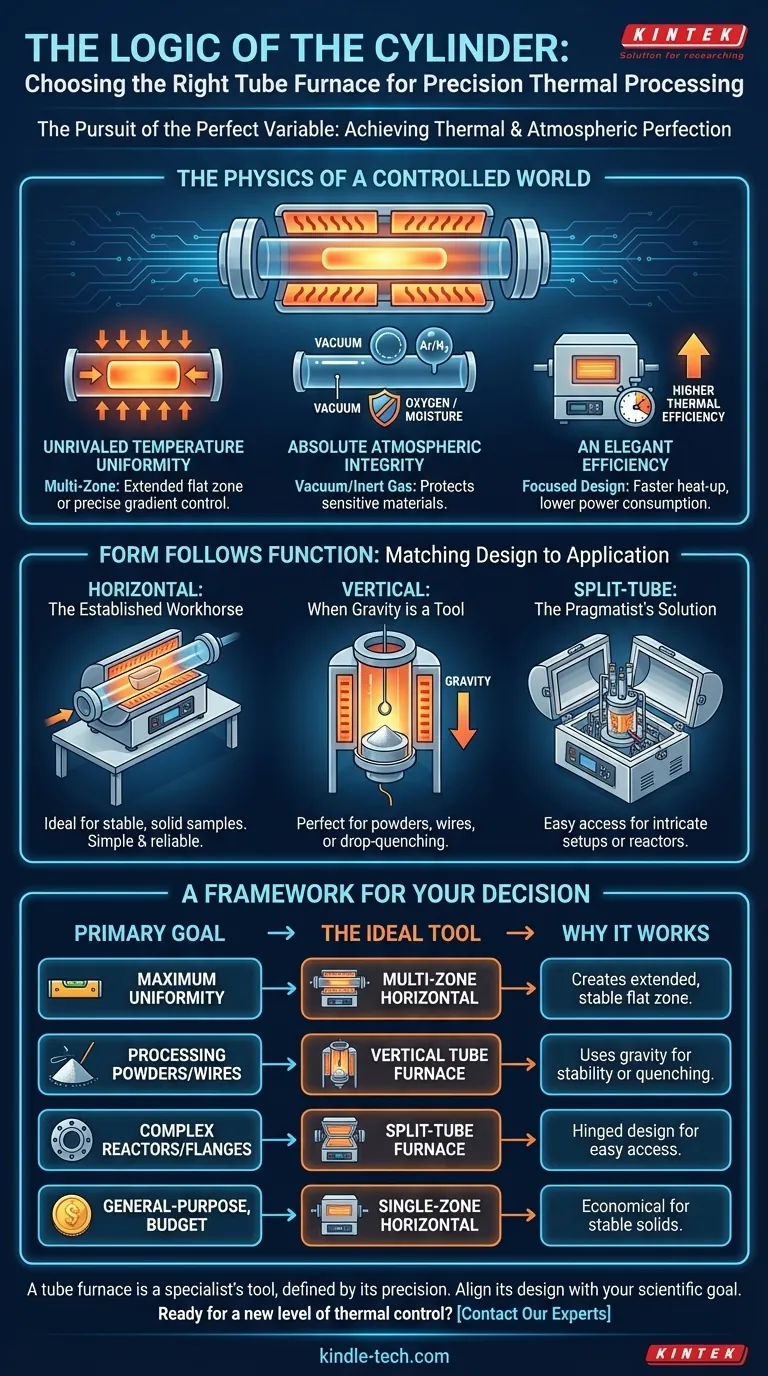
A tube furnace isn't just a smaller box furnace. Its cylindrical geometry is a deliberate engineering choice that delivers distinct advantages rooted in physics and efficiency.
Unrivaled Temperature Uniformity
The primary reason to choose a tube furnace is its ability to surround a sample with heat. By arranging heating elements symmetrically around a central tube, it creates a uniform thermal flux. The sample doesn't just get hot; it gets hot from all sides at once.
For processes demanding absolute precision, multi-zone furnaces take this a step further. By creating independently controlled heating zones along the tube, they can either extend the length of the perfectly uniform "flat zone" or create a deliberate, precise temperature gradient for advanced thermal processing.
Absolute Atmospheric Integrity
Many modern materials are incredibly sensitive. Exposure to oxygen or moisture at high temperatures can ruin them. The enclosed tube of a furnace acts as a fortress.
It allows you to completely evacuate the atmosphere to create a vacuum or purge the chamber with a high-purity inert gas like argon. This control over the atmosphere is non-negotiable for applications in semiconductors, advanced ceramics, and sensitive chemical synthesis.
An Elegant Efficiency
In a world of wasted energy, the tube furnace is remarkably focused. Its design places the heating elements in close proximity to the sample, minimizing the volume that needs to be heated.
This results in higher thermal efficiency, faster heat-up and cool-down times, and lower power consumption. It's an efficient tool for a precise job, saving both time and operational costs.
Form Follows Function: Matching Design to Application
The choice of furnace configuration is a direct reflection of your material and your process. The right choice isn't the most expensive one, but the one whose design solves your specific logistical challenges.
Horizontal: The Established Workhorse
The horizontal tube furnace is the default for a reason. It is perfectly suited for processing stable, solid samples that can be placed in a crucible or boat and slid into the center. It's simple, reliable, and effective for a vast range of general-purpose heat treatment applications.
Vertical: When Gravity is a Tool
What happens when your sample is a powder that can't be disturbed, or a wire that needs to be suspended? Or when you need to rapidly quench a sample by dropping it into a cooling bath?
In these cases, gravity is a crucial part of the process. A vertical tube furnace is designed specifically for these scenarios. It uses gravity to its advantage, enabling bottom-loading for delicate samples or top-loading for processes like drop-quenching, where speed is critical.
Split-Tube: The Pragmatist's Solution
Imagine trying to install a sealed quartz reactor with complex end flanges into a solid, one-piece furnace tube. It's often impossible.
The split-tube furnace, with its hinged, clamshell design, is the pragmatic solution. It opens up to allow easy placement of the work tube or reactor, making it indispensable for experiments with intricate setups that simply cannot be loaded from the end.
A Framework for Your Decision
Choosing the right furnace is about identifying your single most important requirement. The limitations of one design are often the strengths of another.
| Primary Goal | The Ideal Tool | Why It Works |
|---|---|---|
| Maximum Temperature Uniformity | Multi-Zone Horizontal Furnace | Independent zones create an extended, highly stable flat zone for repeatable results. |
| Processing Powders or Wires | Vertical Tube Furnace | Uses gravity to ensure samples remain stable or suspended during processing. Ideal for quenching. |
| Using Complex Reactors/Flanges | Split-Tube Furnace | Hinged design provides direct access to the work tube, simplifying complex setups. |
| General-Purpose, Budget-Friendly | Single-Zone Horizontal Furnace | The most economical and straightforward solution for heating stable, solid samples. |
Understanding these trade-offs is key. A tube furnace is a specialist's tool. Its power comes from its constraints—the small diameter, the precise thermal zone, the controlled atmosphere. It does one thing, but it does it with a level of perfection that larger, more general-purpose equipment cannot match.
Choosing the right furnace is not just about specs; it's about aligning a tool's fundamental design with your scientific goal. At KINTEK, we specialize in providing these precise tools for ambitious research. If you're ready to achieve a new level of thermal control, Contact Our Experts.
Visual Guide
Related Products
- Rotary Tube Furnace Split Multi Heating Zone Rotating Tube Furnace
- Laboratory Vacuum Tilt Rotary Tube Furnace Rotating Tube Furnace
- 1200℃ Split Tube Furnace with Quartz Tube Laboratory Tubular Furnace
- 1400℃ Laboratory High Temperature Tube Furnace with Alumina Tube
- 1700℃ Laboratory High Temperature Tube Furnace with Alumina Tube
Related Articles
- The Geometry of Heat: Why Motion Matters in Material Synthesis
- Exploring the Advantages of Rotary Tube Furnaces in Industrial and Laboratory Applications
- Exploring Rotary Tube Furnaces: A Comprehensive Guide
- Exploring the Benefits and Applications of Rotary Furnaces: A Comprehensive Guide
- The Physics of Perfection: How Rotary Furnaces Eliminate Randomness in Material Processing



















