Blog The Physics of Limits: Understanding Tube Furnace Temperatures
The Physics of Limits: Understanding Tube Furnace Temperatures

The Physics of Limits: Understanding Tube Furnace Temperatures

6 hours ago

The Illusion of the Dial

In the laboratory, there is a seduction to high numbers. We look at a furnace specification sheet, see "1600°C," and assume that is the machine's natural state.

But temperature is not a static feature. It is a struggle against entropy.

A tube furnace is a vessel designed to contain a violent amount of energy in a very small space. The limit of that energy is not dictated by the controller on the front panel. It is dictated by the materials inside the chamber.

When you ask, "What is the temperature of a tube furnace?", you are actually asking a materials science question: What is the breaking point of the heating element?

Understanding this distinction is the difference between a successful experiment and a melted, expensive pile of scrap.

The Hierarchy of Heat

Engineering is the art of trade-offs. To achieve higher temperatures, we must trade common materials for exotic ones.

The thermal capacity of a tube furnace is determined strictly by the composition of its heating elements. There are three distinct tiers, each acting as a gatekeeper to a specific thermal realm.

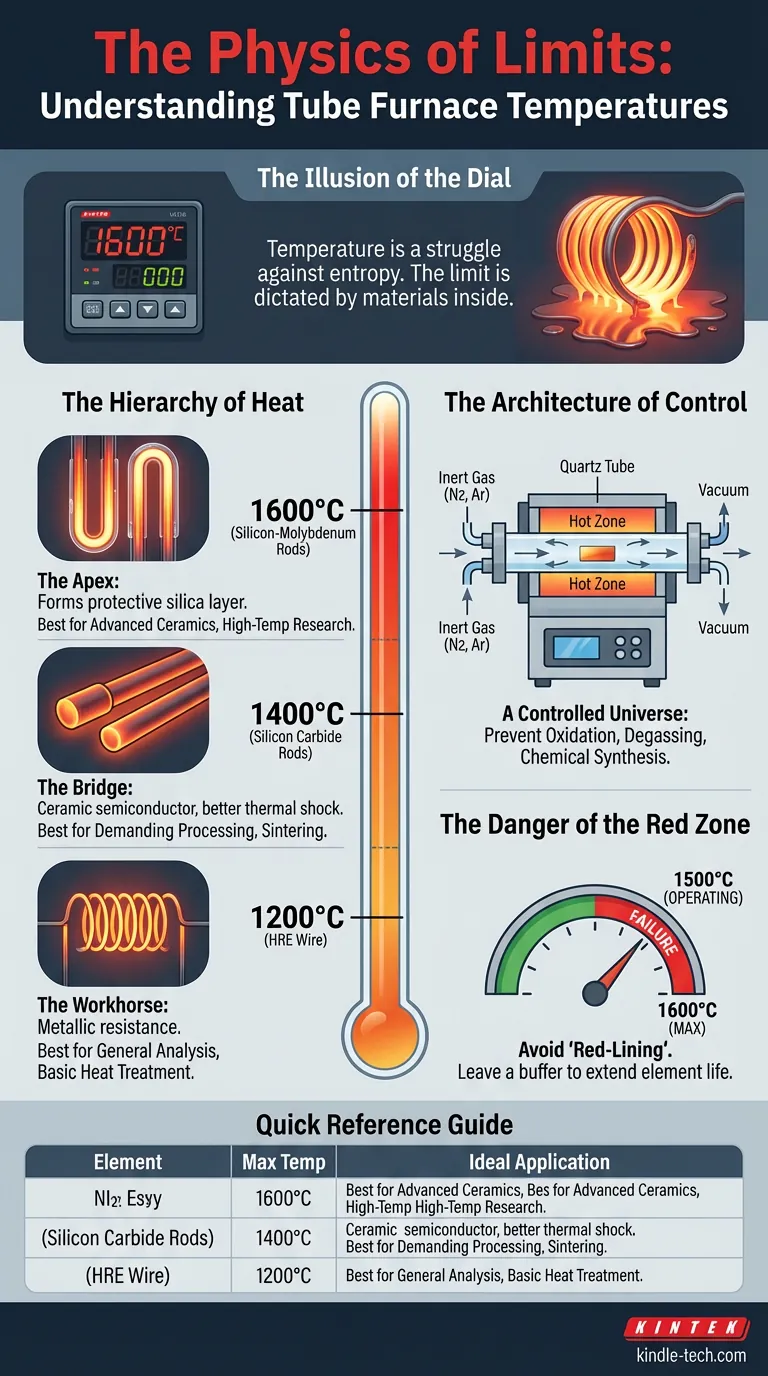
1. The Workhorse: HRE Resistance Wire (Up to 1200°C)

Think of this as the elevated version of the filament in a toaster, but engineered for precision. High-Resistance Element (HRE) wire is reliable and cost-effective.

  • The Physics: It relies on metallic resistance to generate heat.
  • The Limit: Beyond 1200°C, the metal structure begins to degrade rapidly.
  • Best For: General chemical analysis, basic heat treatment.

2. The Bridge: Silicon Carbon Rods (Up to 1400°C)

When metal fails, we turn to ceramics. Silicon Carbide (SiC) is a robust semiconductor material that can withstand thermal shock better than wire.

  • The Physics: These rods glow with an intense, rigid heat.
  • The Limit: They push the boundary to 1400°C, allowing for processing that requires significant energy input.
  • Best For: Demanding materials processing and sintering.

3. The Apex: Silicon-Molybdenum Rods (Up to 1600°C)

At 1600°C, steel is a liquid. To sustain this environment, we use Molybdenum Disilicide (MoSi2).

  • The Physics: When heated, these rods form a protective glass-like layer of silica on their surface, preventing oxidation even at extreme temperatures.
  • The Limit: This is the current standard for non-induction high-temperature research.
  • Best For: Advanced ceramics sintering, high-temperature research.

The Architecture of Control

The "temperature" is only half the story. The romance of the tube furnace lies in what accompanies the heat: The Atmosphere.

A standard box furnace is often just a hot box of air. A tube furnace is a controlled universe.

By inserting a quartz or alumina tube through the heating elements, we create a barrier. Inside that tube, we can strip away the oxygen. We can introduce nitrogen, argon, or hydrogen.

This allows for chemistry that nature usually forbids:

  • Prevention of Oxidation: Keeping metals pure while hot.
  • Degassing: Using vacuum pressure to pull trapped gases out of a solid lattice.
  • Chemical Synthesis: Encouraging reactions that only occur in inert environments.

The Danger of the "Red Zone"

There is a psychological trap in engineering called "Red-Lining." It is the tendency to run a machine at exactly its maximum rated capacity.

If you buy a furnace rated for 1600°C and run it at 1600°C every day, you are choosing failure.

The operational reality:

  • Rated Temperature vs. Operating Temperature: A wise engineer leaves a buffer. Running a 1200°C furnace at 1100°C extends the life of the elements exponentially.
  • The Gradient: Heat is not perfectly uniform. The center of the tube—the "Hot Zone"—is accurate. The ends, near the insulation plugs, are cooler. Your sample must be positioned with intent.

Selecting Your Instrument

Choosing a furnace is not about buying the highest number you can afford. It is about matching the tool to the problem.

If you are annealing copper, a Silicon-Molybdenum furnace is financial overkill. If you are sintering zirconia, an HRE wire furnace is physically incapable of the task.

Quick Reference Guide

Heating Element Max Temp Ideal Application
HRE Wire 1200°C General analysis, basic annealing
Silicon Carbon 1400°C Harder materials, faster ramp rates
Silicon-Molybdenum 1600°C Advanced ceramics, sintering, research

Conclusion

The tube furnace is a testament to our ability to control the fundamental forces of nature—heat and atmosphere—on a desktop scale. But it requires respect for the materials that make it possible.

At KINTEK, we don't just sell equipment; we engineer solutions for the precise thermal environments your research demands. Whether you need the reliability of a 1200°C system or the extreme capability of a 1600°C workstation, we ensure the physics works in your favor.

Contact Our Experts

Visual Guide

The Physics of Limits: Understanding Tube Furnace Temperatures Visual Guide

Related Products

Related Articles

Related Products

1700℃ Laboratory High Temperature Tube Furnace with Alumina Tube

1700℃ Laboratory High Temperature Tube Furnace with Alumina Tube

Looking for a high-temperature tube furnace? Check out our 1700℃ Tube Furnace with Alumina Tube. Perfect for research and industrial applications up to 1700C.

Laboratory Rapid Thermal Processing (RTP) Quartz Tube Furnace

Laboratory Rapid Thermal Processing (RTP) Quartz Tube Furnace

Get lightning-fast heating with our RTP Rapid Heating Tube Furnace. Designed for precise, high-speed heating and cooling with convenient sliding rail and TFT touch screen controller. Order now for ideal thermal processing!

1400℃ Laboratory High Temperature Tube Furnace with Alumina Tube

1400℃ Laboratory High Temperature Tube Furnace with Alumina Tube

Looking for a tube furnace for high-temperature applications? Our 1400℃ Tube Furnace with Alumina Tube is perfect for research and industrial use.

1200℃ Split Tube Furnace with Quartz Tube Laboratory Tubular Furnace

1200℃ Split Tube Furnace with Quartz Tube Laboratory Tubular Furnace

KT-TF12 split tube furnace: high-purity insulation, embedded heating wire coils, and max. 1200C. Widely used for new materials and chemical vapour deposition.

Laboratory High Pressure Vacuum Tube Furnace

Laboratory High Pressure Vacuum Tube Furnace

KT-PTF High Pressure Tube Furnace: Compact split tube furnace with strong positive pressure resistance. Working temp up to 1100°C and pressure up to 15Mpa. Also works under controller atmosphere or high vacuum.

1800℃ Muffle Oven Furnace for Laboratory

1800℃ Muffle Oven Furnace for Laboratory

KT-18 muffle furnace with Japan Al2O3 polycrystalline fibe and Silicon Molybdenum heating element, up to 1900℃, PID temperature control and 7" smart touch screen. Compact design, low heat loss, and high energy efficiency. Safety interlock system and versatile functions.

1200℃ Controlled Atmosphere Furnace Nitrogen Inert Atmosphere Furnace

1200℃ Controlled Atmosphere Furnace Nitrogen Inert Atmosphere Furnace

Discover our KT-12A Pro Controlled atmosphere furnace - high precision, heavy duty vacuum chamber, versatile smart touch screen controller, and excellent temperature uniformity up to 1200C. Ideal for both laboratory and industrial application.

Laboratory Vacuum Tilt Rotary Tube Furnace Rotating Tube Furnace

Laboratory Vacuum Tilt Rotary Tube Furnace Rotating Tube Furnace

Discover the versatility of Laboratory Rotary Furnace: Ideal for calcination, drying, sintering, and high-temperature reactions. Adjustable rotating and tilting functions for optimal heating. Suitable for vacuum and controlled atmosphere environments. Learn more now!

Rotary Tube Furnace Split Multi Heating Zone Rotating Tube Furnace

Rotary Tube Furnace Split Multi Heating Zone Rotating Tube Furnace

Multi zone rotary furnace for high-precision temperature control with 2-8 independent heating zones. Ideal for lithium ion battery electrode materials and high-temperature reactions. Can work under vacuum and controlled atmosphere.

Multi-zone Laboratory Tube Furnace

Multi-zone Laboratory Tube Furnace

Experience precise, efficient thermal testing with our Multi Zone Tube Furnace. Independent heating zones and temperature sensors allow for controlled high-temperature gradient heating fields. Order now for advanced thermal analysis!

Multi Heating Zones CVD Tube Furnace Machine Chemical Vapor Deposition Chamber System Equipment

Multi Heating Zones CVD Tube Furnace Machine Chemical Vapor Deposition Chamber System Equipment

KT-CTF14 Multi Heating Zones CVD Furnace - Precise Temperature Control and Gas Flow for Advanced Applications. Max temp up to 1200℃, 4 channels MFC mass flow meter, and 7" TFT touch screen controller.

Vacuum Sealed Continuous Working Rotary Tube Furnace Rotating Tube Furnace

Vacuum Sealed Continuous Working Rotary Tube Furnace Rotating Tube Furnace

Experience efficient material processing with our vacuum-sealed rotary tube furnace. Perfect for experiments or industrial production, equipped with optional features for controlled feeding and optimized results. Order now.

1700℃ Controlled Atmosphere Furnace Nitrogen Inert Atmosphere Furnace

1700℃ Controlled Atmosphere Furnace Nitrogen Inert Atmosphere Furnace

KT-17A Controlled atmosphere furnace: 1700℃ heating, vacuum sealing technology, PID temperature control, and versatile TFT smart touch screen controller for laboratory and industrial use.

1700℃ Muffle Oven Furnace for Laboratory

1700℃ Muffle Oven Furnace for Laboratory

Get superior heat control with our 1700℃ Muffle Furnace. Equipped with intelligent temperature microprocessor, TFT touch screen controller & advanced insulation materials for precise heating up to 1700C. Order now!

Vacuum Heat Treat and Sintering Furnace with 9MPa Air Pressure

Vacuum Heat Treat and Sintering Furnace with 9MPa Air Pressure

The air pressure sintering furnace is a high-tech equipment commonly used for the sintering of advanced ceramic materials. It combines vacuum sintering and pressure sintering techniques to achieve high-density and high-strength ceramics.

Molybdenum Vacuum Heat Treat Furnace

Molybdenum Vacuum Heat Treat Furnace

Discover the benefits of a high-configuration molybdenum vacuum furnace with heat shield insulation. Ideal for high-purity, vacuum environments like sapphire crystal growth and heat treatment.

Horizontal High Temperature Graphite Vacuum Graphitization Furnace

Horizontal High Temperature Graphite Vacuum Graphitization Furnace

Horizontal Graphitization Furnace: This type of furnace is designed with the heating elements placed horizontally, allowing for uniform heating of the sample. It's well-suited for graphitizing large or bulky samples that require precise temperature control and uniformity.

1400℃ Muffle Oven Furnace for Laboratory

1400℃ Muffle Oven Furnace for Laboratory

Get precise high-temperature control up to 1500℃ with KT-14M Muffle furnace. Equipped with a smart touch screen controller and advanced insulation materials.

Vacuum Heat Treat Sintering Brazing Furnace

Vacuum Heat Treat Sintering Brazing Furnace

A vacuum brazing furnace is a type of industrial furnace used for brazing, a metalworking process that joins two pieces of metal using a filler metal that melts at a lower temperature than the base metals. Vacuum brazing furnaces are typically used for high-quality applications where a strong, clean joint is required.

Ultra-High Temperature Graphite Vacuum Graphitization Furnace

Ultra-High Temperature Graphite Vacuum Graphitization Furnace

The ultra-high temperature graphitization furnace utilizes medium frequency induction heating in a vacuum or inert gas environment. The induction coil generates an alternating magnetic field, inducing eddy currents in the graphite crucible, which heats up and radiates heat to the workpiece, bringing it to the desired temperature. This furnace is primarily used for graphitization and sintering of carbon materials, carbon fiber materials, and other composite materials.


Leave Your Message