Blog The Thermodynamics of Ambition: Why Your Tube Furnace Limit Is a Design Choice, Not a Number
The Thermodynamics of Ambition: Why Your Tube Furnace Limit Is a Design Choice, Not a Number

The Thermodynamics of Ambition: Why Your Tube Furnace Limit Is a Design Choice, Not a Number

3 hours ago

The Illusion of the Single Number

In the world of laboratory engineering, we often look for a single number to define capability. We ask, "What is the maximum temperature of this furnace?" as if asking for the top speed of a sports car.

But a furnace is not a car. It is a system fighting against entropy.

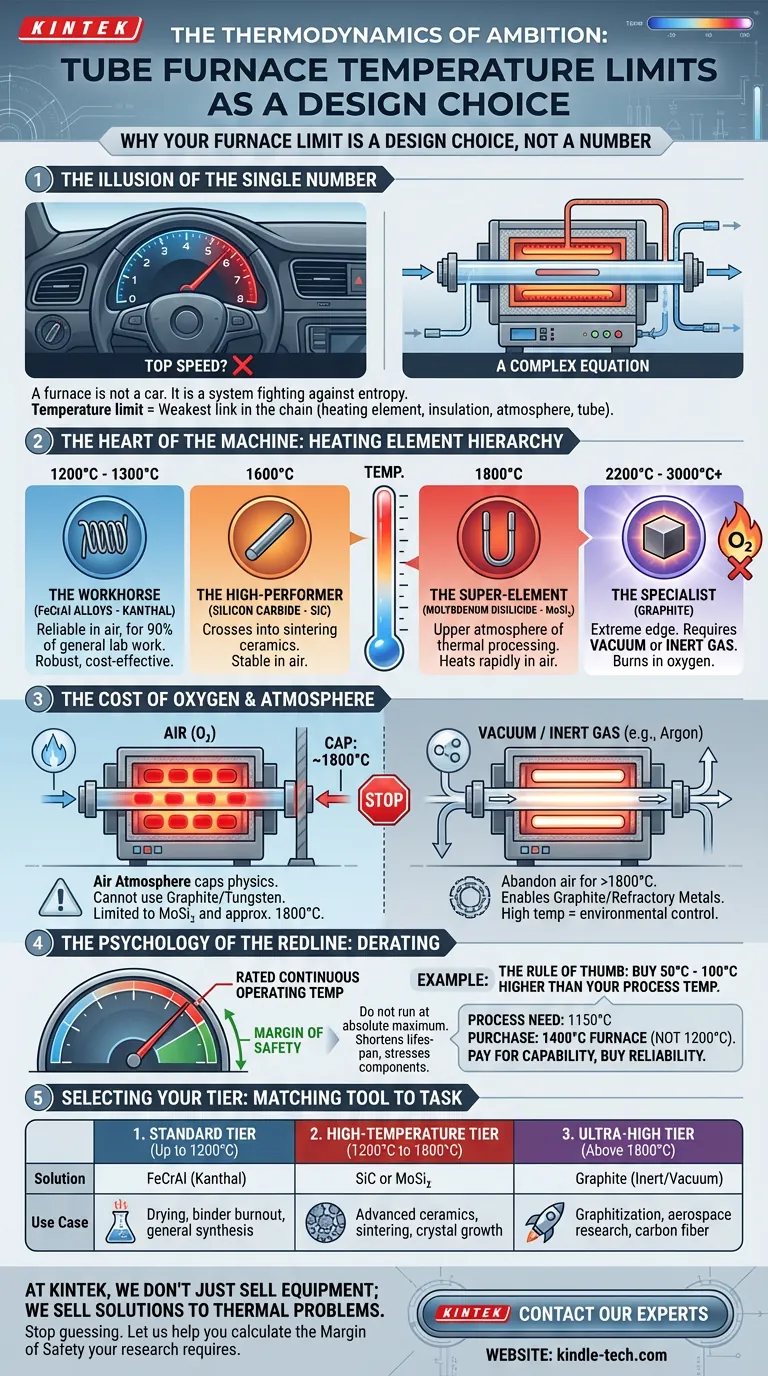
The answer to "how hot can it get?" is never a simple integer. It is a complex equation defined by the weakest link in the chain: the heating element, the insulation, the atmosphere, and the process tube itself.

A standard lab furnace might top out at 1200°C. A specialized graphite unit can scream past 3000°C.

The gap between those two numbers isn't just degrees. It is a fundamental difference in engineering philosophy and material science. To choose the right tool, you must understand the architecture of heat.

The Heart of the Machine: Heating Elements

The primary constraint on temperature is the material used to generate it.

When you push a material beyond its atomic limits, it doesn't just stop working. It oxidizes. It sags. It fails.

Here is the hierarchy of heat, defined by the elements that survive it:

  • The Workhorse (FeCrAl Alloys): Known as Kanthal, these are the standard for 90% of general lab work. They are robust and inexpensive, operating reliably in air up to 1200°C – 1300°C.
  • The High-Performer (Silicon Carbide): When you need to cross the threshold into sintering ceramics, SiC takes over. It remains stable in air up to 1600°C.
  • The Super-Element (Molybdenum Disilicide): MoSi₂ elements are designed for the upper atmosphere of thermal processing. They heat rapidly and can operate continuously in air up to 1800°C.
  • The Specialist (Graphite): This is the extreme edge. Graphite can reach 2200°C to 3000°C. But there is a catch: in the presence of oxygen, graphite burns. It requires a vacuum or inert gas to survive.

The Cost of Oxygen

This brings us to the most overlooked variable in thermal engineering: the atmosphere.

Heat does not exist in a vacuum—unless you build a machine specifically to create one.

If your process requires an air atmosphere (oxygen), your physics are capped. You cannot use graphite or tungsten elements, as they will destroy themselves at high temperatures. You are effectively limited to MoSi₂ elements and a ceiling of roughly 1800°C.

If you need to go higher—into the realm of 3000°C for graphitization or advanced aerospace testing—you must abandon air. You must invest in complex systems that maintain a vacuum or pump inert gases like argon.

High temperature is not just about power. It is about environmental control.

The Psychology of the Redline

In finance, there is a concept called the "Margin of Safety." In engineering, we call it "Derating."

Every furnace has a Rated Continuous Operating Temperature. This is the redline.

Can you drive a car at the redline for 10 hours straight? Yes. Should you? Absolutely not.

Running a furnace at its absolute maximum rating drastically shortens the lifespan of the heating elements and the insulation. It stresses the ceramic fiber and pushes the quartz or alumina tubes to their breaking points.

The Rule of Thumb: Always buy a furnace rated for 50°C to 100°C higher than your actual process temperature.

If you need to sinter at 1150°C daily, do not buy a 1200°C furnace. Buy a 1400°C model. You pay for the capability, but you are buying reliability.

Selecting Your Tier

We can simplify the complexity of thermal engineering into three distinct tiers of application.

1. The Standard Tier (Up to 1200°C)

The Solution: FeCrAl (Kanthal) Elements. The Use Case: This covers the majority of lab needs—drying, binder burnout, and general synthesis. It is cost-effective and low-maintenance.

2. The High-Temperature Tier (1200°C to 1800°C)

The Solution: SiC or MoSi₂ Elements. The Use Case: Essential for advanced materials science. This is where you sinter metal powders, process advanced ceramics, and grow crystals.

3. The Ultra-High Tier (Above 1800°C)

The Solution: Graphite or Refractory Metals (in vacuum/inert gas). The Use Case: Specialized industrial research. Carbon fiber production and extreme material testing.

Summary of Capabilities

Temperature Range Heating Element Typical Applications
Up to 1200°C Kanthal (FeCrAl) Drying, binder burnout, heat treatment
1200°C - 1800°C Silicon Carbide (SiC) / MoSi₂ Advanced ceramics, sintering, crystal growth
Above 1800°C Graphite (Inert/Vacuum only) Graphitization, aerospace research

Conclusion: Matching the Tool to the Task

A higher temperature rating is not always "better." It is simply different, usually more expensive, and often more complex to operate.

The goal is not to buy the furnace with the highest number on the datasheet. The goal is to buy the furnace that solves your specific problem with the highest degree of reliability.

At KINTEK, we don't just sell equipment; we sell solutions to thermal problems. Whether you need a robust daily driver for annealing or a specialized vacuum system for ultra-high temperature research, our engineers understand the trade-offs.

Stop guessing about the limits of your equipment. Let us help you calculate the Margin of Safety your research requires.

Contact Our Experts

Visual Guide

The Thermodynamics of Ambition: Why Your Tube Furnace Limit Is a Design Choice, Not a Number Visual Guide

Related Products

Related Articles

Related Products

1700℃ Laboratory High Temperature Tube Furnace with Alumina Tube

1700℃ Laboratory High Temperature Tube Furnace with Alumina Tube

Looking for a high-temperature tube furnace? Check out our 1700℃ Tube Furnace with Alumina Tube. Perfect for research and industrial applications up to 1700C.

1400℃ Laboratory High Temperature Tube Furnace with Alumina Tube

1400℃ Laboratory High Temperature Tube Furnace with Alumina Tube

Looking for a tube furnace for high-temperature applications? Our 1400℃ Tube Furnace with Alumina Tube is perfect for research and industrial use.

Laboratory High Pressure Vacuum Tube Furnace

Laboratory High Pressure Vacuum Tube Furnace

KT-PTF High Pressure Tube Furnace: Compact split tube furnace with strong positive pressure resistance. Working temp up to 1100°C and pressure up to 15Mpa. Also works under controller atmosphere or high vacuum.

1200℃ Split Tube Furnace with Quartz Tube Laboratory Tubular Furnace

1200℃ Split Tube Furnace with Quartz Tube Laboratory Tubular Furnace

KT-TF12 split tube furnace: high-purity insulation, embedded heating wire coils, and max. 1200C. Widely used for new materials and chemical vapour deposition.

Laboratory Rapid Thermal Processing (RTP) Quartz Tube Furnace

Laboratory Rapid Thermal Processing (RTP) Quartz Tube Furnace

Get lightning-fast heating with our RTP Rapid Heating Tube Furnace. Designed for precise, high-speed heating and cooling with convenient sliding rail and TFT touch screen controller. Order now for ideal thermal processing!

1200℃ Controlled Atmosphere Furnace Nitrogen Inert Atmosphere Furnace

1200℃ Controlled Atmosphere Furnace Nitrogen Inert Atmosphere Furnace

Discover our KT-12A Pro Controlled atmosphere furnace - high precision, heavy duty vacuum chamber, versatile smart touch screen controller, and excellent temperature uniformity up to 1200C. Ideal for both laboratory and industrial application.

Multi Heating Zones CVD Tube Furnace Machine Chemical Vapor Deposition Chamber System Equipment

Multi Heating Zones CVD Tube Furnace Machine Chemical Vapor Deposition Chamber System Equipment

KT-CTF14 Multi Heating Zones CVD Furnace - Precise Temperature Control and Gas Flow for Advanced Applications. Max temp up to 1200℃, 4 channels MFC mass flow meter, and 7" TFT touch screen controller.

1800℃ Muffle Oven Furnace for Laboratory

1800℃ Muffle Oven Furnace for Laboratory

KT-18 muffle furnace with Japan Al2O3 polycrystalline fibe and Silicon Molybdenum heating element, up to 1900℃, PID temperature control and 7" smart touch screen. Compact design, low heat loss, and high energy efficiency. Safety interlock system and versatile functions.

1700℃ Muffle Oven Furnace for Laboratory

1700℃ Muffle Oven Furnace for Laboratory

Get superior heat control with our 1700℃ Muffle Furnace. Equipped with intelligent temperature microprocessor, TFT touch screen controller & advanced insulation materials for precise heating up to 1700C. Order now!

Multi-zone Laboratory Tube Furnace

Multi-zone Laboratory Tube Furnace

Experience precise, efficient thermal testing with our Multi Zone Tube Furnace. Independent heating zones and temperature sensors allow for controlled high-temperature gradient heating fields. Order now for advanced thermal analysis!

Laboratory Vacuum Tilt Rotary Tube Furnace Rotating Tube Furnace

Laboratory Vacuum Tilt Rotary Tube Furnace Rotating Tube Furnace

Discover the versatility of Laboratory Rotary Furnace: Ideal for calcination, drying, sintering, and high-temperature reactions. Adjustable rotating and tilting functions for optimal heating. Suitable for vacuum and controlled atmosphere environments. Learn more now!

Laboratory Muffle Oven Furnace Bottom Lifting Muffle Furnace

Laboratory Muffle Oven Furnace Bottom Lifting Muffle Furnace

Efficiently produce batches with excellent temperature uniformity using our Bottom Lifting Furnace. Features two electric lifting stages and advanced temperature control up to 1600℃.

1400℃ Muffle Oven Furnace for Laboratory

1400℃ Muffle Oven Furnace for Laboratory

Get precise high-temperature control up to 1500℃ with KT-14M Muffle furnace. Equipped with a smart touch screen controller and advanced insulation materials.

Vacuum Heat Treat and Molybdenum Wire Sintering Furnace for Vacuum Sintering

Vacuum Heat Treat and Molybdenum Wire Sintering Furnace for Vacuum Sintering

A vacuum molybdenum wire sintering furnace is a vertical or bedroom structure, which is suitable for withdrawal, brazing, sintering and degassing of metal materials under high vacuum and high temperature conditions. It is also suitable for dehydroxylation treatment of quartz materials.

Ultra-High Temperature Graphite Vacuum Graphitization Furnace

Ultra-High Temperature Graphite Vacuum Graphitization Furnace

The ultra-high temperature graphitization furnace utilizes medium frequency induction heating in a vacuum or inert gas environment. The induction coil generates an alternating magnetic field, inducing eddy currents in the graphite crucible, which heats up and radiates heat to the workpiece, bringing it to the desired temperature. This furnace is primarily used for graphitization and sintering of carbon materials, carbon fiber materials, and other composite materials.

Horizontal High Temperature Graphite Vacuum Graphitization Furnace

Horizontal High Temperature Graphite Vacuum Graphitization Furnace

Horizontal Graphitization Furnace: This type of furnace is designed with the heating elements placed horizontally, allowing for uniform heating of the sample. It's well-suited for graphitizing large or bulky samples that require precise temperature control and uniformity.

Vacuum Hot Press Furnace Heated Vacuum Press Machine Tube Furnace

Vacuum Hot Press Furnace Heated Vacuum Press Machine Tube Furnace

Reduce forming pressure & shorten sintering time with Vacuum Tube Hot Press Furnace for high-density, fine-grain materials. Ideal for refractory metals.

Molybdenum Vacuum Heat Treat Furnace

Molybdenum Vacuum Heat Treat Furnace

Discover the benefits of a high-configuration molybdenum vacuum furnace with heat shield insulation. Ideal for high-purity, vacuum environments like sapphire crystal growth and heat treatment.

Vertical High Temperature Graphite Vacuum Graphitization Furnace

Vertical High Temperature Graphite Vacuum Graphitization Furnace

Vertical high temperature graphitization furnace for carbonization and graphitization of carbon materials up to 3100℃.Suitable for shaped graphitization of carbon fiber filaments and other materials sintered in a carbon environment.Applications in metallurgy, electronics, and aerospace for producing high-quality graphite products like electrodes and crucibles.

Mesh belt controlled atmosphere furnace

Mesh belt controlled atmosphere furnace

Discover our KT-MB mesh belt sintering furnace - perfect for high-temperature sintering of electronic components & glass insulators. Available for open air or controlled atmosphere environments.


Leave Your Message