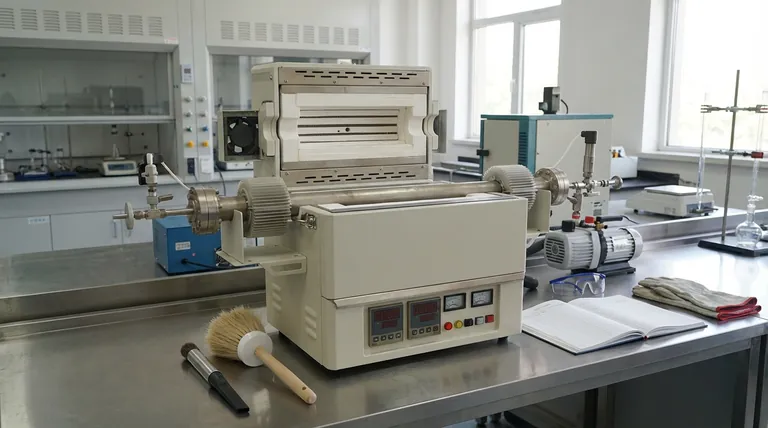
Most laboratory equipment failures are not mysteries of engineering. They are failures of patience.
We often view a tube furnace as a static, robust metal box designed to endure extreme conditions. In reality, it is a delicate ecosystem of thermodynamics and brittle materials. The components that allow it to reach 1600°C—silicon carbide rods and fibrous insulation—are paradoxically fragile when handled by human hands.
Cleaning a furnace is less about hygiene and more about resetting the baseline for your data. A contaminated furnace doesn't just look bad; it creates hot spots, alters atmospheric chemistry, and introduces phantom variables into your experiments.
Here is the protocol for maintaining the integrity of your thermal processing, blending strict engineering safety with the necessary human discipline.
The First Law: Patience (The Cool Down)
The single most dangerous moment in furnace maintenance occurs before you even pick up a tool. It happens when an operator, pressed for time, opens a warm furnace.
Thermal shock is the silent killer of ceramics. Introducing cool room air or cold tools to a hot chamber creates differential expansion that snaps heating elements and cracks tubes.
The Protocol:
- Ambient Only: The furnace must be completely cool. Not "touchable," but truly at ambient temperature.
- Power Severance: Disconnect the power source entirely. This prevents accidental activation and electrical shock.
- Water Cooling Logic: If your unit is water-cooled, do not cut the water immediately. Wait until the furnace drops below 200°C. Stopping the flow too early can cause the residual heat to boil the water in the lines, damaging the seals.
The Archaeology of Residue
Cleaning is an act of careful excavation. You are removing the history of past experiments—ash, spatter, and volatile condensates—without disturbing the architecture of the furnace.
Many operators make the mistake of using compressed air. This is a critical error. Compressed air does not remove debris; it drives conductive particles deep into the fibrous insulation, creating electrical shorts and permanent contamination.
The Method:
- The Soft Touch: Use a soft-bristled brush. The goal is to loosen, not scrub. Heating elements often have a protective oxide layer; scrubbing too hard can strip this away.
- Vacuum, Don't Blow: Use a vacuum with a narrow attachment. You want to extract the entropy, not redistribute it.
The Inspection: Reading the Signs
While the chamber is open, you are looking for the narrative of the furnace's aging process.
Look at the heating elements and the refractory ceramics. You will likely see small, hairline cracks on the surface of the ceramics.
Do not panic.
This is the "skin" of the furnace reacting to thermal cycling. It is often superficial. However, you must distinguish between these signs of aging and structural failure. Deep cracks, sagging elements, or erosion require immediate intervention.
Prevention: The Invisible Maintenance
The best way to clean a furnace is to prevent it from getting dirty in the first place. Contamination is usually a symptom of aggressive process parameters.
If you find yourself constantly cleaning up spatter, your physics are wrong.
Control the Ramp
Materials spatter when they are heated faster than they can reach thermal equilibrium.
- The Rule: Generally, keep heating and cooling rates below 10°C per minute.
- The Result: This prevents the violent release of volatiles that coat the inside of your tube.
Manage the Atmosphere
Moisture is the enemy of high-temperature insulation. At high heat, water vapor becomes a corrosive agent. Isolate your furnace from humid air and corrosive gases unless the unit is specifically designed and protected for such environments.
The Trade-Offs of Handling
Every time you touch the furnace, you introduce risk.
The internal components, particularly Silicon Carbide (SiC) rods, are brittle. They have high compressive strength but very low tensile strength. A bump from a vacuum nozzle can shatter them.
Furthermore, mechanical handling matters. Never lift a furnace by its door. It seems like a convenient handle, but it disrupts the precise alignment of the seal, leading to heat leaks and efficiency loss.
Summary Protocol
The following table outlines the non-negotiable steps for a safe maintenance cycle.
| Step | Action | The "Why" (Engineering Logic) |
|---|---|---|
| 1 | Disconnect & Cool | Prevents thermal shock to ceramics and electrical shock to humans. |
| 2 | Brush & Vacuum | Removes conductive debris without embedding it into the insulation (unlike compressed air). |
| 3 | Visual Inspection | Distinguishes between normal thermal aging (hairlines) and structural failure. |
| 4 | Process Review | Checks ramp rates (<10°C/min) to stop the root cause of spatter. |
The KINTEK Solution
A tube furnace is an investment in precision. Maintaining it requires a mindset that values consistency over speed.
At KINTEK, we understand that the reliability of your data depends on the reliability of your tools. We specialize in high-performance lab equipment and the consumables required to keep them running. whether you need replacement heating elements, upgraded tubes, or a new furnace designed for easier maintenance, we have the engineering expertise to assist.
Do not let equipment maintenance be the variable that ruins your experiment.
Contact Our Experts today to discuss your specific high-temperature needs and maintenance protocols.
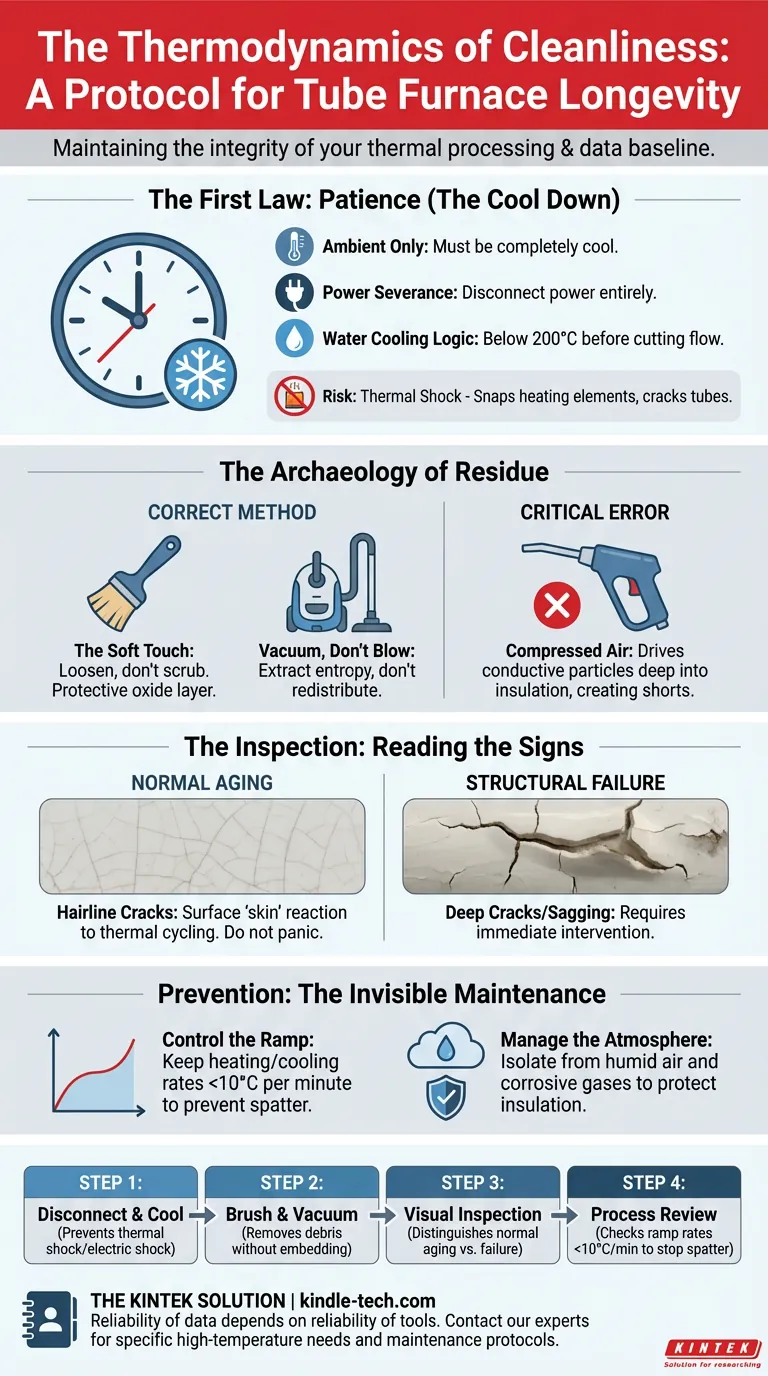
Visual Guide
Related Products
- Rotary Tube Furnace Split Multi Heating Zone Rotating Tube Furnace
- Laboratory Vacuum Tilt Rotary Tube Furnace Rotating Tube Furnace
- 1200℃ Split Tube Furnace with Quartz Tube Laboratory Tubular Furnace
- 1400℃ Laboratory High Temperature Tube Furnace with Alumina Tube
- 1700℃ Laboratory High Temperature Tube Furnace with Alumina Tube
Related Articles
- The Geometry of Heat: Why Motion Matters in Material Synthesis
- Exploring Rotary Tube Furnaces: A Comprehensive Guide
- Exploring the Functions and Advantages of Rotary Tube Furnaces
- Exploring the Benefits and Applications of Rotary Furnaces: A Comprehensive Guide
- The Physics of Perfection: How Rotary Furnaces Eliminate Randomness in Material Processing



















