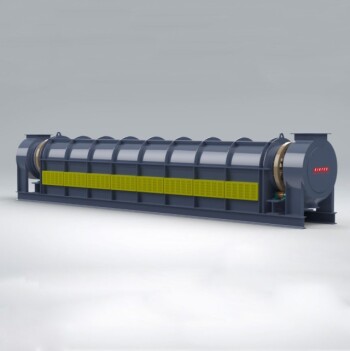
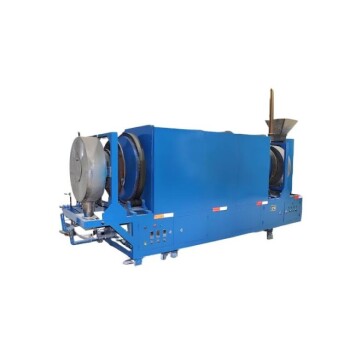
Muffle and atmosphere furnaces function as the precise thermal reactors required to convert co-precipitated powders into usable Y-Ti-Zr-O composite oxide precursors. Through a process of calcination and annealing at temperatures between 700°C and 850°C, these furnaces drive thermal decomposition to chemically transform the raw material into stable nanoparticles.
The primary function of these furnaces is to deliver a uniform heat field that crystallizes raw powders into a stable fluorite-garnet structure, a prerequisite for their effective use as strengthening agents in ODS steel.
The Thermal Transformation Process
From Co-precipitation to Calcination
The synthesis begins with initial powders obtained through co-precipitation methods. These raw powders are not yet in a usable state for high-performance applications.
They must be introduced into the furnace environment to undergo calcination. This heating step is the mechanism that triggers the necessary chemical changes in the precursor material.
Achieving the Fluorite-Garnet Structure
Inside the furnace, the material undergoes thermal decomposition. This is not merely drying the powder; it is a fundamental phase transformation.
The specific goal is to convert the precursors into a stable fluorite-garnet crystal structure. Achieving this specific crystalline phase is critical for the material's future performance as a composite oxide.
Critical Processing Parameters
The 700°C to 850°C Window
The primary reference highlights a specific operational range for this synthesis: 700°C to 850°C.
Operating within this window is essential to facilitate the correct annealing process. Temperatures outside this specific band may fail to yield the desired stable nanoparticle structure.
The Importance of Heat Uniformity
Muffle and atmosphere furnaces are utilized specifically for their ability to provide a uniform heat field.
Inconsistent heating can lead to variations in the phase transformation. Uniformity ensures that the entire batch of powder achieves the same stable properties simultaneously.
Why This Process Matters for ODS Steel
Precise Control of Strengthening Phases
The ultimate utility of these Y-Ti-Zr-O precursors is their role as additives in Oxide Dispersion Strengthened (ODS) steel.
By using a dedicated furnace process to pre-synthesize these oxides, engineers gain precise control over the material's chemical ratio. This is superior to relying on in-situ reactions that may be less predictable.
Optimizing Particle Size
The furnace treatment also dictates the initial particle size of the oxides.
Controlling the particle size during the calcination stage directly influences the quality of the strengthening phases in the final ODS steel product.
Operational Considerations and Trade-offs
Sensitivity to Thermal History
While these furnaces allow for precision, the process is highly sensitive to the defined temperature range.
Failing to maintain the strict 700°C to 850°C environment can result in incomplete decomposition or unstable phases. This renders the precursors ineffective for strengthening ODS steel.
Equipment Selection
The choice between a muffle furnace and an atmosphere furnace depends on the specific environmental control required beyond temperature.
However, both must be capable of sustaining the high temperatures and uniformity required for the fluorite-garnet transformation.
Making the Right Choice for Your Goal
To maximize the quality of your Y-Ti-Zr-O composite oxides, align your furnace operations with your specific material objectives.
- If your primary focus is Phase Stability: Ensure your furnace can maintain a strict, uniform hold within the 700°C to 850°C range to guarantee the formation of the fluorite-garnet structure.
- If your primary focus is ODS Steel Performance: Utilize this pre-synthesis method to tightly control the initial particle size and chemical ratio of your strengthening additives before introducing them to the steel matrix.
The effective utilization of these furnaces is the defining step in transforming raw chemical powders into high-performance metallurgical additives.
Summary Table:
| Process Parameter | Specification / Goal |
|---|---|
| Temperature Range | 700°C to 850°C |
| Core Mechanism | Thermal decomposition & Calcination |
| Target Phase | Stable fluorite-garnet crystal structure |
| Material Form | Stable nanoparticles (700-850°C range) |
| Primary Application | Strengthening agents for ODS steel |
Precision is non-negotiable when synthesizing high-performance Y-Ti-Zr-O precursors. KINTEK specializes in laboratory equipment designed for metallurgical excellence, offering a comprehensive range of high-temperature muffle and atmosphere furnaces that ensure the heat uniformity required for perfect phase transformation. From vacuum and CVD systems to our precision dental and induction melting furnaces, our tools empower researchers to control particle size and chemical ratios with unmatched accuracy. Enhance your material science workflow with KINTEK’s industry-leading furnaces, hydraulic presses, and ceramic consumables—contact us today to find the perfect thermal solution for your lab!
References
- Alberto Meza, Mónica Campos. Development of New 14 Cr ODS Steels by Using New Oxides Formers and B as an Inhibitor of the Grain Growth. DOI: 10.3390/met10101344
This article is also based on technical information from Kintek Solution Knowledge Base .
Related Products
- Controlled Nitrogen Inert Hydrogen Atmosphere Furnace
- High Temperature Muffle Oven Furnace for Laboratory Debinding and Pre Sintering
- Ultra-High Temperature Graphite Vacuum Graphitization Furnace
- Horizontal High Temperature Graphite Vacuum Graphitization Furnace
- Dental Porcelain Zirconia Sintering Ceramic Furnace Chairside with Transformer
People Also Ask
- Why is hydrogen used in furnaces? Achieve Superior Purity and Bright Finishes
- What is the role of a hydrogen atmosphere furnace in diamond/copper composites? Enhance Your Material Purity
- What are the characteristics and risks of a hydrogen atmosphere in a furnace? Master the Balance of Power and Control
- Why is a hydrogen atmosphere furnace necessary for W-Cu composite? Unlock Superior Infiltration and Density
- What is the use of hydrogen in furnace? A Key to Oxygen-Free High-Temperature Processing