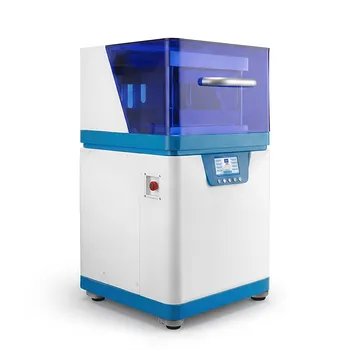
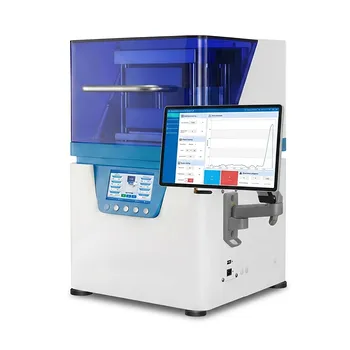
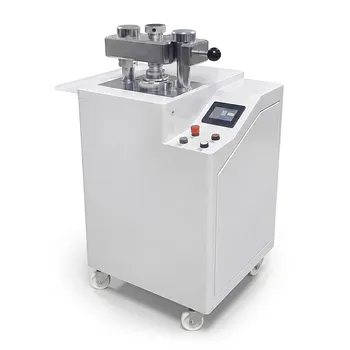
Precision laboratory molds and hydraulic presses are the essential tools for transforming raw C/Co nanoplate mixtures into standardized test specimens. By applying high, uniform pressure to a blend of C/Co nanoplates and a matrix material—commonly paraffin—these tools create samples with exact dimensions, such as rings or rectangles. This physical consistency is a prerequisite for accurate microwave testing and the generation of reliable 3D reflection loss maps.
The integration of hydraulic presses and precision molds ensures sample uniformity and high internal density, which are critical for eliminating experimental noise and ensuring the reproducibility of electromagnetic characterization data.
The Role of Controlled Compression in Sample Integrity
Achieving Uniform Particle Rearrangement
A laboratory hydraulic press applies a constant static pressure to the mixed powders within the mold, forcing particles to undergo physical rearrangement. This process ensures that the C/Co nanoplates and matrix material achieve a tight packing state at room temperature.
Eliminating Internal Voids and Air Bubbles
High-pressure molding is essential for eliminating internal pores and trapped air bubbles that can interfere with signal transmission. By removing these voids, the press creates a dense internal structure that provides a consistent medium for electromagnetic waves.
Inhibiting Unwanted Grain Growth
In specialized high-pressure environments, the hydraulic press can inhibit the growth of nanocrystalline grains during consolidation. This allows researchers to maintain the fine-grained microstructures of the C/Co nanoplates while still achieving a high-density bulk composite.
Geometric Precision for Electromagnetic Characterization
Standardization for Microwave Testing
Precision molds allow for the creation of specific shapes, such as toroidal rings or rectangles, required by microwave test fixtures. These standardized dimensions ensure that the sample fits perfectly within the waveguide or coaxial line, preventing leakage and ensuring data accuracy.
Ensuring Dimensional Parallelism
The use of precision equipment ensures that the top and bottom surfaces of the sample are perfectly parallel with a consistent thickness. This geometric accuracy is vital for calculating dielectric constants and conductivity, as even minor deviations can lead to significant measurement errors.
Minimizing Density Gradients
Uniform pressure distribution across the mold prevents the formation of density gradients within the sample. A sample with uniform density ensures that microwave performance is consistent throughout the material, allowing for the creation of accurate 3D reflection loss maps.
Understanding the Trade-offs
The Risk of Excessive Pressure
While high pressure increases density, exceeding the material's limits can lead to residual stress or the physical deformation of the C/Co nanoplates. If the pressure is too high, it may inadvertently alter the very nanostructures being studied, skewing the final performance results.
Thermal Considerations During Molding
Some composites require a heated press to ensure the matrix, such as molten paraffin or polymers, completely fills the mold. The trade-off involves balancing temperature and pressure; excessive heat can degrade the matrix material, while insufficient heat leads to incomplete filling and internal defects.
Material Compatibility and Recovery
Different matrix materials have different "spring-back" rates once removed from the mold. Precision molding must account for this elastic recovery to ensure the final, relaxed dimensions of the C/Co composite still meet the required experimental tolerances.
How to Apply This to Your Project
Making the Right Choice for Your Goal
To achieve the most accurate characterization of C/Co nanoplate composites, your molding process must align with your specific analytical needs.
- If your primary focus is Microwave Absorption (Reflection Loss): Use precision molds to create specific ring or rectangular dimensions that eliminate air gaps in the test waveguide.
- If your primary focus is Dielectric Performance: Prioritize the hydraulic press's ability to maintain constant pressure to ensure perfect parallelism and thickness consistency across all samples.
- If your primary focus is Structural Nanomaterial Integrity: Utilize controlled, high-pressure consolidation to inhibit grain growth and maintain the unique properties of the C/Co nanoplates.
By mastering the balance of pressure, temperature, and mold precision, researchers can ensure that their experimental data reflects the true potential of the C/Co nanoplate composite.
Summary Table:
| Preparation Phase | Role of Equipment | Key Benefit for Testing |
|---|---|---|
| Compression | High static pressure | Eliminates internal voids and air bubbles |
| Molding | Precise geometric shaping | Creates standardized rings/rectangles for waveguides |
| Consolidation | Controlled particle packing | Inhibits grain growth and ensures density uniformity |
| Finishing | Dimensional parallelism | Vital for accurate dielectric constant calculations |
Elevate Your Composite Research with KINTEK Precision
Ensure the reproducibility of your electromagnetic characterization with equipment designed for absolute accuracy. KINTEK specializes in high-performance laboratory solutions, providing the essential tools for advanced material science. Our range includes:
- Hydraulic Presses: Pellet, hot, and isostatic presses for high-density sample consolidation.
- High-Temperature Furnaces: Muffle, tube, vacuum, and atmosphere furnaces for specialized thermal processing.
- Material Processing: Crushing and milling systems, sieving equipment, and precision molds.
- Advanced Reactors: High-temperature high-pressure reactors and autoclaves for complex synthesis.
Whether you are characterizing C/Co nanoplates or developing next-generation microwave absorbers, our expertise in high-pressure molding and thermal treatment ensures your samples meet the strictest experimental tolerances.
Ready to eliminate experimental noise and achieve superior sample consistency?
References
- Mengqi Wang, Mao‐Sheng Cao. Thermally Derived Hierarchical Nanoplates for Electromagnetic Protection and Waste Energy Recovery Device. DOI: 10.1002/smll.202303186
This article is also based on technical information from Kintek Solution Knowledge Base .
Related Products
- Automatic Hydraulic Hot Press with 500x500mm Heating Plates and Multi Stage PLC Control for Material Sintering
- Heated Hydraulic Press Machine with Heated Plates for Vacuum Box Laboratory Hot Press
- Automatic High Temperature Heated Hydraulic Press Machine with Heated Plates for Lab
- Manual High Temperature Heated Hydraulic Press Machine with Heated Plates for Lab
- 24T 30T 60T Heated Hydraulic Press Machine with Heated Plates for Laboratory Hot Press
People Also Ask
- How do hydraulic presses facilitate material solidification in Low-Temperature LPS? Optimize Your Material Densification
- Why is 800 MPa required for TiNiPdCu alloy green bodies? Master High-Density Compaction for Superior Material Strength
- How does KBr pellet preparation facilitate FTIR of high-ash mud? Precision Sample Prep for Structural Analysis
- Why is an industrial hydraulic press with precision stainless steel molds used? For Uniform Mo-Fe Precursor Compacts.
- Purpose of Coaxial Ring Molds & Presses in EM Testing? Achieve Precise VNA Data & Fit