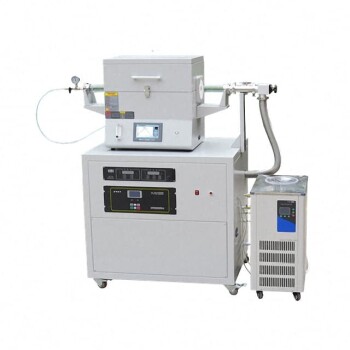
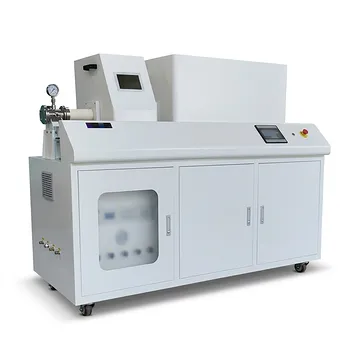
Chemical Vapor Deposition (CVD) systems ensure material quality by strictly regulating the reaction environment to force carbon atoms to assemble at the atomic level. Through the precise manipulation of precursor gas flow rates, internal vacuum levels, and reaction temperatures, these systems create a stable environment where volatile gases decompose and deposit uniform carbon layers directly onto a catalytic substrate.
The core strength of CVD lies in its ability to achieve atomic-level vapor deposition. This precision allows for the growth of large-area, highly continuous graphene films with controllable layer counts, creating the ideal electronic conduction network required for high-performance battery electrodes.
The Pillars of Process Control
To achieve high-quality graphene, CVD systems do not rely on mechanical application but rather on chemical synthesis. The system maintains quality by synchronizing three critical variables.
Regulating Precursor Flow Rates
The system introduces volatile precursor gases into the chamber. By precisely controlling the flow rate of these source materials, the system dictates exactly how much carbon is available for the reaction.
Maintaining Vacuum Levels
Quality is heavily dependent on pressure. CVD systems utilize vacuum levels to create a controlled atmosphere, ensuring contaminants are removed and the mean free path of the gas molecules is optimized for deposition.
Managing Reaction Temperatures
Heat is the catalyst that drives the decomposition of the precursor gases. The system maintains specific reaction temperatures to ensure the source material breaks down efficiently and bonds correctly to the substrate.
Achieving Material Consistency
The goal of these controls is not just to coat the electrode, but to grow a specific crystalline structure.
Atomic-Level Deposition
Unlike spray coating or dipping, CVD deposits material atom by atom. This fundamental approach results in a film that is chemically bonded to the substrate rather than just sitting on top of it.
Controllable Layer Counts
By managing the duration of the process (time) and the power input, engineers can control the thickness of the graphene film. This allows for the production of specific layer counts tailored to the electrode's conductivity requirements.
Large-Area Continuity
One of the distinct advantages of this method is the creation of "highly continuous" films. The CVD process minimizes grain boundaries and defects, resulting in a large-area sheet that offers superior electron transport compared to fragmented flakes.
Understanding the Trade-offs
While CVD offers exceptional quality, it is a sensitive process that requires rigorous stability.
Sensitivity to Variables
The reliance on "precise control" means there is little margin for error. A fluctuation in vacuum pressure or a drift in temperature can disrupt the atomic lattice, introducing defects into the graphene sheet.
Complexity of Scale
Achieving uniformity across a large-area substrate requires that the flow rates and temperatures remain consistent across the entire wafer. As the substrate size increases, maintaining this homogeneity becomes increasingly complex.
Optimizing Electrode Production
When evaluating CVD for graphene electrode manufacturing, align your process parameters with your specific performance targets.
- If your primary focus is Conductivity: Prioritize the continuity of the film by strictly maintaining vacuum levels to minimize defects and grain boundaries.
- If your primary focus is Specific Capacity: Focus on the "controllable layer counts" by adjusting reaction time and precursor flow to minimize thickness while maintaining coverage.
By mastering the variables of heat, pressure, and flow, CVD transforms volatile gases into the solid, conductive foundation of modern energy storage.
Summary Table:
| Quality Factor | Control Mechanism | Benefit to Graphene Electrodes |
|---|---|---|
| Precursor Flow | Gas Flow Regulation | Dictates carbon availability for precise layer growth |
| Vacuum Level | Contaminant Removal | Ensures high purity and optimized molecular deposition |
| Temperature | Thermal Decomposition | Catalyzes efficient source breakdown and atomic bonding |
| Process Time | Growth Duration | Enables controllable layer counts for specific conductivity |
| Uniformity | Homogeneous Heating | Minimizes grain boundaries for large-area film continuity |
Elevate Your Material Research with KINTEK Precision
Unlock the full potential of graphene-coated electrodes with KINTEK’s advanced CVD and PECVD systems. Our technology provides the rigorous stability required for atomic-level vapor deposition, ensuring your lab achieves superior conductivity and material consistency every time.
Beyond CVD, KINTEK specializes in a comprehensive range of laboratory solutions, including:
- High-Temperature Solutions: Muffle, tube, rotary, and vacuum furnaces.
- Material Processing: Crushing, milling, and hydraulic presses (pellet, hot, isostatic).
- Energy & Battery Tools: High-pressure reactors, autoclaves, and electrolytic cells.
- Lab Essentials: ULT freezers, freeze dryers, and high-quality ceramic crucibles.
Ready to optimize your electrode production? Contact our technical experts today to find the perfect equipment tailored to your research performance targets.
References
- Hernán Paz Penagos, Diego Arturo Coy Sarmiento. Graphene and coltan. DOI: 10.23850/2422068x.5835
This article is also based on technical information from Kintek Solution Knowledge Base .
Related Products
- Chemical Vapor Deposition CVD Equipment System Chamber Slide PECVD Tube Furnace with Liquid Gasifier PECVD Machine
- Customer Made Versatile CVD Tube Furnace Chemical Vapor Deposition Chamber System Equipment
- HFCVD Machine System Equipment for Drawing Die Nano-Diamond Coating
- Split Chamber CVD Tube Furnace with Vacuum Station Chemical Vapor Deposition System Equipment Machine
- Multi Heating Zones CVD Tube Furnace Machine Chemical Vapor Deposition Chamber System Equipment
People Also Ask
- What are the advantages of chemical vapor deposition? Achieve Superior Thin Films for Your Lab
- What types of substrates are used in CVD to facilitate graphene films? Optimize Graphene Growth with the Right Catalyst
- What is the chemical vapor deposition growth process? Build Superior Thin Films from the Atom Up
- How expensive is chemical vapor deposition? Understanding the True Cost of High-Performance Coating
- Why is Chemical Vapor Deposition (CVD) equipment uniquely suited for constructing hierarchical superhydrophobic structures?