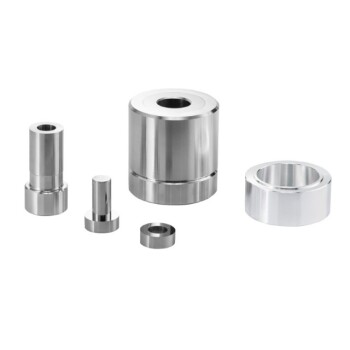
In vacuum hot-press sintering, graphite dies serve a dual purpose as the structural molding container and the active medium for transmitting axial pressure to Zinc Sulfide (ZnS) powder.
These components act as the physical interface between the hydraulic system and the ceramic material. They enable the simultaneous application of high temperatures (up to 1000°C) and uniaxial mechanical pressure (up to 50 MPa) required to achieve high density in the final ceramic product.
Core Takeaway While graphite dies are essential for thermal conductivity and pressure transmission during densification, they introduce a significant risk of chemical contamination. Under high heat and pressure, carbon ions can diffuse into the ZnS ceramic, creating carbonate defects that degrade the material's infrared optical performance.
The Functional Mechanics of the Die
Acting as the Pressure Transmitter
The primary function of the graphite die—specifically the punch assembly—is to transfer axial mechanical pressure from the press to the ceramic powder.
This pressure, often reaching 50 MPa, forces the ZnS particles to rearrange and bond. This promotes densification through plastic flow, eliminating internal pores to achieve densities near the theoretical limit (99.8%).
Ensuring Thermal Uniformity
Graphite is selected for this process due to its excellent thermal conductivity and stability at high temperatures.
Because the die surrounds the powder, it acts as a heat distributor. It ensures that the heat from the furnace is transferred uniformly to the internal powder, preventing thermal gradients that could crack the ceramic or cause uneven sintering.
Defining Physical Geometry
The die acts as the rigid container that defines the final shape and dimensions of the ZnS ceramic.
It must possess high high-temperature strength to maintain these dimensions without deforming under the immense mechanical stress of the pressing process.
Understanding the Trade-offs: Carbon Contamination
The Diffusion Mechanism
While structurally beneficial, the interaction between graphite and ZnS at the molecular level presents a challenge.
At elevated temperatures and pressures, carbon ions from the graphite die can detach and migrate. These ions diffuse into the ceramic material, primarily moving through the grain boundaries of the ZnS structure.
Impact on Optical Quality
This diffusion is not merely cosmetic; it chemically alters the ceramic.
The intruding carbon reacts to form carbonate defects within the material. In Infrared (IR) spectroscopy, these defects appear as specific absorption bands, which significantly reduce the ceramic's transparency and utility in optical applications.
Strategies for Process Control
Utilizing Isolation Layers
To mitigate direct interaction, graphite foil is often placed between the mold punches and the ZnS powder.
This acts as a physical barrier that prevents the ceramic from sticking or bonding to the mold. It also serves as a first line of defense against direct contamination from the punch material.
Optimizing Die Selection
The quality of the graphite itself is a critical variable in controlling contamination.
Manufacturers must select high-purity, high-density graphite for these dies. A denser graphite structure is less porous and more stable, reducing the likelihood of carbon ion detachment and subsequent diffusion.
Making the Right Choice for Your Goal
To balance mechanical densification with optical purity, you must prioritize specific parameters based on your end-use requirements:
- If your primary focus is Optical Clarity: Prioritize the use of high-purity graphite dies and graphite foil barriers to minimize the formation of carbonate absorption bands.
- If your primary focus is Structural Density: Focus on the die's high-temperature strength to ensure it can withstand the maximum uniaxial pressure (50 MPa) required for pore elimination.
Success in sintering ZnS ceramics lies in leveraging the mechanical strength of graphite while strictly managing its chemical volatility.
Summary Table:
| Interaction Factor | Role in Sintering Process | Impact on ZnS Ceramic Quality |
|---|---|---|
| Pressure Transmission | Applies up to 50 MPa uniaxial force | Eliminates pores; achieves 99.8% theoretical density |
| Thermal Conductivity | Distributes heat uniformly | Prevents thermal gradients and material cracking |
| Carbon Diffusion | Ion migration at high temperatures | Creates carbonate defects; reduces IR transparency |
| Structural Geometry | Acts as a rigid molding container | Defines final shape and dimensional accuracy |
Elevate Your Advanced Ceramic Production with KINTEK
Precision in vacuum hot-pressing requires more than just high temperatures—it demands the right materials and equipment to prevent contamination and ensure structural integrity. At KINTEK, we specialize in providing high-performance laboratory solutions tailored for the most demanding research and manufacturing needs.
Whether you are sintering ZnS ceramics or developing new composite materials, our comprehensive range of products supports your success:
- High-Temperature Furnaces: Precision vacuum and atmosphere control for consistent results.
- Hydraulic Presses: Advanced pellet, hot, and isostatic presses for maximum densification.
- Specialized Consumables: High-purity graphite dies, ceramics, and crucibles designed to minimize chemical interference.
- Material Processing: Expert-grade crushing, milling, and sieving systems.
Ready to optimize your sintering process and achieve superior optical clarity? Contact our technical experts today to discover how KINTEK’s laboratory equipment and consumables can enhance your lab's efficiency and material performance.
Related Products
- 2200 ℃ Graphite Vacuum Heat Treat Furnace
- Ultra-High Temperature Graphite Vacuum Graphitization Furnace
- Graphite Vacuum Continuous Graphitization Furnace
- Graphite Vacuum Furnace Bottom Discharge Graphitization Furnace for Carbon Materials
- Vertical High Temperature Graphite Vacuum Graphitization Furnace
People Also Ask
- What is the process of vacuum heat treating? Achieve Superior Hardening with a Clean, Bright Finish
- How does heat transmit in a vacuum? Mastering Thermal Radiation for Purity & Precision
- Why do you heat treat in a vacuum? Achieve Perfect Surface Finish and Material Integrity
- How does a vacuum heat treat furnace work? Achieve Pristine, Oxide-Free Metal Parts
- What is graphite heating? A Guide to Durable, High-Temp Industrial Furnace Solutions