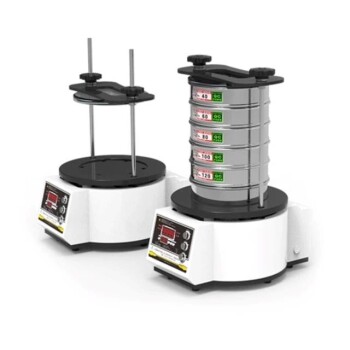
Industrial-grade sieving systems facilitate the adjustment of chromium powder combustion by rigorously controlling particle size distribution to manipulate the physical structure of the powder bed. By refining raw powder into precise granule fractions—such as 63–80 µm or 500–1000 µm—these systems directly alter the material's porosity. This physical modification optimizes gas filtration conditions, which is the primary driver for maintaining a stable and continuous combustion process.
Core Takeaway: Combustion stability in chromium powder is largely a function of gas permeability. By sieving powder into specific granule sizes, you can increase the porosity of the material layer (e.g., from 64% to 78%), ensuring that gases flow freely to sustain steady reaction propagation.
The Mechanics of Particle Control
Precision Fractioning
Industrial sieving allows you to move beyond random particle distribution. By isolating specific fractions, such as the 63–80 µm or 500–1000 µm ranges, you standardize the fuel source.
This eliminates the inconsistency inherent in raw powder. Uniform particles create a predictable foundation for the combustion reaction.
Manipulating Bed Porosity
The most critical physical change achieved through sieving is the alteration of the material layer's density.
Refining the powder into granules of specific sizes significantly increases the porosity of the bed. Data indicates that proper sieving can raise porosity from a baseline of 64% to as high as 78%.
Impact on Combustion Stability
Optimizing Gas Filtration
Combustion requires efficient gas exchange. A tightly packed powder bed with low porosity chokes this flow.
By increasing porosity through sieving, you improve gas filtration conditions within the material layer. This allows reactants and byproducts to move through the bed with minimal resistance.
Ensuring Stable Propagation
When gas filtration is optimized, the combustion front moves predictably.
High porosity prevents pressure buildups or oxygen starvation that can cause the reaction to stall or surge. This results in the stable propagation of the combustion process from start to finish.
Understanding the Trade-offs
The Balance of Density and Porosity
While increasing porosity improves stability, it inherently reduces the bulk density of the material layer.
You must balance the need for gas permeability (high porosity) with the need for material mass (density). Prioritizing porosity ensures the fire keeps burning, but it may alter the total energy released per unit of volume.
Granule Integrity Implications
Achieving high porosity relies on the granules maintaining their specific size.
If the sieved granules break down back into dust during handling, the porosity gains—and the resulting combustion stability—will be lost. The process requires careful handling to preserve the filtration structure.
Making the Right Choice for Your Process
To effectively adjust chromium powder combustion, consider your specific stability requirements:
- If your primary focus is preventing reaction stalls: Prioritize sieving for larger granule fractions (e.g., 500–1000 µm) to maximize porosity and gas flow.
- If your primary focus is process consistency: Use sieving to strictly limit the particle size range (e.g., 63–80 µm) to ensure a uniform material layer structure.
The goal is not just to sort the powder, but to engineer the empty space within it to allow the reaction to breathe.
Summary Table:
| Parameter | Raw Powder | Precision Sieved Granules | Impact on Combustion |
|---|---|---|---|
| Particle Size | Random/Mixed | Defined (e.g., 500–1000 µm) | Standardizes fuel reaction rate |
| Bed Porosity | Lower (~64%) | Higher (~78%) | Enhances gas permeability |
| Gas Filtration | Restricted | Optimized | Prevents stalls and pressure buildup |
| Process Stability | Inconsistent | Stable Propagation | Ensures predictable thermal output |
Optimize Your Powder Processing with KINTEK Precision Solutions
At KINTEK, we understand that material performance is defined by precision. Our advanced industrial-grade sieving systems and crushing and milling equipment are engineered to give you total control over particle size distribution and bed porosity, ensuring the stable combustion and reaction propagation your research requires.
Beyond sieving, KINTEK offers a comprehensive suite of laboratory tools to support your entire workflow, including:
- High-Temperature Furnaces & Reactors: Muffle, vacuum, and CVD systems for advanced thermal processing.
- Hydraulic Presses: Pellet, hot, and isostatic presses for material densification.
- Battery Research & Cooling: ULT freezers and specialized consumables for sensitive material storage.
Ready to engineer the perfect material structure for your application? Contact KINTEK today to discover how our high-performance laboratory equipment can enhance your process efficiency and consistency.
References
- Nikolay S. Evseev, Yuliya N. Ryzhikh. Process of Obtaining Chromium Nitride in the Combustion Mode under Conditions of Co-Flow Filtration. DOI: 10.3390/pr8091056
This article is also based on technical information from Kintek Solution Knowledge Base .
Related Products
- Three-dimensional electromagnetic sieving instrument
- Laboratory Vibratory Sieve Shaker Machine for Dry and Wet Three-Dimensional Sieving
- Laboratory Test Sieves and Sieving Machines
- Laboratory Wet Three-Dimensional Vibratory Sieve Shaker Machine
- Custom PTFE Teflon Parts Manufacturer for PTFE Mesh F4 Sieve
People Also Ask
- Why is sieving equipment essential for the classification of processed bio-activated carbon? Optimize Performance
- What are the limitations of sieving? Understanding the Constraints of Particle Size Analysis
- What are advantages and disadvantages of sieving method? A Guide to Reliable & Cost-Effective Particle Sizing
- How is sieving important? The Critical Role of Particle Size Analysis in Quality Control
- What is sieving and how does it work? A Guide to Accurate Particle Size Analysis