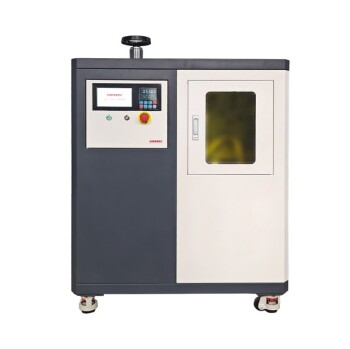
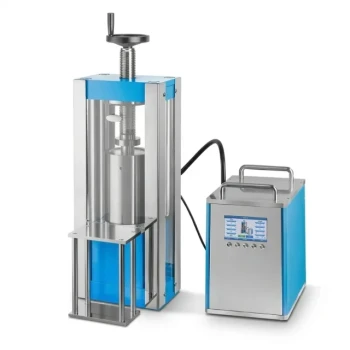
Industrial Hot Isostatic Pressing (HIP) furnaces facilitate diffusion bonding by creating an environment of simultaneous high heat and uniform pressure that forces materials to unite at an atomic level. Specifically, the furnace applies temperatures (such as 1121°C) and isostatic pressures (around 103 MPa) to compress gas-atomized powders against a solid substrate. This process drives plastic deformation and thermal diffusion to create a seamless joint without ever melting the parent materials.
Core Takeaway HIP technology achieves high-integrity bonding by using uniform pressure to eliminate voids and thermal energy to drive atoms across material interfaces. This results in fully densified, stable joints between dissimilar metals while maintaining the materials in a solid state.
The Mechanics of the HIP Environment
Simultaneous Heat and Pressure application
The core of the HIP process involves subjecting components to two extreme forces at once.
The furnace maintains a constant high temperature, often exceeding 1000°C, while simultaneously applying immense isostatic pressure.
Uniform Isostatic Force
Unlike traditional pressing which applies force from one direction, HIP applies pressure equally from all directions (isostatically).
This ensures that the force distribution is uniform across the entire geometry of the part, preventing distortion while maximizing contact.
Interaction with Gas-Atomized Powder
The process is particularly effective when bonding gas-atomized powders to solid substrates.
Under these conditions, the powder particles are forced to conform tightly to the substrate surface, setting the stage for bonding.
How Diffusion Bonding Occurs
Inducing Plastic Deformation
The initial phase of bonding is mechanical. The high isostatic pressure (e.g., 103 MPa) forces the powder particles to undergo plastic deformation.
This physical shifting closes gaps between particles and the substrate, ensuring intimate contact at the interface.
Driving Atomic Diffusion
Once physical contact is maximized, the thermal energy takes over.
The high temperature excites the atoms within the materials, causing them to diffuse across the interface between the powder and the substrate.
Achieving Full Densification
As atoms migrate and intermingle, the boundary between the distinct materials begins to disappear effectively.
This results in full powder densification, transforming the loose powder into a solid, non-porous mass integral to the substrate.
Solid-State Bonding
Crucially, this entire process occurs without melting the parent metals.
By avoiding the liquid phase, HIP preserves the microstructural integrity of the dissimilar metals, preventing common fusion-welding issues like segregation or brittle intermetallic formation.
Understanding the Trade-offs
Operational Intensity
Achieving diffusion bonding requires maintaining extreme parameters, such as 1121°C and 103 MPa, for extended periods.
This necessitates robust equipment capable of sustaining these energy-intensive conditions safely and consistently.
Material Constraints
While the process avoids melting, the materials involved must still withstand significant thermal and mechanical stress.
The substrates and powders selected must be compatible with the specific temperature and pressure regimes required to induce diffusion.
Optimizing Manufacturing Outcomes
To best utilize Hot Isostatic Pressing for your specific manufacturing goals, consider the following principles:
- If your primary focus is porosity elimination: Ensure your process parameters prioritize sufficient isostatic pressure to force plastic deformation and achieve 100% densification.
- If your primary focus is joining dissimilar metals: Prioritize precise temperature control to maximize atomic diffusion across the interface without approaching the melting point of either material.
HIP transforms the joining process by substituting the chaos of melting with the precision of atomic diffusion.
Summary Table:
| Feature | HIP Diffusion Bonding Mechanism | Impact on Joint Quality |
|---|---|---|
| Pressure Application | Isostatic (Uniform from all directions) | Eliminates voids and ensures 100% densification |
| Temperature State | Solid-state (Below melting point) | Preserves microstructure and prevents brittleness |
| Bonding Drive | Plastic deformation + Atomic diffusion | Creates seamless, high-strength atomic-level bonds |
| Material Synergy | Powder-to-solid or Solid-to-solid | Enables joining of complex dissimilar metal pairs |
Elevate Your Manufacturing with KINTEK HIP Solutions
Unlock the full potential of diffusion bonding and material densification with KINTEK’s advanced Hot Isostatic Pressing (HIP) furnaces. Whether you are joining dissimilar metals or eliminating porosity in gas-atomized powders, our precision-engineered systems deliver the uniform pressure and thermal control required for high-integrity components.
As a global leader in laboratory and industrial equipment, KINTEK offers a comprehensive range of solutions including:
- High-Temperature Furnaces: Muffle, Tube, Vacuum, and CVD/PECVD systems.
- Advanced Material Processing: Isostatic, pellet, and hot hydraulic presses.
- Specialized Lab Tools: High-pressure reactors, autoclaves, and cooling solutions.
Ready to transform your production outcomes with 100% densification and superior joint strength? Contact our technical experts today to find the perfect HIP or crushing and milling solution for your specific application.
References
- Benjamin Sutton, David Gandy. Assessment of Powder Metallurgy-Hot Isostatic Pressed Nozzle-to-Safe End Transition Joints. DOI: 10.1115/pvp2017-65776
This article is also based on technical information from Kintek Solution Knowledge Base .
Related Products
- 600T Vacuum Induction Hot Press Furnace for Heat Treat and Sintering
- Warm Isostatic Press for Solid State Battery Research
- Laboratory High Pressure Vacuum Tube Furnace
- Vacuum Hot Press Furnace Heated Vacuum Press Machine Tube Furnace
- Vacuum Hot Press Furnace Machine Heated Vacuum Press
People Also Ask
- What role does an induction vacuum hot pressing furnace play in sintering? Achieve 98% Density in Carbide Blocks
- What advantages does a vacuum hot press furnace provide for LSLBO ceramic electrolytes? Achieve 94% Relative Density
- What role does a Vacuum Hot Press (VHP) furnace play in the densification of austenitic stainless steel 316 composites?
- What are the advantages of a vacuum hot press furnace for W-50%Cu? Achieve 99.6% Density at Lower Temperatures
- What role does mechanical pressure play during the vacuum diffusion bonding of tungsten and copper? Keys to Solid Bonding