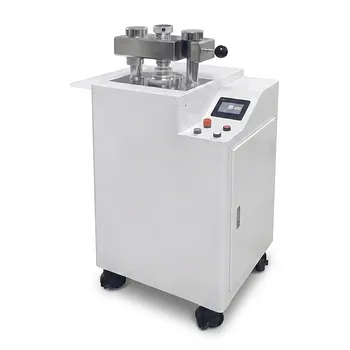
The key to accurate FTIR spectroscopy lies in sample transparency. Laboratory hydraulic presses and pellet molds are used to compress a mixture of ground sample material and Potassium Bromide (KBr) into a thin, uniform pellet. This process creates a solid, semi-transparent medium that allows infrared light to pass through the sample, enabling the instrument to accurately detect the vibration peaks of characteristic functional groups.
By applying high pressure to a diluted powder mixture, hydraulic presses eliminate light-scattering air gaps and create a transparent pellet. This ensures the infrared beam captures a clear molecular fingerprint with high signal-to-noise ratios and minimal interference.
The Role of the Hydraulic Press and Pellet Mold
Achieving Precise Dilution and Uniformity
For effective FTIR analysis, a powder sample must be diluted in a medium that does not interfere with infrared light. A small quantity of the sample is mixed with Potassium Bromide (KBr), typically at a precise ratio of 1:100.
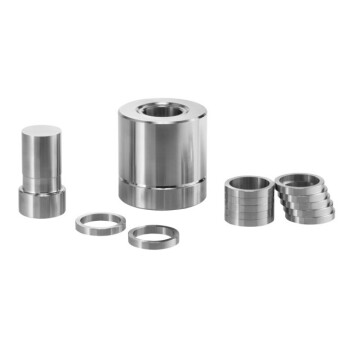
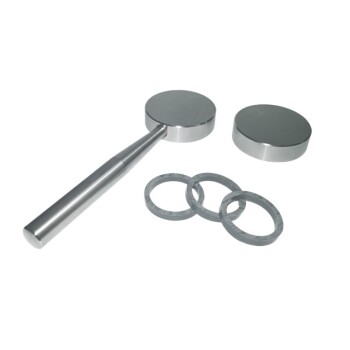
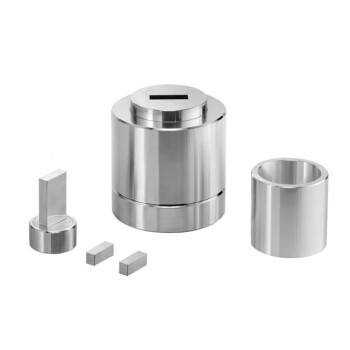
The pellet mold, or die, holds this mixture in a contained chamber. This ensures that the resulting pellet has a uniform thickness, which is a prerequisite for consistent light transmission and reproducible results.
Eliminating Scattering through High Pressure
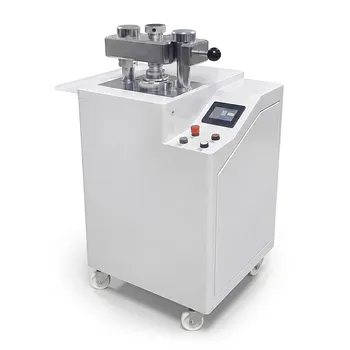
Raw powder mixtures contain air gaps that cause non-specific scattering of infrared light, which obscures the data. The hydraulic press applies high, uniform force to the mixture within the mold to fuse the particles into a solid mass.
This high-pressure pelletizing process eliminates air gaps and reduces scattering interference. The result is a stable baseline in the resulting spectrum, allowing for the clear identification of chemical interactions.
Why Pelletization is Critical for FTIR Analysis
Ensuring Infrared Light Transmittance
Potassium Bromide is used because it is transparent to infrared radiation. When the press transforms the KBr-sample mixture into a transparent pellet, it allows the spectrometer to "see" the sample material without the carrier medium blocking the signal.
This transparency allows infrared light to penetrate the sample entirely. Without this level of clarity, the infrared beam would be reflected or absorbed by the carrier, rendering the molecular structure unreadable.
Capturing Clear Absorption Peaks
The primary goal of FTIR is to identify characteristic absorption peaks that represent specific molecular bonds. A well-pressed pellet ensures these peaks are sharp and distinct.
Clear peaks are necessary to analyze whether physical encapsulation or chemical interactions have occurred between substances, such as drugs and polymer matrices. This level of detail is only possible when the sample is within the detection range of the FTIR instrument.
Understanding the Trade-offs and Common Pitfalls
Moisture Sensitivity of KBr
KBr is highly hygroscopic, meaning it readily absorbs moisture from the air. If the powder is not kept dry or if the pressing process is too slow, water vapor can introduce unwanted "OH" peaks into the spectrum, potentially masking the sample's actual characteristics.
Pressure and Pellet Integrity
If the hydraulic press applies insufficient pressure, the pellet will remain opaque and scatter light. Conversely, applying pressure too quickly or unevenly can cause the pellet to crack or become cloudy, which compromises the signal-to-noise ratio and leads to inaccurate data.
Optimizing Your Sample Preparation
Proper sample preparation is the most influential factor in the quality of your FTIR spectra. Selecting the right tools and techniques depends on your specific analytical requirements.
- If your primary focus is high-resolution research: Ensure you use a high-precision manual or automated hydraulic press to achieve maximum pellet transparency and eliminate all air gaps.
- If your primary focus is rapid routine testing: Use standardized pellet molds and pre-measured KBr packets to maintain a consistent 1:100 ratio and ensure reproducibility across multiple samples.
- If your primary focus is analyzing sensitive nanoparticles: Prioritize a slow, steady pressure application to avoid damaging the molecular structure of the nanoparticles while ensuring a clear characteristic spectrum.
Mastering the use of the hydraulic press and pellet mold transforms a simple powder into a window through which the molecular world becomes visible.
Summary Table:
| Component | Primary Function | Benefit for FTIR Analysis |
|---|---|---|
| Hydraulic Press | Applies high, uniform force | Eliminates air gaps and reduces light scattering |
| Pellet Mold (Die) | Contains and shapes the mixture | Ensures uniform thickness and reproducible results |
| KBr Medium | Acts as an IR-transparent carrier | Allows infrared light to pass through the sample clearly |
| Sample Mixture | Dilutes sample at a 1:100 ratio | Enables detection of sharp, distinct molecular peaks |
Elevate Your FTIR Precision with KINTEK
Achieving the perfect KBr pellet is essential for high-resolution molecular fingerprints. KINTEK specializes in high-performance laboratory equipment designed to optimize your sample preparation workflow. Our precision manual and automated hydraulic presses (pellet, hot, and isostatic), coupled with durable pellet molds, ensure maximum transparency and minimal interference for your FTIR testing.
Beyond spectroscopy, KINTEK offers a comprehensive range of lab solutions, including:
- High-temperature furnaces (muffle, vacuum, CVD, and more)
- Crushing and milling systems for perfect sample grinding
- High-pressure reactors and autoclaves for advanced material research
- Specialized consumables like PTFE products, ceramics, and crucibles
Ready to enhance your lab's efficiency and data accuracy? Contact our experts today to find the perfect pressing solution!
References
- Zhengdong Xu, Fan Yang. Synthesis and Performance Evaluation of Graphene-Based Comb Polymer Viscosity Reducer. DOI: 10.3390/en16155779
This article is also based on technical information from Kintek Solution Knowledge Base .
Related Products
- Automatic Laboratory Hydraulic Press for XRF & KBR Pellet Press
- Laboratory Hydraulic Pellet Press for XRF KBR FTIR Lab Applications
- XRF & KBR steel ring lab Powder Pellet Pressing Mold for FTIR
- XRF & KBR plastic ring lab Powder Pellet Pressing Mold for FTIR
- kbr pellet press 2t
People Also Ask
- What is the significance of applying 200 MPa of pressure with a laboratory hydraulic pellet press for composite ceramics?
- What is the role of a laboratory hydraulic pellet press and stainless steel molds in the fabrication of RuO2/NbC anodes?
- How does a laboratory hydraulic pellet press contribute to SiCw/2024 aluminum composite preforms? Optimize Densification
- What is the necessity of using a laboratory hydraulic pellet press in the preparation of biomass fuel pellets? Guide
- What is the function of a laboratory hydraulic pellet press in supercapacitor electrode fabrication? Optimize 3D VNCN.