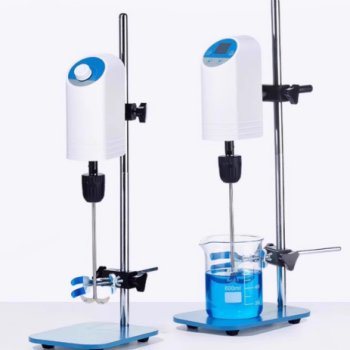
Magnetic stirring systems function as the essential physical enabler in lithium mineral leaching, primarily by ensuring uniform contact between mineral powders and concentrated sulfuric acid. By facilitating consistent heat transfer and preventing material settling, these systems create the homogeneity required to reach extraction efficiencies exceeding 97%.
Core Takeaway While the leaching of lithium is fundamentally a chemically controlled process, magnetic stirring provides the non-negotiable physical prerequisites for high yield. It does not alter the chemical reaction rate itself but removes physical barriers—such as thermal gradients and particle clumping—that would otherwise throttle efficiency.
The Physical Foundation of Leaching Efficiency
Maximizing Reactant Contact
The primary role of magnetic stirring is to ensure thorough interaction between the solid mineral phase and the liquid acid phase.
Without this mechanical agitation, the mineral powder cannot achieve adequate exposure to the concentrated sulfuric acid. This lack of contact creates "dead zones" where the reaction stalls due to reactant starvation.
Facilitating Uniform Heat Transfer
Leaching reactions are highly sensitive to temperature. Magnetic stirring circulates the fluid continuously, distributing thermal energy evenly throughout the reactor.
This prevents temperature stratification, ensuring that the entire volume of the mixture remains at the optimal reaction temperature simultaneously.
Operational Impacts on Process Integrity
Preventing Material Agglomeration
A significant risk in slurry-based reactions is the tendency of solid particles to settle and clump.
Magnetic stirring, specifically at controlled speeds such as 120 r min⁻¹, counteracts gravity to keep particles in suspension. This prevents the formation of sediment layers at the bottom of the reactor which would otherwise resist acid penetration.
Eliminating Localized Overheating
Static or poorly mixed reactors are prone to hotspots, where heat accumulates in specific areas.
By maintaining fluid motion, magnetic stirring eliminates localized overheating. This protects the reactor vessel and ensures the reaction proceeds safely without thermal runaway in isolated pockets.
Understanding the Trade-offs
Chemical Control vs. Physical Uniformity
It is critical to understand the hierarchy of control in this process. The reaction kinetics are primarily chemically controlled, meaning the speed is dictated by the chemical properties of the lithium mineral and the acid.
Therefore, increasing stirring speed beyond what is necessary to achieve uniformity will not significantly accelerate the reaction. Stirring is the necessary prerequisite to unlock the chemical potential, not the driver of the chemical rate itself.
Making the Right Choice for Your Goal
To optimize your lithium leaching process, consider the following based on your specific operational targets:
- If your primary focus is Maximizing Yield: Ensure your stirring mechanism creates a fully suspended slurry to prevent agglomeration, a requirement for reaching >97% leaching rates.
- If your primary focus is Process Safety: Utilize magnetic stirring to normalize thermal gradients, specifically to prevent dangerous localized overheating during the addition of concentrated acid.
Ultimate success depends on viewing magnetic stirring not just as a mixer, but as a critical thermal and physical stabilizer.
Summary Table:
| Key Feature | Impact on Lithium Leaching | Strategic Benefit |
|---|---|---|
| Reactant Contact | Eliminates "dead zones" between powder and acid | Ensures complete mineral exposure |
| Thermal Distribution | Prevents temperature stratification and hotspots | Maintains optimal reaction temperature |
| Particle Suspension | Counteracts gravity and prevents agglomeration | Prevents sediment layers and clogging |
| Kinetic Role | Provides physical uniformity for chemical control | Enables maximum theoretical yield (>97%) |
Elevate Your Lithium Extraction with KINTEK Precision
Maximize your leaching efficiency and ensure process safety with KINTEK’s advanced laboratory solutions. As experts in high-performance equipment, KINTEK specializes in laboratory equipment and consumables, providing the precision needed for complex chemical extractions. Whether you require high-temperature high-pressure reactors, magnetic stirring systems, or specialized electrolytic cells and electrodes, our portfolio is designed to meet the rigorous demands of battery research and mineral processing.
Unlock the full potential of your research today:
- Superior Uniformity: Achieve >97% extraction rates with our optimized mixing and thermal solutions.
- Comprehensive Range: From muffle furnaces and hydraulic presses to ULT freezers and crucibles, we supply everything your lab needs.
- Expert Support: Benefit from our deep industry knowledge in lithium mineral processing and material science.
Contact KINTEK today to find the perfect equipment for your lab!
References
- Lin Gao, Min Wang. Recovery of Lithium from Lepidolite by Sulfuric Acid and Separation of Al/Li by Nanofiltration. DOI: 10.3390/min10110981
This article is also based on technical information from Kintek Solution Knowledge Base .
Related Products
- Laboratory Small Constant Temperature Heated Magnetic Stirrer Heater and Stirrer
- Custom PTFE Teflon Parts Manufacturer for Magnetic Stirring Bar
- Three-dimensional electromagnetic sieving instrument
- High Performance Laboratory Stirrers for Diverse Applications
- Custom PTFE Teflon Parts Manufacturer for PTFE Stirring Bar Recovery Rod
People Also Ask
- What role does a magnetic stirrer with heating play in ZnO nanoparticle synthesis? Precision Control for Quality Results
- What role does a constant temperature heating magnetic stirrer play in MFC-HAp synthesis? Achieve Material Homogeneity
- What is the function of a laboratory magnetic stirrer in Ni–Cr–P electrodeposition? Optimize Ion Transport & Coating
- Why is a laboratory magnetic stirrer required for benzoic acid esters? Boost Reaction Speed & Yield with High RPM
- What role does a laboratory magnetic stirrer play in TiO2 and TiO2-Ag sol preparation? Master Chemical Kinetics