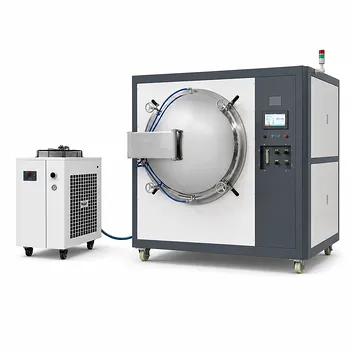
The primary difference lies in the mechanism of heat generation and the duration of the thermal cycle. While Spark Plasma Sintering (SPS) utilizes pulsed electric current for rapid, internal heating, a vacuum hot press sintering furnace relies on external heating elements and significantly longer holding times.
Core Takeaway: The choice between these methods dictates the microstructure of your composite. Vacuum hot press sintering favors prolonged thermal exposure to create distinct, measurable interfacial diffusion layers, whereas SPS prioritizes rapid densification to suppress grain growth and preserve nanostructures.
The Heating Mechanism: Internal vs. External
External Thermal Application
Vacuum hot press sintering utilizes an external heating source. Heat is applied to the outside of the mold and must conduct through to the sample material.
Internal Pulsed Current
In contrast, Spark Plasma Sintering (SPS) operates by passing a pulsed electric current directly through the pressing die (typically graphite) and the component itself. This results in internal heat generation, allowing the material to reach sintering temperatures almost instantaneously.
Impact on Diffusion and Interfaces
Promoting Thorough Diffusion
The defining characteristic of the vacuum hot press method is its extended holding time, often lasting an hour or more. This prolonged exposure to heat is not a byproduct of inefficiency, but a critical processing feature.
Creation of Transition Layers
According to your primary reference, this extended thermal application drives thorough elemental diffusion. This process facilitates the formation of distinct interfacial transition layers with measurable thickness between the reinforcement particles and the matrix.
The Advantage for Research
Because the vacuum hot press creates these substantial transition layers, it is the superior choice for studying interfacial diffusion behavior. It allows researchers to observe chemical interactions that simply do not have time to occur during rapid sintering processes.
Efficiency and Grain Structure
Rapid Densification
SPS is characterized by extremely high heating rates and short process cycles. This allows materials to reach high density rapidly at lower overall temperatures compared to traditional hot pressing.
Preserving Microstructure
The speed of SPS offers a distinct metallurgical advantage: it effectively suppresses abnormal grain growth. By avoiding long-duration high-temperature exposure, SPS preserves the grain refinement effects and superior mechanical properties of nano-reinforcement phases.
Understanding the Trade-offs
Time vs. Interaction
The primary trade-off is between process efficiency and interfacial reaction. SPS is highly efficient and creates dense materials quickly, but the rapid cycle may prevent the formation of beneficial reaction layers if the constituents require time to diffuse.
Structural Integrity vs. Grain Size
Vacuum hot press allows for strong interfacial bonding through diffusion, but the long heat exposure risks grain coarsening. Conversely, SPS maintains fine grain structures but may require careful tuning to ensure adequate bonding between the matrix and reinforcement without the aid of long diffusion times.
Making the Right Choice for Your Goal
To select the correct equipment for your metal matrix composite, you must determine whether your priority is microstructural analysis or mechanical performance optimization.
- If your primary focus is studying interfacial diffusion behavior: Choose the vacuum hot press sintering furnace to ensure sufficient time for distinct, measurable transition layers to form between the matrix and reinforcement.
- If your primary focus is preserving nanostructures and high efficiency: Choose Spark Plasma Sintering (SPS) to achieve rapid densification while suppressing abnormal grain growth and reducing processing time.
The correct method is defined not by which machine is faster, but by which thermal history creates the material properties your application demands.
Summary Table:
| Feature | Vacuum Hot Press Sintering | Spark Plasma Sintering (SPS) |
|---|---|---|
| Heating Method | External (Conduction) | Internal (Pulsed Electric Current) |
| Cycle Duration | Long (Hours) | Short (Minutes) |
| Interfacial Diffusion | High (Formation of thick transition layers) | Low (Limited chemical interaction) |
| Grain Structure | Risk of grain coarsening | Preserves fine/nanostructures |
| Primary Goal | Interfacial research & diffusion study | Rapid densification & grain refinement |
Elevate Your Material Research with KINTEK
Choosing the right sintering technology is critical to the performance of your metal matrix composites. Whether you need the precision of a vacuum hot press furnace for in-depth diffusion studies or the rapid efficiency of SPS to preserve nanostructures, KINTEK provides the high-performance laboratory equipment you require.
Our extensive portfolio includes:
- Advanced High-Temperature Furnaces: Vacuum, muffle, tube, and atmosphere furnaces tailored for precise thermal cycles.
- Precision Sample Preparation: Crushing, milling, and hydraulic presses (pellet, hot, isostatic) for superior sample integrity.
- Comprehensive Lab Solutions: From high-pressure reactors and autoclaves to battery research tools and essential ceramics.
Ready to optimize your sintering process? Contact our technical experts today to find the perfect solution for your lab’s specific needs.
Related Products
- 600T Vacuum Induction Hot Press Furnace for Heat Treat and Sintering
- Vacuum Heat Treat and Sintering Furnace with 9MPa Air Pressure
- Vacuum Heat Treat and Pressure Sintering Furnace for High Temperature Applications
- 2200 ℃ Tungsten Vacuum Heat Treat and Sintering Furnace
- Vacuum Hot Press Furnace Heated Vacuum Press Machine Tube Furnace
People Also Ask
- What role does an induction vacuum hot pressing furnace play in sintering? Achieve 98% Density in Carbide Blocks
- What advantages does a vacuum hot press furnace provide for LSLBO ceramic electrolytes? Achieve 94% Relative Density
- What role does a Vacuum Hot Press (VHP) furnace play in the densification of austenitic stainless steel 316 composites?
- What are the advantages of a vacuum hot press furnace for W-50%Cu? Achieve 99.6% Density at Lower Temperatures
- What role does mechanical pressure play during the vacuum diffusion bonding of tungsten and copper? Keys to Solid Bonding