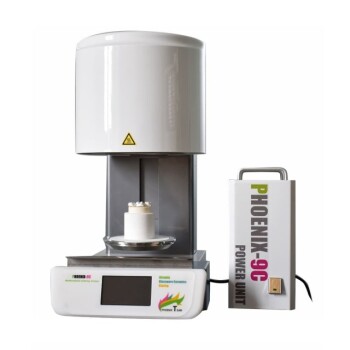
Knowledge How do traditional high-temperature sintering furnaces facilitate YSZ thin films? Achieving the Gold Standard.
Author avatar

Tech Team · Kintek Solution

Updated 5 days ago

How do traditional high-temperature sintering furnaces facilitate YSZ thin films? Achieving the Gold Standard.


Traditional high-temperature sintering furnaces serve as the definitive baseline for developing Yttria-Stabilized Zirconia (YSZ) thin films. By subjecting ceramic precursors to a controlled thermal environment—ranging from 800°C to 1400°C over several hours—these furnaces ensure the complete decomposition of organic components and facilitate the structural evolution necessary for high-performance electrolytes.

The primary role of traditional sintering in modern development is to establish a performance benchmark. By producing samples with maximum crystallinity and density, this method provides the "gold standard" data required to evaluate the effectiveness of newer, rapid sintering technologies.

The Physiology of Film Densification

Eliminating Organic Precursors

Before a film can become a functional electrolyte, it must be purged of non-ceramic elements.

Traditional furnaces apply sustained heat to ensure the complete decomposition of organic binders and components found in the ceramic precursors. This slow, thorough burn-out prevents structural defects that can occur if organics are trapped inside rapidly hardening materials.

Driving Grain Growth and Crystallinity

Once the organics are removed, the focus shifts to the ceramic structure itself.

The thermal energy provided by the furnace drives grain growth, forcing the individual particles to fuse. This transforms the loose precursor material into a fully crystalline structure, which is essential for the material's mechanical stability.

Achieving a Gas-Tight Seal

For a YSZ film to function as an electrolyte, it must physically isolate the fuel from the oxidant.

High-temperature sintering—often requiring temperatures up to 1400°C for specific densification targets—transforms the layer into a gas-tight, pore-free membrane. This density is critical for preventing gas leakage while maintaining specific channels for oxygen ion transport.

The Strategic Value: Benchmarking

Setting the Standard for Conductivity

In the research of thin films, relative data is often more useful than absolute data.

Traditional furnaces produce YSZ films with optimal ionic conductivity due to their high density and ordered crystal lattice. Researchers use these measurements to set the upper limit of what is theoretically possible for a specific material formulation.

Validating Rapid Sintering Methods

Newer manufacturing methods aim to sinter ceramics in seconds rather than hours.

However, to determine if a rapid method is viable, its output is compared against the crystallinity and grain size established by traditional furnace sintering. If the rapid method cannot approximate the properties of the furnace-sintered film, the process requires further optimization.

Understanding the Trade-offs

The Cost of Perfection

While traditional furnaces produce superior structural quality, the process is inherently slow.

The requirement for extended heating times (several hours) limits manufacturing throughput compared to photonic or laser sintering techniques.

Energy Consumption

Achieving and maintaining temperatures between 800°C and 1400°C is energy-intensive.

This makes traditional sintering less ideal for large-scale, low-cost mass production where energy efficiency is a primary KPI, despite its superior consistency.

Making the Right Choice for Your Goal

While rapid methods are the future of manufacturing, traditional sintering remains the backbone of material development and quality assurance.

  • If your primary focus is Material Characterization: Use a traditional furnace to create a flawless reference sample, ensuring you understand the material's maximum theoretical performance.
  • If your primary focus is Process Validation: Use the data from furnace-sintered samples to audit the quality of films produced by emerging, faster techniques.

Ultimately, traditional sintering provides the rigorous control necessary to transform raw precursors into the high-quality benchmarks that drive innovation in solid oxide fuel cells.

Summary Table:

Feature Impact on YSZ Thin Film Development
Temperature Range 800°C to 1400°C for optimal crystallization and density.
Organic Removal Ensures complete decomposition of binders to prevent structural defects.
Densification Creates gas-tight, pore-free membranes essential for electrolytes.
Benchmarking Establishes the "gold standard" for ionic conductivity and grain size.
Structural Integrity Promotes maximum crystallinity and mechanical stability.

Elevate Your Material Research with KINTEK Precision

To achieve the "gold standard" in YSZ electrolyte development, you need the uncompromising thermal control of KINTEK’s high-performance laboratory equipment. We specialize in providing researchers with the tools necessary for rigorous material characterization and process validation.

Our Comprehensive Portfolio Includes:

  • High-Temperature Furnaces: Muffle, tube, vacuum, and atmosphere furnaces designed for precise sintering up to 1400°C and beyond.
  • Material Processing: Advanced crushing, milling systems, and hydraulic presses (pellet, hot, isostatic) for superior precursor preparation.
  • Specialized Lab Tools: High-pressure reactors, autoclaves, and high-quality ceramic crucibles tailored for thin-film research.

Whether you are setting performance benchmarks or optimizing new manufacturing techniques, KINTEK offers the reliable solutions your laboratory demands.

Contact KINTEK today to find the perfect sintering solution for your lab!

Related Products

People Also Ask

Related Products

Dental Porcelain Zirconia Sintering Ceramic Vacuum Press Furnace

Dental Porcelain Zirconia Sintering Ceramic Vacuum Press Furnace

Get precise dental results with Dental Vacuum Press Furnace. Automatic temperature calibration, low noise tray, and touch screen operation. Order now!

Ultra-High Temperature Graphite Vacuum Graphitization Furnace

Ultra-High Temperature Graphite Vacuum Graphitization Furnace

The ultra-high temperature graphitization furnace utilizes medium frequency induction heating in a vacuum or inert gas environment. The induction coil generates an alternating magnetic field, inducing eddy currents in the graphite crucible, which heats up and radiates heat to the workpiece, bringing it to the desired temperature. This furnace is primarily used for graphitization and sintering of carbon materials, carbon fiber materials, and other composite materials.

1800℃ Muffle Oven Furnace for Laboratory

1800℃ Muffle Oven Furnace for Laboratory

KT-18 muffle furnace with Japan Al2O3 polycrystalline fibe and Silicon Molybdenum heating element, up to 1900℃, PID temperature control and 7" smart touch screen. Compact design, low heat loss, and high energy efficiency. Safety interlock system and versatile functions.

Mesh belt controlled atmosphere furnace

Mesh belt controlled atmosphere furnace

Discover our KT-MB mesh belt sintering furnace - perfect for high-temperature sintering of electronic components & glass insulators. Available for open air or controlled atmosphere environments.

1700℃ Muffle Oven Furnace for Laboratory

1700℃ Muffle Oven Furnace for Laboratory

Get superior heat control with our 1700℃ Muffle Furnace. Equipped with intelligent temperature microprocessor, TFT touch screen controller & advanced insulation materials for precise heating up to 1700C. Order now!

1400℃ Laboratory High Temperature Tube Furnace with Alumina Tube

1400℃ Laboratory High Temperature Tube Furnace with Alumina Tube

Looking for a tube furnace for high-temperature applications? Our 1400℃ Tube Furnace with Alumina Tube is perfect for research and industrial use.

1700℃ Laboratory High Temperature Tube Furnace with Alumina Tube

1700℃ Laboratory High Temperature Tube Furnace with Alumina Tube

Looking for a high-temperature tube furnace? Check out our 1700℃ Tube Furnace with Alumina Tube. Perfect for research and industrial applications up to 1700C.

Laboratory Muffle Oven Furnace Bottom Lifting Muffle Furnace

Laboratory Muffle Oven Furnace Bottom Lifting Muffle Furnace

Efficiently produce batches with excellent temperature uniformity using our Bottom Lifting Furnace. Features two electric lifting stages and advanced temperature control up to 1600℃.

High Pressure Laboratory Vacuum Tube Furnace Quartz Tubular Furnace

High Pressure Laboratory Vacuum Tube Furnace Quartz Tubular Furnace

KT-PTF High Pressure Tube Furnace: Compact split tube furnace with strong positive pressure resistance. Working temp up to 1100°C and pressure up to 15Mpa. Also works under controller atmosphere or high vacuum.

1400℃ Muffle Oven Furnace for Laboratory

1400℃ Muffle Oven Furnace for Laboratory

Get precise high-temperature control up to 1500℃ with KT-14M Muffle furnace. Equipped with a smart touch screen controller and advanced insulation materials.

Horizontal High Temperature Graphite Vacuum Graphitization Furnace

Horizontal High Temperature Graphite Vacuum Graphitization Furnace

Horizontal Graphitization Furnace: This type of furnace is designed with the heating elements placed horizontally, allowing for uniform heating of the sample. It's well-suited for graphitizing large or bulky samples that require precise temperature control and uniformity.

Vacuum Heat Treat and Sintering Furnace with 9MPa Air Pressure

Vacuum Heat Treat and Sintering Furnace with 9MPa Air Pressure

The air pressure sintering furnace is a high-tech equipment commonly used for the sintering of advanced ceramic materials. It combines vacuum sintering and pressure sintering techniques to achieve high-density and high-strength ceramics.

2200 ℃ Tungsten Vacuum Heat Treat and Sintering Furnace

2200 ℃ Tungsten Vacuum Heat Treat and Sintering Furnace

Experience the ultimate refractory metal furnace with our Tungsten vacuum furnace. Capable of reaching 2200℃, perfect for sintering advanced ceramics and refractory metals. Order now for high-quality results.

1200℃ Split Tube Furnace with Quartz Tube Laboratory Tubular Furnace

1200℃ Split Tube Furnace with Quartz Tube Laboratory Tubular Furnace

KT-TF12 split tube furnace: high-purity insulation, embedded heating wire coils, and max. 1200C. Widely used for new materials and chemical vapour deposition.

Small Vacuum Heat Treat and Tungsten Wire Sintering Furnace

Small Vacuum Heat Treat and Tungsten Wire Sintering Furnace

The small vacuum tungsten wire sintering furnace is a compact experimental vacuum furnace specially designed for universities and scientific research institutes. The furnace features a CNC welded shell and vacuum piping to ensure leak-free operation. Quick-connect electrical connections facilitate relocation and debugging, and the standard electrical control cabinet is safe and convenient to operate.

1400℃ Controlled Atmosphere Furnace with Nitrogen and Inert Atmosphere

1400℃ Controlled Atmosphere Furnace with Nitrogen and Inert Atmosphere

Achieve precise heat treatment with KT-14A controlled atmosphere furnace. Vacuum sealed with a smart controller, it's ideal for lab and industrial use up to 1400℃.

Vertical High Temperature Graphite Vacuum Graphitization Furnace

Vertical High Temperature Graphite Vacuum Graphitization Furnace

Vertical high temperature graphitization furnace for carbonization and graphitization of carbon materials up to 3100℃.Suitable for shaped graphitization of carbon fiber filaments and other materials sintered in a carbon environment.Applications in metallurgy, electronics, and aerospace for producing high-quality graphite products like electrodes and crucibles.

2200 ℃ Graphite Vacuum Heat Treat Furnace

2200 ℃ Graphite Vacuum Heat Treat Furnace

Discover the power of the KT-VG Graphite Vacuum Furnace - with a maximum working temperature of 2200℃, it's perfect for vacuum sintering of various materials. Learn more now.

Graphite Vacuum Continuous Graphitization Furnace

Graphite Vacuum Continuous Graphitization Furnace

High-temperature graphitization furnace is a professional equipment for graphitization treatment of carbon materials. It is a key equipment for the production of high-quality graphite products. It has high temperature, high efficiency and uniform heating. It is suitable for various high-temperature treatments and graphitization treatments. It is widely used in metallurgy, electronics, aerospace, etc. industry.

Laboratory Rapid Thermal Processing (RTP) Quartz Tube Furnace

Laboratory Rapid Thermal Processing (RTP) Quartz Tube Furnace

Get lightning-fast heating with our RTP Rapid Heating Tube Furnace. Designed for precise, high-speed heating and cooling with convenient sliding rail and TFT touch screen controller. Order now for ideal thermal processing!


Leave Your Message