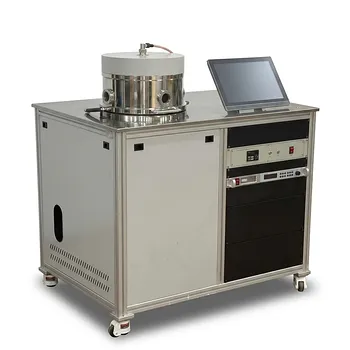
A Chemical Vapor Infiltration (CVI) furnace addresses the critical challenge of densification by utilizing a controlled low-pressure, high-temperature reaction environment. Unlike methods that rely on extreme heat or mechanical force, CVI allows gaseous precursors to deeply penetrate complex fiber preforms. This process enables the deposition of a ceramic matrix at relatively low temperatures, preserving the structural integrity of sensitive fibers while ensuring high material purity.
The CVI furnace acts as a precision tool for composite densification, prioritizing material integrity over aggressive processing. Its ability to deposit matrices at lower temperatures is the defining factor that prevents thermal degradation of the fibers and enables the engineering of exact interface layers.
The Mechanics of Infiltration
Overcoming Geometric Complexity
The primary technical hurdle in preparing continuous fiber-reinforced UHTCMCs is getting the matrix material into the intricate voids of a fiber weave.
A CVI furnace solves this by introducing the matrix material as a gas. Because the precursors are gaseous, they can permeate the complex geometry of the fiber preform more effectively than liquid or solid methods.
The Role of Low Pressure
The furnace operates at low pressure. This environment is crucial for controlling the mean free path of the gas molecules.
By lowering the pressure, the system ensures that the gas diffuses deep into the preform before reacting, rather than just coating the outer surface.
Preserving Material Integrity
Avoiding Thermal Shock
Many ceramic processing techniques require temperatures that can degrade or embrittle high-performance fibers.
The CVI furnace addresses this by facilitating matrix deposition at relatively low temperatures. This "gentle" thermal profile is essential for maintaining the tensile strength and flexibility of the reinforcement fibers within the composite.
Ensuring High Purity
Contaminants in a ceramic matrix can lead to catastrophic failure under ultra-high temperature conditions.
The CVI environment allows for high-purity deposition. By strictly controlling the input gases and the reaction environment, the furnace minimizes the introduction of impurities that often plague other consolidation methods.
Precision Interface Engineering
Controlling the Interphase
The interface between the fiber and the matrix determines the fracture behavior of the composite. A CVI furnace provides the precise control necessary to deposit specific interface layers, such as PyC (Pyrolytic Carbon) or BN (Boron Nitride).
Nanoscale Thickness Control
Beyond just material selection, the CVI process allows for precise control over the thickness of these layers.
This capability ensures that the interface is thick enough to deflect cracks and prevent brittle failure, but thin enough to maintain load transfer between the fiber and the matrix.
Understanding Process Constraints
The Necessity of Strict Control
While CVI offers superior quality, it relies heavily on maintaining a strictly controlled reaction environment.
If the temperature or pressure fluctuates outside of the optimal range, the deposition may occur too quickly on the surface, blocking the pores and preventing full densification of the interior.
Process Complexity
The requirement for managing gaseous precursors and vacuum conditions adds a layer of complexity to the manufacturing process compared to simpler sintering methods.
Making the Right Choice for Your Goal
The CVI furnace is a specialized tool designed for applications where material quality cannot be compromised.
- If your primary focus is Fiber Integrity: CVI is the optimal choice because its relatively low deposition temperatures prevent thermal damage to the reinforcement fibers.
- If your primary focus is Fracture Toughness: This method is essential, as it allows for the precise application of PyC or BN interface layers that deflect cracks.
Ultimately, the CVI furnace transforms the challenge of densification into an opportunity for precision engineering, delivering a composite where the matrix and fiber work in perfect unison.
Summary Table:
| Feature | Technical Challenge Addressed | Impact on UHTCMC Quality |
|---|---|---|
| Gaseous Precursors | Geometric Complexity | Ensures deep penetration into intricate fiber weaves |
| Low-Pressure Environment | Surface Sealing | Promotes diffusion to the core before reaction occurs |
| Lower Deposition Temp | Thermal Degradation | Preserves tensile strength and flexibility of fibers |
| Interphase Control | Brittle Failure | Enables precise PyC/BN layers for crack deflection |
| High-Purity Reaction | Material Contamination | Minimizes impurities for extreme temperature stability |
Elevate Your Advanced Material Research with KINTEK
Precision engineering is the backbone of high-performance ceramics. KINTEK specializes in cutting-edge laboratory equipment, including specialized CVD/CVD-CVI furnaces, vacuum systems, and crushing and milling solutions designed to meet the rigorous demands of UHTCMC and battery research.
Whether you are developing fiber-reinforced composites or exploring advanced electrolytic cell configurations, our expert team provides the high-temperature high-pressure reactors and high-purity consumables (PTFE, ceramics, and crucibles) you need for reliable, repeatable results.
Ready to optimize your densification process? Contact KINTEK today to discuss our comprehensive range of furnace systems and laboratory solutions tailored for your success.
Related Products
- Customer Made Versatile CVD Tube Furnace Chemical Vapor Deposition Chamber System Equipment
- Split Chamber CVD Tube Furnace with Vacuum Station Chemical Vapor Deposition System Equipment Machine
- Multi Heating Zones CVD Tube Furnace Machine Chemical Vapor Deposition Chamber System Equipment
- Chemical Vapor Deposition CVD Equipment System Chamber Slide PECVD Tube Furnace with Liquid Gasifier PECVD Machine
- Controlled Nitrogen Inert Hydrogen Atmosphere Furnace
People Also Ask
- What is a CVD tube furnace? A Complete Guide to Thin-Film Deposition
- What is the function of a high-temperature CVD tube furnace in 3D graphene foam prep? Master 3D Nanomaterial Growth
- What are the technical advantages of using a CVD tube furnace? Optimize Silicon-Carbon Battery Anodes
- How does a CVD tube furnace inhibit the sintering of silver supports? Boost Membrane Durability and Performance
- What is the function of a tube furnace in CVD SiC synthesis? Achieving Ultra-Pure Silicon Carbide Powders