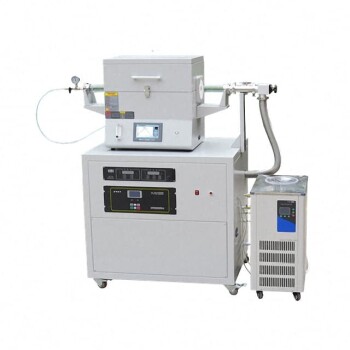
Controlled atmosphere tube furnaces facilitate Ni–Al synthesis by providing a hermetically sealed environment that enables precise thermal activation while preventing the destructive oxidation of reactive metal powders.
By maintaining an inert argon atmosphere and a constant temperature—typically around 570 °C—the furnace triggers a solid-state reaction between nickel and aluminum atoms. This process transforms raw pre-coatings into a dense, chemically stable Ni–Al intermetallic phase that possesses superior high-temperature strength.
The controlled atmosphere tube furnace serves as a precision reactor that manages the delicate balance between thermal energy and chemical purity. It allows for the controlled diffusion of atoms required to form intermetallic compounds while shielding the material from atmospheric contaminants that would otherwise degrade its mechanical properties.
The Role of Atmospheric Control
Preventing Surface Oxidation
Nickel and aluminum, particularly in powder or coating form, are highly susceptible to oxidation when heated in the presence of oxygen.
The tube furnace replaces ambient air with a protective argon atmosphere, ensuring that the metals react with each other rather than forming unwanted oxides.
This strict environmental control is essential for maintaining the chemical purity of the resulting intermetallic phase, which directly impacts the coating’s final performance.
Enabling Chemical Stability
By excluding nitrogen and oxygen, the furnace prevents the formation of brittle impurities that could compromise the material's integrity.
A stable, inert environment ensures that the stoichiometry of the Ni–Al compound remains consistent throughout the entire heat treatment cycle.
This leads to a more predictable phase transformation, resulting in a coating with enhanced high-temperature strength and chemical resistance.
Thermal Precision and Reaction Kinetics
Facilitating Solid-State Diffusion
The synthesis of Ni–Al intermetallic compounds relies on the movement of atoms across the interface of the two metals.
The furnace provides a constant temperature environment (often calibrated to 570 °C) that provides the necessary kinetic energy for these atoms to migrate.
This solid-state reaction is what facilitates the transition from a simple mixture of metals to a complex, bonded intermetallic structure.
Managing Heating Rates and Gradients
Precise heating programs allow for a uniform temperature gradient across the material, which is critical for consistent alloying.
Using a steady heating rate, such as 5 °C/min, helps manage the kinetics of the reaction and prevents localized overheating.
This controlled approach inhibits Ostwald ripening, ensuring that the resulting microstructure remains fine and uniformly distributed rather than forming large, coarse grains.
Understanding the Trade-offs
Balancing Temperature and Grain Growth
While higher temperatures can accelerate the diffusion process, they also increase the risk of excessive grain growth.
If the temperature is too high or the "soak time" is too long, the material may lose its fine-grained structure, leading to a decrease in mechanical toughness.
Conversely, temperatures that are too low will fail to trigger the complete transformation into the intermetallic phase, leaving residual unreacted nickel or aluminum.
Gas Flow and Pressure Maintenance
Maintaining a continuous flow of inert gas is necessary to sweep away any outgassed impurities, but it requires careful calibration.
Insufficient flow may allow trace contaminants to accumulate, while excessive flow can create temperature fluctuations within the tube, leading to non-uniform reactions.
Achieving the "sweet spot" in gas pressure and flow rate is a fundamental challenge in scaling Ni–Al synthesis for industrial applications.
How to Apply This to Your Project
Making the Right Choice for Your Goal
To achieve the best results with a controlled atmosphere tube furnace, your operational parameters must align with your specific material requirements.
- If your primary focus is Maximum Density: Prioritize a longer dwell time at a constant temperature of 570 °C to allow for complete solid-state diffusion.
- If your primary focus is Fine Microstructure: Utilize a strict heating rate of 5 °C/min or less to inhibit grain growth and maintain a uniform phase distribution.
- If your primary focus is Chemical Purity: Ensure a continuous, high-purity argon flow and verify the furnace seals to prevent any atmospheric oxygen ingress.
By mastering the intersection of thermal precision and atmospheric purity, you can reliably transform raw metallic precursors into high-performance Ni–Al intermetallic compounds.
Summary Table:
| Key Parameter | Role in Ni-Al Synthesis | Benefit for Material Integrity |
|---|---|---|
| Atmosphere | Protective Argon Gas | Prevents oxidation and ensures chemical purity |
| Temperature | Constant ~570 °C | Facilitates solid-state diffusion and atom migration |
| Heating Rate | Precise 5 °C/min | Inhibits Ostwald ripening for fine microstructure |
| Sealing | Hermetic Tube Environment | Maintains stoichiometry and prevents brittle impurities |
Elevate Your Material Synthesis with KINTEK Precision
Achieving the perfect Ni-Al intermetallic phase requires absolute control over your thermal environment. KINTEK specializes in high-performance laboratory equipment designed to meet the rigorous demands of advanced material science. Our controlled atmosphere tube furnaces provide the hermetic sealing and thermal stability necessary to prevent oxidation and ensure superior high-temperature strength in your coatings and compounds.
Our extensive portfolio supports every stage of your research and production:
- Advanced Furnaces: Muffle, tube, vacuum, CVD, PECVD, and atmosphere-controlled systems.
- Material Processing: Hydraulic pellet presses, crushing and milling systems, and sieving equipment.
- Specialized Reactors: High-temperature high-pressure reactors and autoclaves.
- Lab Essentials: Cooling solutions (ULT freezers), homogenizers, and high-purity consumables like PTFE, ceramics, and crucibles.
Don’t compromise on chemical purity or mechanical toughness. Let KINTEK provide the reliable tools your laboratory needs to succeed.
Contact our experts today to find your ideal thermal solution!
References
- Zhikai Liu, Xiaohua Jie. Fabrication of In Situ rGO Reinforced Ni–Al Intermetallic Composite Coatings by Low Pressure Cold Spraying with Desired High Temperature Wear Characteristics. DOI: 10.3390/ma16093537
This article is also based on technical information from Kintek Solution Knowledge Base .
Related Products
- 1200℃ Controlled Atmosphere Furnace Nitrogen Inert Atmosphere Furnace
- 1700℃ Controlled Atmosphere Furnace Nitrogen Inert Atmosphere Furnace
- 1400℃ Controlled Atmosphere Furnace with Nitrogen and Inert Atmosphere
- Controlled Nitrogen Inert Hydrogen Atmosphere Furnace
- Mesh belt controlled atmosphere furnace
People Also Ask
- What is the function of a high-precision controlled atmosphere furnace for Alloy 617? Simulate Extreme VHTR Conditions
- What is the role of the furnace atmosphere? Master Precise Metallurgical Control for Your Heat Treatment
- Can you braze copper to brass without flux? Yes, but only under these specific conditions.
- What is controlled atmosphere furnace? Precision Heating Without Oxidation for Superior Materials
- Why is a high-temperature furnace with a controlled atmosphere required for S@MMPC? Master Precision Synthesis