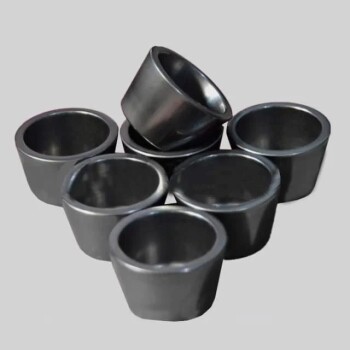
The conical bottom tip serves as a geometric filter designed to enforce single-crystal nucleation. In the Bridgman method, this specific shape forces the molten material to solidify first within a highly restricted volume. By physically limiting the space available for initial crystallization, the crucible suppresses the formation of multiple grains and ensures that only a single seed crystal survives to propagate through the bulk of the material.
The conical geometry acts as a natural selection mechanism, isolating a single nucleation event at the tip to prevent polycrystalline defects and ensure uniform single-crystal propagation throughout the melt.
The Mechanics of Nucleation Control
Leveraging the Temperature Gradient
In the Bridgman technique, the crucible is mechanically lowered through a vertical furnace. It moves from a hot zone (liquid) to a cold zone (solid).
Because of the crucible's orientation, the conical tip enters the cooling zone first. This ensures that the solidification process initiates exclusively at the very bottom of the vessel, rather than randomly along the walls.
Restricting the Nucleation Volume
The fundamental purpose of the cone is to minimize the volume of material that solidifies initially.
By narrowing the bottom to a sharp point, the geometry creates the smallest possible volume point. This physical restriction drastically limits the number of nuclei that can form simultaneously, acting as a bottleneck for crystal formation.
Isolating the "seed"
The goal is to allow only a single crystal nucleus to form in this restricted space.
If multiple nuclei do form, the narrow geometry forces them to compete for space immediately. Usually, one dominant grain will outgrow the others within the cone, effectively selecting itself as the "seed" for the rest of the ingot.
Promoting Single-Crystal Dominance
Occupying the Interface
Once the single nucleus is established at the tip, it grows upward.
Because it was isolated by the cone, this single grain expands to occupy the entire liquid-solid interface. It becomes the template for all subsequent growth.
Continuous Growth
As the wider, cylindrical part of the crucible enters the cooling zone, the melt solidifies against the established crystal interface.
This induces continuous single-crystal growth throughout the remaining melt. The result is a high-yield ingot that maintains the crystalline structure defined by that initial point in the cone.
Understanding the Trade-offs
The "All-or-Nothing" Risk
The conical tip strategy relies on the assumption that the single nucleus formed at the tip is perfect.
If a defect or polycrystalline structure forms at the tip and is not filtered out, that defect will propagate through the entire widening cylinder. The geometry magnifies the initial state; if the tip fails to isolate one grain, the entire ingot may be compromised.
Complexity of Machining
While effective, conical crucibles are more complex to manufacture than flat-bottomed ones.
This geometry requires precise engineering to ensure the tip is sharp enough to restrict volume effectively, but robust enough to withstand the thermal stress of the furnace.
Making the Right Choice for Your Goal
When selecting crucible geometry for the Bridgman method, consider your specific yield requirements:
- If your primary focus is Single-Crystal Yield: Prioritize a crucible with a sharp, well-defined conical tip to aggressively filter initial nuclei.
- If your primary focus is Material Volume: Ensure the transition from the cone to the cylinder is smooth to allow the single grain to expand without inducing stress defects.
Ultimately, the conical tip is a passive but critical control device that turns a random solidification process into a structured, high-yield manufacturing technique.
Summary Table:
| Feature | Conical Tip Function | Impact on Crystal Growth |
|---|---|---|
| Geometric Filtering | Restricts initial solidification volume | Suppresses multiple grain formation |
| Thermal Gradient | Enters cold zone first | Ensures bottom-up solidification |
| Grain Selection | Forces competition in narrow space | Isolates a single seed crystal |
| Interface Stability | Provides a single growth template | Promotes uniform single-crystal yield |
Elevate Your Crystal Growth Precision with KINTEK
Achieve flawless single-crystal yields with high-performance laboratory solutions from KINTEK. Whether you are utilizing the Bridgman method or advanced CVD/PECVD processes, our expertise in high-temperature furnaces (tube, muffle, vacuum) and specialized ceramics and crucibles ensures your research produces reliable, defect-free results.
From high-temperature high-pressure reactors to precision crushing, milling, and sieving equipment, KINTEK provides the comprehensive tools needed for advanced material science and battery research.
Ready to optimize your laboratory workflow? Contact us today to discover how our tailored equipment and consumables can bring superior consistency to your most demanding applications.
References
- M. Sanjiv. Introduction to Crystal Growth. DOI: 10.22214/ijraset.2022.46933
This article is also based on technical information from Kintek Solution Knowledge Base .
Related Products
- Engineering Advanced Fine Alumina Al2O3 Ceramic Crucible for Laboratory Muffle Furnace
- Engineering Advanced Fine Ceramics Alumina Al2O3 Crucible With Lid Cylindrical Laboratory Crucible
- Electron Beam Evaporation Coating Oxygen-Free Copper Crucible and Evaporation Boat
- Arc-Shaped Alumina Ceramic Crucible High Temperature Resistant for Engineering Advanced Fine Ceramics
- Electron Beam Evaporation Coating Gold Plating Tungsten Molybdenum Crucible for Evaporation
People Also Ask
- What crucible is used in muffle furnace? Select the Right Material for Your Application
- Why are alumina crucibles and mother powder essential for LATP sintering? Optimize Your Solid Electrolyte Performance
- Why are high-purity alumina crucibles used for liquid lead corrosion experiments? Ensure Data Accuracy at 550°C
- Why Use Alumina Crucibles & Powder Burial for NaSICON? Ensure Phase Purity and Prevent Elemental Volatilization
- What is the primary purpose of using alumina crucibles for LLTO ceramics? Optimize Your High-Temperature Sintering