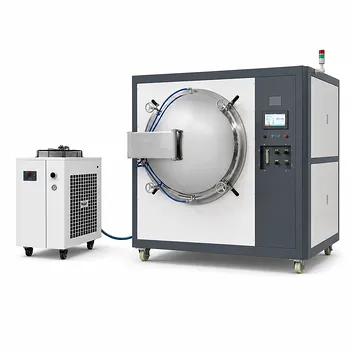
A graphite resistance vacuum hot pressing furnace overcomes the inherent sintering resistance of Zirconium Diboride (ZrB2) by combining ultra-high temperatures with external mechanical force. It creates a vacuum environment to prevent oxidation while simultaneously applying uniaxial pressure at temperatures between 1700°C and 2000°C, forcing particle rearrangement and diffusion where heat alone would fail.
Core Insight: ZrB2 possesses strong covalent bonds and a low self-diffusion coefficient, making it chemically resistant to densification. The furnace solves this by leveraging a synergistic effect: the vacuum purifies the powder surfaces, while mechanical pressure physically forces grains together to induce plastic deformation and grain boundary diffusion.
The Challenge of Sintering ZrB2
The Covalent Bond Barrier
Zirconium Diboride is characterized by extremely strong covalent bonding. This atomic structure results in a very low self-diffusion coefficient, meaning atoms do not move easily even at high temperatures.
The Need for External Force
Standard pressureless sintering often fails to achieve full density because the driving force (surface energy reduction) is insufficient to overcome these bonds. To eliminate porosity, an external driving force—mechanical pressure—is required.
The Role of Temperature and Vacuum
Rapid Resistance Heating
The furnace utilizes graphite resistance heating elements to rapidly reach ultra-high processing temperatures, typically ranging from 1700°C to 2000°C. High heating rates are often employed to bypass lower-temperature coarsening mechanisms, ensuring the energy is used for densification rather than unwanted grain growth.
Vacuum Purification
The vacuum environment (often reaching levels like 5 x 10^-2 Pa) is critical for surface chemistry. It prevents the oxidation of the ZrB2 powder during heating. Furthermore, it facilitates the evaporation of oxide impurities (such as B2O3) and the removal of gaseous by-products, which cleans the grain boundaries and removes physical barriers to diffusion.
The Mechanism of Densification
Uniaxial Mechanical Pressure
While the material is at peak temperature, the furnace applies uniaxial pressure (typically 20–40 MPa) via a ram. This pressure physically forces the ceramic particles into a tighter configuration, known as particle rearrangement.
Inducing Plastic Flow
At these extreme temperatures and pressures, the material undergoes plastic deformation and creep. The external force closes internal pores and significantly enhances grain boundary diffusion, driving the material toward near-theoretical density.
The Function of Graphite Components
Thermal Stability and Pressure Transfer
Graphite molds serve as the containment vessel for the powder. Because graphite creates a high-temperature resistant container, it can withstand temperatures exceeding 1500°C without deforming, ensuring the uniaxial pressure is transferred uniformly to the ceramic sample.
Reducing Atmosphere
Beyond structural support, the graphite material contributes to a local reducing atmosphere. This assists in scavenging residual oxygen, further protecting the ZrB2 from oxidation and ensuring a purer final ceramic.
Understanding the Trade-offs
Geometry Limitations
The application of uniaxial pressure generally limits part geometry to simple shapes, such as plates, disks, or cylinders. Complex, net-shape components are difficult to produce directly via hot pressing and may require expensive diamond machining later.
Efficiency and Scalability
Vacuum hot pressing is typically a batch process. While it yields superior material properties, the cycle times (heating, holding, cooling) and the limitation of processing one or a few parts at a time can make it less efficient for high-volume production compared to pressureless sintering.
Making the Right Choice for Your Goal
The vacuum hot pressing process is a precision tool designed for specific material outcomes.
- If your primary focus is maximum density: Prioritize the synergy of pressure and temperature (1700°C+ and >20 MPa) to force plastic flow and close all residual pores.
- If your primary focus is material purity: Monitor the vacuum levels closely to ensure the evaporation of volatile surface oxides (like B2O3) before maximum pressure is applied.
- If your primary focus is structural integrity: Ensure the graphite mold design allows for uniform pressure distribution to prevent density gradients within the ceramic block.
Success in sintering ZrB2 relies not just on heat, but on using mechanical force to physically conquer the material's atomic resistance to bonding.
Summary Table:
| Feature | Specification/Role |
|---|---|
| Processing Temperature | 1700°C to 2000°C |
| Applied Pressure | 20–40 MPa (Uniaxial) |
| Vacuum Level | ~5 x 10^-2 Pa |
| Heating Element | Graphite Resistance |
| Key Mechanisms | Particle rearrangement, plastic flow, grain boundary diffusion |
| Primary Benefits | High density, oxide impurity removal, oxidation prevention |
Elevate Your Material Research with KINTEK Precision Solutions
Are you struggling with the densification of ultra-high-temperature ceramics like ZrB2? KINTEK specializes in advanced laboratory equipment designed to conquer the most challenging sintering barriers. Our high-performance vacuum hot pressing furnaces and high-temperature furnaces (muffle, tube, vacuum, and CVD) provide the precise thermal and mechanical control required for near-theoretical density.
Why choose KINTEK?
- Advanced Metallurgy: From crushing and milling systems to high-pressure reactors.
- Comprehensive Lab Tools: We offer everything from hydraulic presses and pellet dies to specialized ceramics, crucibles, and cooling solutions.
- Targeted Expertise: We empower researchers in battery technology, dental materials, and aerospace ceramics with reliable, high-purity consumables and systems.
Transform your results today. Contact our technical experts at KINTEK to find the perfect furnace configuration for your specific application.
Related Products
- 2200 ℃ Graphite Vacuum Heat Treat Furnace
- Ultra-High Temperature Graphite Vacuum Graphitization Furnace
- Horizontal High Temperature Graphite Vacuum Graphitization Furnace
- Vertical High Temperature Graphite Vacuum Graphitization Furnace
- Large Vertical Graphite Vacuum Graphitization Furnace
People Also Ask
- Why do you heat treat in a vacuum? Achieve Perfect Surface Finish and Material Integrity
- What is the process of vacuum heat treating? Achieve Superior Hardening with a Clean, Bright Finish
- How does heat transmit in a vacuum? Mastering Thermal Radiation for Purity & Precision
- How does a vacuum heat treat furnace work? Achieve Pristine, Oxide-Free Metal Parts
- What is graphite heating? A Guide to Durable, High-Temp Industrial Furnace Solutions