Knowledge How does a hammer mill work step by step? Master High-Impact Particle Size Reduction
Author avatar

Tech Team · Kintek Solution

Updated 6 days ago

How does a hammer mill work step by step? Master High-Impact Particle Size Reduction


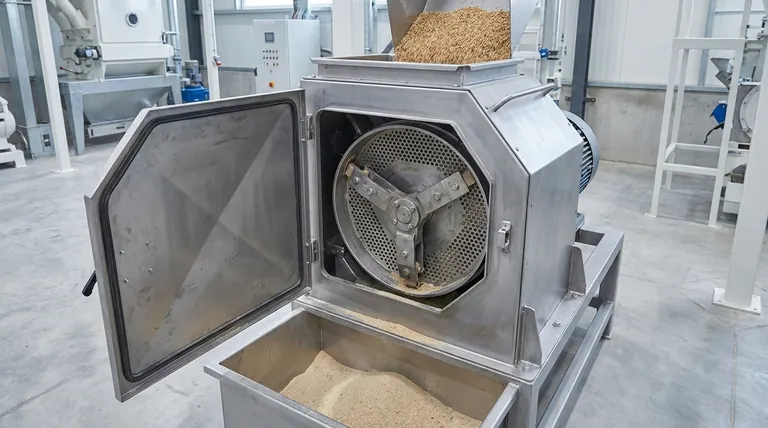
At its core, a hammer mill operates on a simple principle of brute-force impact. Material is fed into a steel chamber where a set of rotating hammers, spinning at high speed on a central rotor, strike the material repeatedly. This intense collision shatters the material, breaking it down until it is small enough to pass through a perforated screen at the bottom of the chamber.

A hammer mill achieves particle size reduction not through cutting or crushing, but through a rapid series of impacts. The final particle size is ultimately determined not by the hammers themselves, but by the size of the openings in an interchangeable screen.
How does a hammer mill work step by step? Master High-Impact Particle Size Reduction

The Step-by-Step Grinding Process

Understanding how a hammer mill works involves visualizing a four-stage process that happens almost instantaneously within the grinding chamber.

Step 1: Material Feeding

The process begins when the raw material is introduced into the mill, typically through an infeed chute at the top. Gravity causes the material to fall directly into the path of the rotating hammers.

Step 2: Initial Impact and Shattering

As the material enters the grinding chamber, it is immediately struck by hammers moving at extremely high speeds. This first impact is responsible for the initial fracture, shattering the material in mid-air.

Step 3: Secondary Reduction

The force of the impact propels the broken particles against the inner wall of the grinding chamber. This collision causes further reduction in size. The material continues to be struck by the hammers and collide with the chamber wall and other particles until it is pulverized.

Step 4: Sizing and Discharge

The ground material is continuously forced against a perforated screen that forms part of the chamber wall. Particles that have been reduced to a size smaller than the screen's holes can pass through and are discharged as the final product. Larger particles remain in the chamber for further impacts.

Key Components and Their Function

The efficiency and output of a hammer mill are dictated by the interplay of its primary components.

The Rotor and Hammers

This is the heart of the machine. The rotor is a spinning shaft to which the hammers are attached. The hammers are typically free-swinging and often four-way reversible, meaning they can be rotated to present a new striking face as they wear down, significantly extending their operational life.

The Grinding Chamber

This is the heavy-duty steel casing that encloses the rotor and hammers. For processing tough or abrasive materials, these chambers are often fitted with replaceable internal wear plates to protect the main housing from damage.

The Perforated Screen

The screen acts as the classifier, controlling the final output. It is an interchangeable part with holes of a specific size. A wide selection of screens allows operators to produce the exact desired finished particle size for a given application.

Understanding the Trade-offs and Variables

A hammer mill is a powerful tool, but its performance depends on matching its configuration to the material being processed.

The Screen Dictates the Output

The single most important factor for controlling the final particle size is the screen. A smaller hole size results in a finer grind but typically reduces the throughput (the rate of production).

Hammer Type and Speed Matter

The shape, number, and speed of the hammers influence the grinding action. Blunt hammers provide more of a shattering impact, ideal for crystalline materials, while sharper-edged hammers can help with more fibrous materials.

Material Characteristics are Crucial

The effectiveness of a hammer mill is highly dependent on the input material. It excels at processing dry, brittle, and non-abrasive materials. Sticky, oily, or highly abrasive materials can pose challenges, causing screen blockages or rapid component wear.

Making the Right Choice for Your Goal

To optimize a hammer mill for your specific needs, focus on the component that has the most influence over your desired outcome.

  • If your primary focus is achieving a precise particle size: Your most critical choice is the perforated screen, as it directly controls the maximum size of the finished product.
  • If your primary focus is processing abrasive materials: Ensure the mill is equipped with hardened, replaceable wear plates and uses durable, reversible hammers to manage maintenance costs.
  • If your primary focus is maximizing throughput: You must select the largest screen size that meets your product requirements and carefully balance the material feed rate with the mill's motor power.

Ultimately, the hammer mill is a remarkably versatile and effective machine for high-impact particle size reduction.

Summary Table:

Component Function
Rotor & Hammers Spinning shaft with attached hammers that strike and shatter material.
Grinding Chamber Enclosed steel casing where impact and reduction occur.
Perforated Screen Interchangeable screen that controls final particle size by allowing only small particles to pass.

Ready to optimize your particle size reduction process? KINTEK specializes in high-quality lab equipment, including hammer mills designed for efficiency and durability. Whether your goal is precise particle sizing, handling abrasive materials, or maximizing throughput, our experts can help you select the perfect solution for your laboratory's unique needs. Contact us today to discuss your application and discover the KINTEK advantage!

Visual Guide

How does a hammer mill work step by step? Master High-Impact Particle Size Reduction Visual Guide

Related Products

People Also Ask

Related Products

Laboratory Single Horizontal Jar Mill

Laboratory Single Horizontal Jar Mill

KT-JM3000 is a mixing and grinding instrument for placing a ball milling tank with a volume of 3000ml or less. It adopts frequency conversion control to realize timing, constant speed, direction change, overload protection and other functions.

High Energy Planetary Ball Mill Milling Machine for Laboratory

High Energy Planetary Ball Mill Milling Machine for Laboratory

Experience fast and effective sample processing with the F-P2000 high-energy planetary ball mill. This versatile equipment offers precise control and excellent grinding capabilities. Perfect for laboratories, it features multiple grinding bowls for simultaneous testing and high output. Achieve optimal results with its ergonomic design, compact structure, and advanced features. Ideal for a wide range of materials, it ensures consistent particle size reduction and low maintenance.

High-Energy Omnidirectional Planetary Ball Mill Milling Machine for Laboratory

High-Energy Omnidirectional Planetary Ball Mill Milling Machine for Laboratory

The KT-P4000E is a new product derived from the vertical high-energy planetary ball mill with a 360° swivel function. Experience faster, uniform, and smaller sample output results with 4 ≤1000ml ball mill jars.

High-Energy Omnidirectional Planetary Ball Mill Machine for Laboratory

High-Energy Omnidirectional Planetary Ball Mill Machine for Laboratory

The KT-P2000E is a new product derived from the vertical high-energy planetary ball mill with a 360°rotation function. The product not only has the characteristics of the vertical high-energy ball mill, but also has a unique 360°rotation function for the planetary body.

High Energy Planetary Ball Mill Milling Machine for Laboratory

High Energy Planetary Ball Mill Milling Machine for Laboratory

The biggest feature is that the high energy planetary ball mill can not only perform fast and effective grinding, but also has good crushing ability

Laboratory Horizontal Planetary Ball Mill Milling Machine

Laboratory Horizontal Planetary Ball Mill Milling Machine

Improve sample uniformity with our Horizontal Planetary Ball Mills. KT-P400H reduces sample deposition and KT-P400E has multi-directional capabilities. Safe, convenient and efficient with overload protection.

High Energy Vibratory Laboratory Ball Mill Double Tank Type

High Energy Vibratory Laboratory Ball Mill Double Tank Type

High-energy vibration ball mill is a small desktop laboratory grinding instrument. It uses 1700r/min high-frequency three-dimensional vibration to make the sample achieve the result of grinding or mixing.

High Energy Planetary Ball Mill Machine for Laboratory Horizontal Tank Type

High Energy Planetary Ball Mill Machine for Laboratory Horizontal Tank Type

The KT-P2000H uses a unique Y-axis planetary trajectory, and utilizes the collision, friction and gravity between the sample and the grinding ball.

High Energy Vibratory Laboratory Ball Mill Grinding Mill Single Tank Type

High Energy Vibratory Laboratory Ball Mill Grinding Mill Single Tank Type

High-energy vibration ball mill is a small desktop laboratory grinding instrument.It can be ball-milled or mixed with different particle sizes and materials by dry and wet methods.

High Energy Planetary Ball Mill for Laboratory Horizontal Tank Type Milling Machine

High Energy Planetary Ball Mill for Laboratory Horizontal Tank Type Milling Machine

KT-P4000H uses the unique Y-axis planetary motion trajectory, and utilizes the collision, friction and gravity between the sample and the grinding ball to have a certain anti-sinking ability, which can obtain better grinding or mixing effects and further improve the sample output.

HFCVD Machine System Equipment for Drawing Die Nano-Diamond Coating

HFCVD Machine System Equipment for Drawing Die Nano-Diamond Coating

The nano-diamond composite coating drawing die uses cemented carbide (WC-Co) as the substrate, and uses the chemical vapor phase method ( CVD method for short ) to coat the conventional diamond and nano-diamond composite coating on the surface of the inner hole of the mold.

Laboratory Test Sieves and Sieving Machines

Laboratory Test Sieves and Sieving Machines

Precision lab test sieves & sieving machines for accurate particle analysis. Stainless steel, ISO-compliant, 20μm-125mm range. Request specs now!

Benchtop Laboratory Freeze Dryer for Lab Use

Benchtop Laboratory Freeze Dryer for Lab Use

Premium benchtop laboratory freeze dryer for lyophilization, preserving samples with ≤ -60°C cooling. Ideal for pharmaceuticals & research.

Laboratory Sterilizer Lab Autoclave Pulse Vacuum Lifting Sterilizer

Laboratory Sterilizer Lab Autoclave Pulse Vacuum Lifting Sterilizer

The pulse vacuum lifting sterilizer is a state-of-the-art equipment for efficient and precise sterilization. It uses pulsating vacuum technology, customizable cycles, and a user-friendly design for easy operation and safety.

Laboratory Sterilizer Lab Autoclave Vertical Pressure Steam Sterilizer for Liquid Crystal Display Automatic Type

Laboratory Sterilizer Lab Autoclave Vertical Pressure Steam Sterilizer for Liquid Crystal Display Automatic Type

Liquid crystal display automatic vertical sterilizer is a safe, reliable and automatic control sterilization equipment, which is composed of heating system, microcomputer control system and overheating and overvoltage protection system.

Anti-Cracking Press Mold for Lab Use

Anti-Cracking Press Mold for Lab Use

The anti-cracking press mold is a specialized equipment designed for molding various shapes and sizes of film using high pressure and electric heating.

Benchtop Laboratory Vacuum Freeze Dryer

Benchtop Laboratory Vacuum Freeze Dryer

Benchtop laboratory freeze dryer for efficient lyophilization of biological, pharmaceutical, and food samples. Features intuitive touchscreen, high-performance refrigeration, and durable design. Preserve sample integrity—consult now!

Small Vacuum Heat Treat and Tungsten Wire Sintering Furnace

Small Vacuum Heat Treat and Tungsten Wire Sintering Furnace

The small vacuum tungsten wire sintering furnace is a compact experimental vacuum furnace specially designed for universities and scientific research institutes. The furnace features a CNC welded shell and vacuum piping to ensure leak-free operation. Quick-connect electrical connections facilitate relocation and debugging, and the standard electrical control cabinet is safe and convenient to operate.

Laboratory Vibratory Sieve Shaker Machine Slap Vibrating Sieve

Laboratory Vibratory Sieve Shaker Machine Slap Vibrating Sieve

KT-T200TAP is a slapping and oscillating sieving instrument for laboratory desktop use, with 300 rpm horizontal circular motion and 300 vertical slapping motions to simulate manual sieving to help sample particles pass through better.

915MHz MPCVD Diamond Machine Microwave Plasma Chemical Vapor Deposition System Reactor

915MHz MPCVD Diamond Machine Microwave Plasma Chemical Vapor Deposition System Reactor

915MHz MPCVD Diamond Machine and its multi-crystal effective growth, the maximum area can reach 8 inches, the maximum effective growth area of single crystal can reach 5 inches. This equipment is mainly used for the production of large-size polycrystalline diamond films, the growth of long single crystal diamonds, the low-temperature growth of high-quality graphene, and other materials that require energy provided by microwave plasma for growth.


Leave Your Message