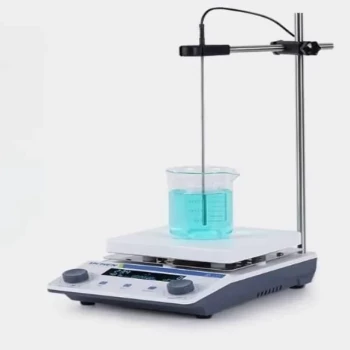
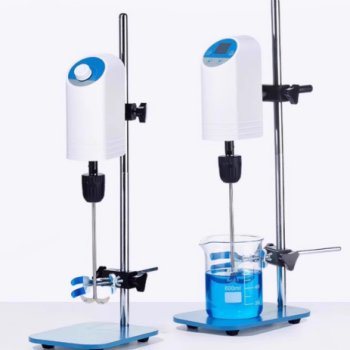
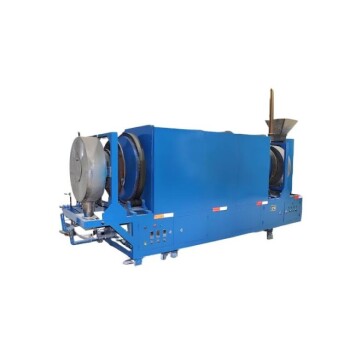
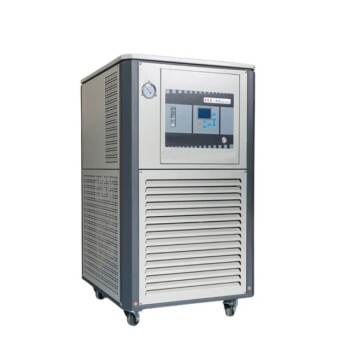
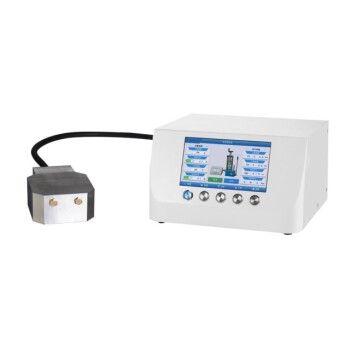
A high-precision heating and stirring system acts as the primary determinant for synthesizing pure 6-line ferrihydrite. By strictly stabilizing deionized water at a target temperature, such as 75°C, and maintaining rapid agitation, the system creates the uniform thermodynamic environment necessary for the instantaneous hydrolysis of ferric nitrate.
Precision control creates a specific thermodynamic window that promotes high crystallinity while actively inhibiting the formation of disordered 2-line ferrihydrite and other impurities.
Establishing Thermodynamic Uniformity
Temperature Stabilization
The synthesis of 6-line ferrihydrite requires an exact thermal baseline. The system is used to preheat and stabilize deionized water at specific set points, often around 75°C.
Maintaining this temperature without fluctuation is critical. It ensures that the energy required for the specific phase transformation is consistently available throughout the solution.
The Role of Rapid Agitation
Heating alone is insufficient without equal distribution. Rapid stirring is employed to eliminate thermal gradients within the vessel.
This ensures that the thermodynamic conditions are uniform across the entire volume of liquid. Every molecule of the precursor interacts with the same thermal energy simultaneously.
Mechanism of Phase Selection
Driving Instantaneous Hydrolysis
The combination of stable heat and rapid stirring facilitates the instantaneous hydrolysis of ferric nitrate.
Because the reaction conditions are optimized and uniform, the chemical conversion happens immediately. This speed and uniformity are essential for directing the crystal growth toward the desired structure.
Inhibiting Impurity Phases
Without high precision, the hydrolysis process can yield mixed results. The system specifically directs the precipitation pathway to form 6-line ferrihydrite with high crystallinity.
Simultaneously, this controlled environment effectively inhibits the formation of unwanted phases. It specifically prevents the precipitation of 2-line ferrihydrite or other impurity phases that typically form under less rigorous conditions.
Understanding the Process Sensitivity
Dependence on Equipment Stability
The success of this synthesis is inextricably linked to the equipment's ability to hold parameters static. Any deviation in temperature or stirring speed disrupts the thermodynamic uniformity.
The Risk of Phase Contamination
If the system fails to maintain instantaneous hydrolysis conditions, the reaction path may drift. This results in a product contaminated with lower-order phases, significantly reducing the quality of the final material.
Making the Right Choice for Your Goal
To optimize your synthesis of ferrihydrite, align your equipment capabilities with your purity requirements.
- If your primary focus is phase purity: Prioritize a system capable of rigorous temperature stabilization at 75°C to strictly inhibit 2-line ferrihydrite formation.
- If your primary focus is crystallinity: Ensure your system delivers rapid, high-torque stirring to guarantee the uniform thermodynamics required for instantaneous hydrolysis.
High-precision control is not merely an operational detail; it is the fundamental driver of phase selectivity in ferrihydrite synthesis.
Summary Table:
| Key Factor | Impact on Phase Formation | Benefit for 6-line Ferrihydrite |
|---|---|---|
| Temperature Stabilization | Precise thermal baseline (e.g., 75°C) | Ensures high crystallinity and stable thermodynamic window |
| Rapid Agitation | Eliminates thermal gradients | Provides uniform thermodynamics for instantaneous hydrolysis |
| Hydrolysis Control | Directs chemical conversion speed | Specifically inhibits the formation of 2-line ferrihydrite |
| Equipment Stability | Prevents parameter drift | Eliminates phase contamination and ensures material purity |
Achieve Superior Phase Purity in Your Material Synthesis
Precision is the difference between a high-quality crystal and a contaminated sample. At KINTEK, we specialize in providing laboratory researchers with the advanced tools needed for rigorous chemical processes. From high-precision heating and stirring systems to high-temperature reactors and autoclaves, our equipment ensures the thermodynamic stability required for the most sensitive synthesis workflows.
Whether you are focusing on ferrihydrite phase selectivity or complex battery research, KINTEK offers a comprehensive range of solutions including:
- Advanced Heating & Stirring: High-torque systems for uniform hydrolysis.
- Precision Labware: High-performance ceramics, crucibles, and PTFE products.
- Specialized Systems: Vacuum furnaces, crushing/milling equipment, and hydraulic presses.
Ready to elevate your research results? Contact our experts today to find the perfect equipment solution for your laboratory.
References
- Marcel G. Görn, Juraj Majzlan. Incorporation of Mo<sup>6+</sup> in Ferrihydrite, Goethite, and Hematite. DOI: 10.1007/s42860-021-00116-x
This article is also based on technical information from Kintek Solution Knowledge Base .
Related Products
- Laboratory Small Constant Temperature Heated Magnetic Stirrer Heater and Stirrer
- Multi Heating Zones CVD Tube Furnace Machine Chemical Vapor Deposition Chamber System Equipment
- High Performance Laboratory Stirrers for Diverse Applications
- 24T 30T 60T Heated Hydraulic Press Machine with Heated Plates for Laboratory Hot Press
- Automatic Heated Hydraulic Press Machine with Heated Plates for Laboratory Hot Press 25T 30T 50T
People Also Ask
- What role does a magnetic stirrer with heating play in ZnO nanoparticle synthesis? Precision Control for Quality Results
- What role does a constant temperature heating magnetic stirrer play in MFC-HAp synthesis? Achieve Material Homogeneity
- What is the function of a laboratory magnetic stirrer in Ni–Cr–P electrodeposition? Optimize Ion Transport & Coating
- Why is a laboratory magnetic stirrer required for benzoic acid esters? Boost Reaction Speed & Yield with High RPM
- What role does a laboratory magnetic stirrer play in TiO2 and TiO2-Ag sol preparation? Master Chemical Kinetics