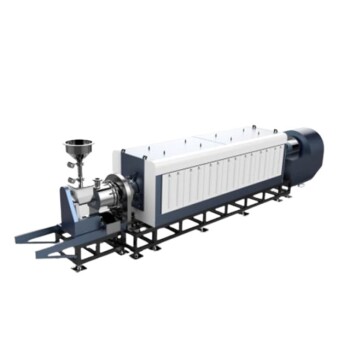
A high-precision tube furnace serves as the critical verification environment for testing Europium Oxybromide (EuOBr) catalysts during bromine cycle reactions. It provides a strictly controlled constant temperature field, specifically ranging from 423 to 793 K, to facilitate hydrogen bromide (HBr) oxidation. This precise thermal control allows researchers to rigorously assess the catalyst's performance and stability under simulated industrial conditions.
The primary value of the high-precision tube furnace lies in its ability to simulate spatial and temporal temperature fluctuations, verifying that EuOBr retains thermal stability and suffers no degradation even at efficient industrial temperatures as low as 523 K.
Simulating Reactor Conditions
To accurately predict how a catalyst will perform in a full-scale reactor, testing environments must mimic real-world stressors. The high-precision tube furnace is designed to replicate these specific thermal dynamics.
Precision Temperature Control
The furnace maintains a constant temperature field across a broad operating window of 423 to 793 K.
This wide range is essential for covering the various thermal stages of the HBr oxidation process. It ensures that the catalyst is tested thoroughly across all potential operating temperatures.
Modeling Thermal Fluctuations
Beyond static heating, the furnace is capable of simulating spatial and temporal temperature fluctuations.
Real-world reactors rarely maintain perfectly static temperatures; they experience gradients and shifts over time. By reproducing these fluctuations, the furnace exposes the EuOBr catalyst to realistic thermal stresses.
Validating Catalyst Stability
The ultimate goal of using this equipment is to verify that the Europium Oxybromide catalyst can withstand the reaction environment without degrading.
Verifying Feed Ratio Compatibility
The testing process within the furnace involves specific stoichiometric feed ratios, such as an O2:HBr ratio of 0.25.
Maintaining this precise ratio within the heated zone is necessary to validate the chemical interaction between the reactants and the catalyst.
Confirming Low-Temperature Performance
A key performance indicator for EuOBr is its ability to operate in ideal industrial windows, specifically as low as 523 K.
The high-precision furnace verifies that no performance degradation occurs at this temperature. This confirms the catalyst's viability for energy-efficient industrial applications.
Critical Testing Variables
While the high-precision tube furnace provides a robust testing ground, precise adherence to input parameters is required for valid results.
Sensitivity to Stoichiometric Ratios
The validity of the stability test relies heavily on maintaining the specific O2:HBr feed ratio of 0.25.
Deviating from this stoichiometry can alter the reaction kinetics, potentially leading to false positives regarding catalyst stability or missing degradation signals entirely.
The Importance of Fluctuation Simulation
Testing for thermal stability must go beyond holding a static temperature.
If the furnace does not accurately simulate spatial and temporal fluctuations, the test may fail to identify weaknesses in the catalyst structure that would only appear under dynamic thermal stress.
Making the Right Choice for Your Goal
To maximize the utility of a high-precision tube furnace in your catalyst development, align your testing protocols with your specific objectives.
- If your primary focus is Thermal Stability Verification: Ensure the furnace is programmed to simulate temperature fluctuations to confirm the catalyst does not degrade at the 523 K floor.
- If your primary focus is Process Optimization: Utilize the full 423 to 793 K range to map performance, but strictly maintain the O2:HBr ratio of 0.25 to ensure data validity.
By strictly controlling thermal fields and feed ratios, you transform the tube furnace from a simple heater into a definitive tool for validating industrial catalyst viability.
Summary Table:
| Feature | Key Benefit | Specification/Requirement |
|---|---|---|
| Temperature Range | Ensures precise HBr oxidation environments | 423 K to 793 K |
| Thermal Dynamics | Simulates real-world industrial stressors | Spatial & temporal fluctuations |
| Stability Floor | Verifies low-temperature performance | Stable operation at 523 K |
| Feed Control | Validates kinetics and catalyst interaction | O2:HBr stoichiometric ratio: 0.25 |
Elevate Your Catalyst Research with KINTEK Precision
At KINTEK, we understand that breakthrough research in bromine cycle reactions requires absolute thermal accuracy. Our high-precision tube furnaces are engineered to provide the stable, controllable environments necessary to validate EuOBr catalysts, ensuring no performance degradation even under complex industrial fluctuations.
Beyond our specialized furnaces (including vacuum, CVD, and atmosphere models), KINTEK offers a comprehensive range of laboratory solutions to support your entire workflow:
- High-Temperature & High-Pressure Reactors for advanced chemical synthesis.
- Crushing and Milling Systems for precise sample preparation.
- Electrolytic Cells and Battery Research Tools for energy-focused studies.
- Essential Consumables like high-purity ceramics, crucibles, and PTFE products.
Ready to optimize your testing environment? Our experts are here to provide tailored equipment solutions that ensure your data is reliable and your results are reproducible.
Contact KINTEK Today for a Professional Consultation
References
- Vladimir Paunović, Javier Pérez‐Ramírez. Europium Oxybromide Catalysts for Efficient Bromine Looping in Natural Gas Valorization. DOI: 10.1002/anie.201704406
This article is also based on technical information from Kintek Solution Knowledge Base .
Related Products
- Vertical Laboratory Tube Furnace
- Laboratory High Pressure Vacuum Tube Furnace
- High Temperature Alumina (Al2O3) Furnace Tube for Engineering Advanced Fine Ceramics
- 1200℃ Split Tube Furnace with Quartz Tube Laboratory Tubular Furnace
- Multi-zone Laboratory Tube Furnace
People Also Ask
- What is the function of a laboratory vertical tube furnace in microalgae catalytic pyrolysis? Optimize Your Bio-Fuel.
- How does a laboratory tube furnace provide atmospheric control during the sintering of glass-ceramics? Achieve Precision
- Why is a laboratory tube furnace required for LMTP0.1/CA materials? Achieve Precise Carbon Coating & Crystal Growth
- How does a laboratory tube furnace provide precise temperature control? Expert Simulation for Steam Cracking
- What role does a laboratory tube furnace play in the high-temperature calcination of LaPrO3+x catalyst precursors? Guide