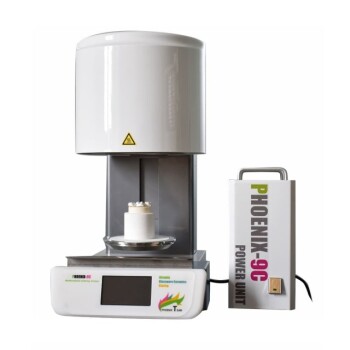
A high-temperature muffle or atmosphere furnace is the critical instrument for synthesizing dense Na2Ni2TeO6 and Na2Zn2TeO6 composite solid electrolytes. By strictly controlling temperature curves between 500°C and 800°C in a stable oxidizing air environment, the furnace drives inter-particle diffusion and the formation of solid solution phases essential for electrochemical performance.
The furnace does not merely heat the material; it orchestrates a precise thermal history that promotes ceramic grain growth and connectivity. This structural densification is the defining factor in achieving the high ionic conductivity required for effective solid-state battery electrolytes.
The Mechanics of Densification
Facilitating Inter-Particle Diffusion
The primary function of the furnace during co-sintering is to provide enough thermal energy to activate inter-particle diffusion. At temperatures ranging from 500°C to 800°C, atoms become mobile enough to cross grain boundaries. This movement is the fundamental mechanism that bonds individual precursor particles into a cohesive solid.
Formation of Solid Solution Phases
The furnace facilitates the chemical interaction required to form solid solution phases between the Na2Ni2TeO6 and Na2Zn2TeO6 components. Rather than remaining as separate, distinct mixtures, the materials integrate at the atomic level. This phase homogeneity is critical for the consistent performance of the electrolyte.
Optimizing Ionic Conductivity
Promoting Grain Growth and Connection
For an electrolyte to function, ions must move through it with minimal resistance. The furnace promotes the growth and connection of ceramic grains. Larger, well-connected grains reduce the number of resistive boundaries that ions must traverse.
Achieving High Electrolyte Density
A porous electrolyte is inefficient and mechanically weak. The controlled high-temperature environment eliminates voids between particles, resulting in a dense electrolyte. This high density is directly correlated with superior ionic conductivity and overall battery efficiency.
The Role of Environmental Control
Stable Oxidizing Atmosphere
These specific composite electrolytes require a stable oxidizing air environment during processing. The muffle or atmosphere furnace ensures that oxygen levels remain constant throughout the heating cycle. This prevents chemical reduction or phase decomposition that could occur in an inert or reducing atmosphere.
Precise Temperature Curves
The quality of the final material depends on following specific temperature control curves. By managing heating rates (often around 5 K/min) and holding temperatures, the furnace ensures the material reacts uniformly. This precision allows researchers to replicate the exact thermal history required for manufacturing compatibility.
Understanding the Trade-offs
The Risk of Thermal Decomposition
While high heat is necessary for sintering, excessive temperatures or prolonged dwell times can lead to material degradation. Supplementary testing often focuses on verifying that the electrolyte does not undergo decomposition or unwanted chemical reactions at the upper limits of the sintering range.
Balancing Densification with Stability
There is a delicate balance between applying enough heat to densify the material and keeping it cool enough to maintain phase purity. If the temperature exceeds the optimal window (above 800°C for this specific range), you risk altering the crystal structure or causing defects that hamper conductivity.
Making the Right Choice for Your Synthesis
To optimize your co-sintering process, you must align your furnace parameters with your specific material goals.
- If your primary focus is maximizing ionic conductivity: Prioritize a sintering profile that maximizes grain connectivity and density near the upper limit of the safe temperature range (800°C).
- If your primary focus is phase stability: Use a conservative heating rate and ensure the oxidizing atmosphere is rigorously maintained to prevent chemical reduction.
Precise thermal management is the bridge between raw precursor powders and a functional, high-performance solid electrolyte.
Summary Table:
| Parameter | Influence on Electrolyte Property | Goal in Co-Sintering |
|---|---|---|
| Sintering Temp (500-800°C) | Activates inter-particle diffusion | Achieve high ceramic density |
| Oxidizing Atmosphere | Maintains chemical phase purity | Prevent decomposition/reduction |
| Heating Rate (e.g., 5 K/min) | Ensures thermal uniformity | Prevent structural cracking/defects |
| Grain Growth Control | Reduces grain boundary resistance | Maximize ionic conductivity |
Elevate Your Battery Research with KINTEK Precision
Unlock the full potential of your solid-state electrolyte synthesis. At KINTEK, we specialize in high-performance laboratory equipment designed for the rigorous demands of advanced material science. Whether you are developing Na2Ni2TeO6 composites or next-generation energy storage, our comprehensive range of high-temperature muffle and atmosphere furnaces provides the stable oxidizing environments and precise thermal curves necessary for superior densification.
From crushing and milling systems for precursor preparation to high-pressure reactors and hydraulic pellet presses for electrolyte shaping, KINTEK offers the complete workflow for battery researchers and industrial labs. Our expertise ensures your materials achieve the grain connectivity and phase purity required for peak electrochemical performance.
Ready to optimize your sintering process? Contact KINTEK Today to Find Your Lab Solution
Related Products
- Spark Plasma Sintering Furnace SPS Furnace
- Mesh belt controlled atmosphere furnace
- Dental Porcelain Zirconia Sintering Ceramic Furnace Chairside with Transformer
- High Temperature Muffle Oven Furnace for Laboratory Debinding and Pre Sintering
- Vacuum Heat Treat and Molybdenum Wire Sintering Furnace for Vacuum Sintering
People Also Ask
- What is SPS sintering method? A Guide to High-Speed, High-Performance Material Fabrication
- Why are Spark Plasma Sintering (SPS) furnaces or hot presses utilized in the preparation of Li3PS4 solid electrolytes?
- What is the difference between spark plasma sintering and flash sintering? A Guide to Advanced Sintering Methods
- What technical advantages does a Spark Plasma Sintering (SPS) furnace offer for LZP ceramics? Enhance Ionic Conductivity
- What is the theory of spark plasma sintering? A Guide to Rapid, Low-Temperature Densification