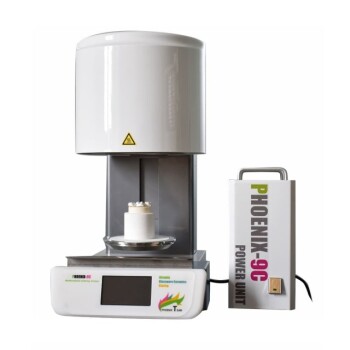
High-temperature sintering furnaces facilitate the production of dense NZSP ceramic pellets by creating a precisely controlled thermal environment, typically maintained at 1180°C. This intense thermal energy drives grain boundary diffusion and volume shrinkage within the ceramic "green body" (the pressed powder). The process systematically eliminates internal pores, increasing the material's relative density to over 95%.
The furnace does not merely heat the material; it provides the thermodynamic conditions required for atomic migration. This transformation from a loose powder compact to a dense solid is the single most critical factor in determining the final electrolyte's mechanical and electrical performance.
How Thermal Energy Drives Densification
Promoting Grain Boundary Diffusion
At the target temperature of roughly 1180°C, the atoms within the ceramic powder gain sufficient kinetic energy to migrate. This migration occurs primarily along the grain boundaries, where the individual particles of the powder meet. This diffusion is the fundamental mechanism that bonds separate particles into a cohesive solid.
Volume Shrinkage
As grain boundary diffusion accelerates, the material undergoes significant volume shrinkage. The furnace environment allows the material to compact physically as the particles fuse together. This shrinkage is necessary to close the voids that exist between the powder particles in the pre-sintered state.
Elimination of Internal Pores
The ultimate goal of this thermal treatment is the removal of porosity. By sustaining high temperatures, the furnace ensures that internal pores are filled or expelled. This results in a relative density exceeding 95%, turning a porous compact into a near-theoretical dense ceramic.
From Density to Performance
Defining Ionic Conductivity
The density achieved in the furnace is the physical foundation for the material's electrical performance. A dense microstructure ensures continuous pathways for ion transport, free from the interruptions caused by pores. This structural continuity is what allows the NZSP electrolyte to achieve high ionic conductivity.
Optimizing Mechanical Strength
The furnace treatment directly determines the mechanical robustness of the final pellet. High relative density correlates with increased Vickers hardness and Young's modulus. These properties are vital for ensuring the solid electrolyte can withstand physical stress during assembly and operation.
Critical Variables and Trade-offs
Temperature Precision vs. Material Stability
While high temperatures are required for densification, the thermal environment must be strictly controlled. The specific target of 1180°C acts as a balance point; temperatures that are too low will result in incomplete sintering and low conductivity. Conversely, excessive heat or lack of uniformity can lead to uncontrolled grain growth or decomposition, undermining the mechanical gains.
The Challenge of Uniformity
Achieving a density of >95% requires uniform heat distribution throughout the entire pellet. Any thermal gradients within the furnace can lead to uneven shrinkage or warping. Therefore, the furnace's ability to maintain a stable, uniform zone is just as important as its ability to reach high temperatures.
Making the Right Choice for Your Goal
When evaluating sintering protocols for NZSP ceramics, your focus should align with your specific performance metrics:
- If your primary focus is Ionic Conductivity: Ensure your furnace can maintain 1180°C precisely to maximize density (>95%) and eliminate pore-based resistance.
- If your primary focus is Mechanical Integrity: Prioritize thermal uniformity to ensure consistent Vickers hardness and Young's modulus across the entire pellet volume.
The high-temperature sintering furnace is the defining tool that transforms raw ceramic potential into functional, high-performance reality.
Summary Table:
| Feature | Impact on NZSP Pellets | Performance Outcome |
|---|---|---|
| Sintering Temperature | Maintained at 1180°C | Drives grain boundary diffusion |
| Relative Density | Exceeds 95% | Minimizes pore-based resistance |
| Volume Shrinkage | Physical compaction | Ensures structural continuity |
| Thermal Uniformity | Prevents warping/gradients | Consistent Vickers hardness & modulus |
| Atomic Migration | Fuses particles into solid | High ionic conductivity |
Elevate Your Material Research with KINTEK Precision
Unlock the full potential of your NZSP ceramic electrolytes with KINTEK’s industry-leading thermal solutions. Our advanced high-temperature furnaces (muffle, tube, and vacuum) and hydraulic pellet presses are engineered to provide the precise 1180°C environment and uniform heat distribution necessary to achieve >95% relative density and superior ionic conductivity.
Whether you are focusing on battery research or advanced ceramics, KINTEK specializes in laboratory equipment and consumables tailored for excellence. From crushing and milling systems for powder preparation to high-temperature high-pressure reactors and crucibles, we provide the comprehensive tools you need to move from raw powder to high-performance reality.
Ready to optimize your sintering protocol? Contact KINTEK today for a customized solution!
Related Products
- Vacuum Heat Treat and Pressure Sintering Furnace for High Temperature Applications
- High Temperature Muffle Oven Furnace for Laboratory Debinding and Pre Sintering
- High Temperature Alumina (Al2O3) Furnace Tube for Engineering Advanced Fine Ceramics
- 2200 ℃ Tungsten Vacuum Heat Treat and Sintering Furnace
- 2200 ℃ Graphite Vacuum Heat Treat Furnace
People Also Ask
- What is the purpose of the heat treatment (sintering) step? Engineering Robust Electroactive Membranes
- What is a vacuum sintering furnace? Unlock Purity and Performance in Advanced Materials
- How does the vacuum environment impact sintering of diamond-copper composites? Protect Against Thermal Damage
- Why must green bodies produced via binder jetting undergo treatment in a vacuum sintering furnace?
- What are some alternative atmospheres to pure hydrogen for powder metallurgy sintering processes? Top Sintering Solutions